
AI-Driven Technology Spending in the Americas: Sector-Specific Growth and ROI Opportunities
The Q3 2025 ISG Index™ reveals a seismic shift in AI-driven technology spending across the Americas, with enterprises accelerating investments in cloud-based and managed services to fuel AI initiatives. Total annual contract value (ACV) for the combined market-encompassing as-a-service (XaaS) and managed services-reached a record $17.3 billion, reflecting a 30% year-over-year increase, the region's highest growth rate in over three years, according to the Q3 2025 ISG Index™ report. This surge is driven by a cloud-first strategy, automation, and the need to optimize costs amid evolving labor policies, such as the H1-B visa fee hikes.
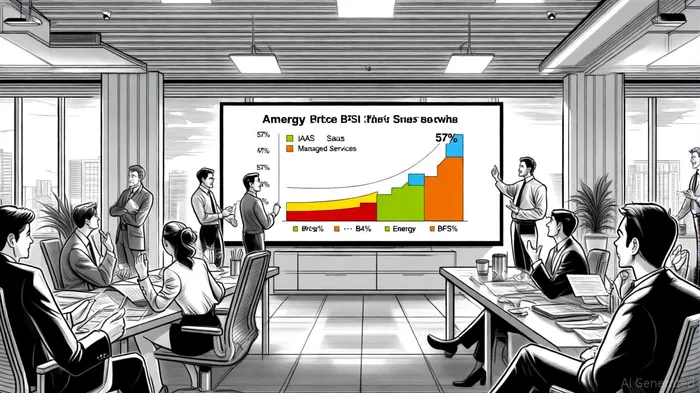
Sector-Specific Growth Opportunities
1. Energy: AI as a Catalyst for Infrastructure Modernization
The energy sector emerged as a standout performer, with a 57% ACV growth in Q3 2025, as noted in the Q3 2025 ISG Index™. This growth is fueled by AI-driven analytics and automation to optimize aging infrastructure and meet surging demand from AI data centers and manufacturing reshoring, according to a BCG playbook. For instance, BrainBox AI, acquired by Trane TechnologiesTT-- in December 2024, leverages autonomous AI to optimize HVAC systems, reducing energy consumption in commercial buildings by up to 20%, as described in a BrainBox AI profile. With global installations spanning 3 million square meters, BrainBox AI exemplifies how AI can align energy efficiency with net-zero goals.
Underappreciated firms like Octopus Energy are also leveraging AI to balance green energy grids, using smart platforms to manage renewable energy distribution. As governments prioritize clean energy, these firms are positioned to capitalize on infrastructure upgrades and AI-driven ROI.
2. BFSI: AI-Driven Transformation in Financial Services
The BFSI sector, the region's largest by ACV, grew by 54% in Q3 2025 according to the Q3 2025 ISG Index™. AI is reshaping operations through chatbots, robo-advisors, and risk management systems. Ascendion, for example, tripled its GenAI-driven revenue in 2024 and is projected to see 40% BFSI AI adoption growth in 2025, particularly in loan processing and payments, per a SIDGS list. Similarly, Quantiphi reduced claims cycle times by 35% for a top-5 U.S. insurer using AI modernization (see the SIDGS list).
Generative AI is also enhancing compliance and fraud detection. A March 2025 BCG survey found that BFSI firms using AI for fraud analytics reported a 40% increase in detection rates while reducing false positives by 30%. Analysts project the AI in BFSI market to grow at a 19.2% CAGR from 2025–2033, driven by automation and real-time decision-making, according to a Global Growth Insights report.
3. Travel/Transportation/Hospitality: Personalization and Operational Efficiency
This sector saw a 64% ACV surge, driven by AI-powered platforms that enhance customer experiences. Breeze Airways, a U.S. airline, uses text-based support and AI-driven route optimization to serve underserved markets, as highlighted in a Fast Company profile. Fora Travel, a digital-first agency, employs AI to provide real-time itinerary customization, boosting agent productivity by 30% (see the Fast Company profile).
In hospitality, AI-driven digital keys, dynamic pricing tools, and guest experience platforms are becoming table stakes. For example, AI analytics enable hotels to adjust pricing in real time based on demand, improving occupancy rates by up to 15%, as shown in an AbodeWorldwide list.
Long-Term ROI and Strategic Considerations
The ROI potential for AI-driven investments is substantial but contingent on strategic integration. According to an AIQLabs report, top AI adopters achieve 18% ROI, compared to 7% for laggards. However, only 5% of companies realize significant financial impact due to fragmented AI tools and poor data integration (see the AIQLabs report).
For energy firms, the ROI lies in reducing operational costs and meeting sustainability targets. BrainBox AI's acquisition by Trane Technologies underscores its value in scaling AI-driven energy solutions (see the BrainBox AI profile). In BFSI, firms like Ascendion and Quantiphi are embedding AI into core workflows, ensuring compliance and reducing processing times (see the SIDGS list). Meanwhile, travel/hospitality players are leveraging AI to differentiate through hyper-personalization, a critical factor in retaining customers in a competitive market (see the Fast Company profile).
Conclusion: Prioritizing Underappreciated Markets
The Americas' AI-driven tech spending boom presents opportunities in underappreciated sectors and firms. Energy companies optimizing infrastructure with AI, BFSI players automating compliance and risk management, and travel/hospitality firms enhancing personalization are all poised for outperformance. As the ISG Index™ highlights, the key to long-term ROI lies in strategic AI integration, scalable infrastructure, and alignment with sustainability goals. Investors should prioritize firms demonstrating measurable efficiency gains and sector-specific innovation, as these are likely to lead in the AI acceleration phase.





Comentarios
Aún no hay comentarios