
The AI-Driven Talent Shift: How Gen Z's Employment Crisis Signals Strategic Opportunities in Human-Centric and AI-Adaptive Skills Markets
The global labor market is undergoing a seismic shift as artificial intelligence (AI) reshapes employment dynamics, particularly for Gen Z. With youth unemployment rates soaring to 36% in Morocco and 17% in India, and 76% of U.S. employers reducing entry-level hiring, the crisis is both structural and technological. While AI is often blamed for displacing jobs, it is equally a catalyst for new opportunities-provided the workforce adapts. The World Economic Forum's 2025 Future of Jobs Report underscores this duality: 41% of organizations plan to cut jobs via automation, but 70% intend to hire for roles requiring AI literacy. This tension between disruption and reinvention creates a fertile ground for investment in education and upskilling technologies that bridge the AI-readiness gap.
The AI-Driven Talent Shift: A Crisis and a Catalyst
Gen Z's struggles are not merely about job scarcity but a misalignment between skills and demand. A Gallup survey reveals that 47% of Gen Z workers use generative AI weekly, yet 41% feel anxious about its implications, lacking the critical evaluation skills to harness its potential. Employers, meanwhile, are prioritizing AI literacy: 71% prefer less experienced candidates with AI skills over more seasoned ones without them. This shift is compounded by the shrinking availability of entry-level roles, with 76% of U.S. employers reducing such positions in 2025.
Yet, Gen Z's response is not passive. The Deloitte 2025 Gen Z and Millennial Survey highlights that 86% of Gen Z and 85% of millennials prioritize soft skills like communication, leadership, and empathy. This signals a growing recognition that human-centric skills-often undervalued in AI-driven automation-will remain irreplaceable. The challenge lies in equipping Gen Z with both AI adaptability and the soft skills to thrive in a hybrid workforce.
The Rise of AI-EdTech: Market Growth and Strategic Priorities
The AI upskilling EdTech market is surging, with global spending projected to exceed $404 billion by 2025, growing at a 16% compound annual growth rate. Key drivers include AI-powered personalized learning, which enables real-time interventions like adaptive quizzes and voice-activated tutoring, and work-integrated learning models such as internships and apprenticeships, supported by government incentives. Investors are increasingly prioritizing scalability and measurable impact, with workforce training accounting for 36% of EdTech funding in 2024.
Corporate giants are doubling down on this trend. Google's $1 billion AI education initiative includes free training programs and advanced tools like Gemini 2.5 Pro, while Microsoft's $4 billion Elevate program aims to credential 20 million people in AI. Amazon's Upskilling 2025 pledge, now reaching 700,000 employees, combines technical training with career pathways in AI and robotics. These efforts highlight a shift from short-term skill gaps to long-term workforce transformation.
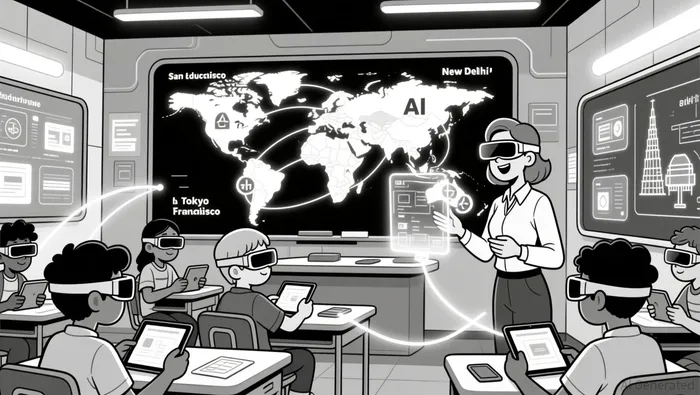
Strategic Opportunities: Startups Bridging AI and Human-Centric Skills
The most compelling investment opportunities lie in startups that combine AI training with soft skills development. For instance:
- Frizzle, a Y Combinator-backed platform, automates grading of handwritten math assignments, freeing teachers to focus on personalized instruction.
- Risely AI, another YC startup, deploys AI agents to streamline university operations, reducing administrative costs while enhancing student retention.
- Miyagi Labs offers AI-powered exam prep for standardized tests, using personalized study plans and adaptive tutoring. Miyagi Labs raised $500K in seed funding in February 2025, while Teacher's Buddy secured $1.85 million to reduce teacher burnout via AI-driven automation. The common thread is their ability to address both technical and human-centric needs-a critical differentiator in a market where 60% of companies report minimal AI impact.
The Investment Imperative: Bridging the AI-Readiness Gap
The urgency for investment is underscored by stark market gaps. McKinsey's 2025 report notes that 92% of companies plan to increase AI investments, yet only 1% have fully integrated it. BCG's analysis reveals that only 5% of firms generate value at scale from AI, emphasizing the need for training programs that embed AI into workflows. Startups like IONI, which offers AI teachers and mentors, and Disco, which focuses on soft skills via AI-powered upskilling, are addressing this gap by fostering both technical and human-centric competencies.
Moreover, the Asia-Pacific EdTech market is growing at a 46.12% annualized rate, with corporate e-learning projected to reach $44.6 billion by 2028. This regional momentum, coupled with STEM institutions' partnerships with tech giants like Google and the National Science Foundation, signals a global shift toward AI-driven education ecosystems.
Conclusion: A Call for Strategic Investment
Gen Z's employment crisis is not a dead end but a pivot point. The AI-driven talent shift demands a dual focus: upskilling for AI literacy and reinforcing human-centric skills. With the EdTech market expanding at 16% CAGR and corporate giants committing billions to AI training, the window for strategic investment is open. Startups like Frizzle, Risely AI, and Miyagi Labs are leading the charge, but broader collaboration between governments, institutions, and investors is needed to scale solutions. As the World Economic Forum and Cognizant warn, the digital skills gap threatens economic growth and social mobility. The answer lies in platforms that bridge AI readiness with the irreplaceable value of human adaptability-a market poised for exponential returns.







Comentarios
Aún no hay comentarios