
The AI-Driven Resurgence of Crypto Mining Equities: A Strategic Inflection Point
The crypto mining sector, long viewed as a volatile and energy-intensive niche, is undergoing a seismic transformation driven by artificial intelligence (AI). As of 2025, former BitcoinBTC-- mining firms are repurposing their infrastructure to meet the surging demand for AI compute power, creating a new asset class that bridges blockchain and high-performance computing (HPC). This pivot is not merely a survival tactic but a strategic repositioning that leverages the unique advantages of mining infrastructure-such as energy-dense facilities, automated operations, and access to low-cost power-to dominate the next frontier of computational demand, according to a Datacenters analysis.
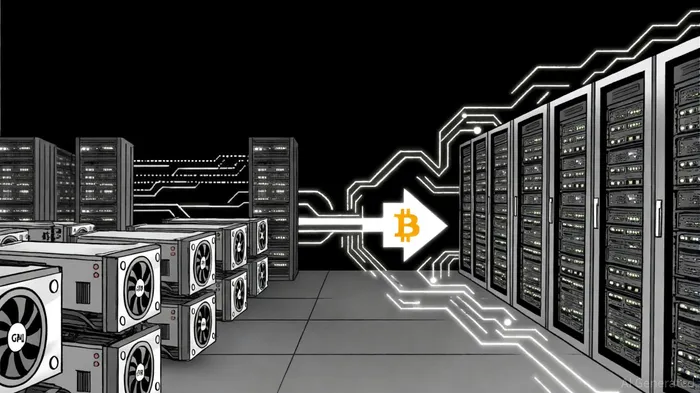
The Infrastructure Shift: From Bitcoin to AI
The 2024 Bitcoin halving, which cut block rewards in half, accelerated the sector's pivot. With mining margins under pressure and regulatory scrutiny intensifying, firms like Core ScientificCORZ--, BitfarmsBITF--, and Marathon Digital have retrofitted GPU-rich environments with AI-specific hardware like NVIDIANVDA-- H100 and AMD MI300X accelerators, the Datacenters analysis reports. These companies now offer AI compute leasing, model hosting, and inference-as-a-service, generating stable, non-crypto revenue streams. For instance, Core Scientific secured a 12-year, $3.5 billion contract with CoreWeaveCRWV-- in June 2024, transforming its data centers into AI cloud hubs, the Datacenters analysis notes. Similarly, Hut 8's Highrise AI division deployed over 1,000 Nvidia H100 chips to support GPU-as-a-Service, while Hive Digital Technologies tripled its AI and HPC hosting revenue to $10.1 million in fiscal 2025, according to the same Datacenters analysis.
This transition is economically compelling. AI workloads require infrastructure similar to Bitcoin mining-high power density, advanced cooling, and 24/7 uptime-but with higher margins, as JPMorgan notes. Iris Energy, for example, projects $500 million in AI Cloud annualized run rates by Q1 2026, while Cipher Mining's 10-year AI deal with Fluidstack is expected to generate $3 billion in revenue, per the Datacenters analysis.
Financial Performance and Venture Capital Frenzy
Despite mixed financial results, the sector's AI pivot has attracted unprecedented capital. In Q2 2025, crypto mining firms captured over $500 million in venture capital investments, driven by a $300 million raise led by Sequoia for cloud-mining operator XY Miners, according to a TrustStrategy analysis. This surge reflects investor confidence in the sector's dual utility: mining firms provide both legacy crypto infrastructure and cutting-edge AI compute.
However, not all players are thriving. Core Scientific's Q2 2025 results highlight the challenges: total revenue fell 44% year-over-year to $78.6 million, driven by a 62% decline in Bitcoin mined, the Datacenters analysis reported. Yet, colocation revenue grew 92% to $10.6 million, signaling progress in diversification. The company's pending merger with CoreWeave-a deal valued at $3.5 billion-underscores the sector's consolidation into AI-focused giants, the Datacenters analysis adds.
Contrast this with Iris Energy and Cipher Mining, which have leveraged AI to achieve profitability. Iris Energy reported a net income of $86.9 million on $501 million in revenue in FY2025, while Cipher Mining's stock surged 320% year-to-date in early October 2025, details the Datacenters analysis. These outliers demonstrate that firms with scalable AI infrastructure and long-term contracts are outperforming peers reliant on crypto volatility.
AI as a Force Multiplier for Mining Efficiency
Beyond diversification, AI is directly enhancing mining operations. TrustStrategy's H2 2025 report revealed a 40% increase in mining efficiency through AI-driven optimizations, including dynamic resource allocation and real-time market adaptation. These algorithms reduce energy waste and stabilize hash rates, with some firms reporting a 30% drop in energy consumption per unit mined, the TrustStrategy report found. For example, MARA Holdings and Riot Platforms are integrating edge computing and AI-ready infrastructure to future-proof operations, as noted in the Datacenters analysis.
This synergy between AI and mining creates a flywheel effect: AI-generated efficiencies lower operational costs, enabling miners to undercut competitors while reinvesting savings into AI expansion. The result is a self-reinforcing cycle of innovation and profitability.
Strategic Risks and the Road Ahead
Not all miners are equally positioned. Companies like Canaan, which rely heavily on ASICs (specialized for Bitcoin but incompatible with AI workloads), face obsolescence risks, the Datacenters analysis warns. Similarly, Riot Platforms and MARA Holdings are still evaluating HPC conversions, lacking major AI contracts to date, the Datacenters analysis observes. Investors must distinguish between firms with proven AI infrastructure and those in the planning phase.
Regulatory risks also persist. While AI demand is global, energy-intensive operations remain vulnerable to policy shifts. However, the sector's pivot to renewable energy-driven by AI's eco-awareness layer-mitigates this risk, the TrustStrategy report suggests. Firms with access to low-cost renewables, such as Marathon Digital's Texas facilities, are best positioned to scale.
Conclusion: A New Era for Crypto Mining Equities
The integration of AI into crypto mining infrastructure marks a strategic inflection point. Firms that successfully pivot are transforming from speculative crypto plays into diversified compute providers with recurring revenue and margin resilience. While challenges remain, the sector's alignment with AI's exponential growth trajectory-projected to require $1 trillion in infrastructure by 2030-positions it as a critical component of the digital economy, according to a DCA Asset Management insight.
For investors, the key is to focus on companies with:
1. Scalable AI infrastructure (e.g., GPU fleets, colocation partnerships).
2. Long-term contracts (e.g., CoreWeave's 12-year deal, Fluidstack's $3B agreement).
3. Energy efficiency (e.g., TrustStrategy's 30% energy savings, renewable power access).
The crypto mining sector is no longer a relic of the 2017 bubble-it's a gateway to the AI revolution.





Comentarios
Aún no hay comentarios