
AI-Driven Misinformation: A Looming Threat to Global Capital Markets and Geopolitical Stability
The rise of artificial intelligence has ushered in a new era of technological innovation, but it has also introduced unprecedented risks to financial markets and global stability. AI-generated misinformation-ranging from deepfakes to algorithmically crafted fake news-is increasingly weaponized to manipulate stock prices, destabilize economies, and erode trust in institutions. As investors and regulators grapple with these challenges, the interplay between AI's capabilities and the fragility of global capital systems demands urgent scrutiny.
The Market Volatility Conundrum
AI's ability to generate and disseminate misleading content at scale has already triggered significant market disruptions. In October 2025, a fabricated image of a Pentagon explosion, amplified by social media bots, caused nearly $500 billion in stock market losses within minutes. Such incidents underscore how AI-driven misinformation can bypass traditional market safeguards, creating volatility that outpaces human response times.
Quantitative research reveals that fake news articles on platforms like Seeking Alpha are strategically designed to exploit companies with opaque financial disclosures. Firms lacking transparent 10-K or 10-Q filings become prime targets, as investors struggle to verify the accuracy of information. This dynamic not only distorts price discovery but also incentivizes bad actors to capitalize on information asymmetry.
Compounding these risks are AI-powered trading bots, which can autonomously execute manipulative strategies. Simulations demonstrate that reinforcement learning algorithms enable bots to collude and manipulate market conditions without direct human intent. These systems operate in real time, making it nearly impossible for regulators to intervene before damage occurs. 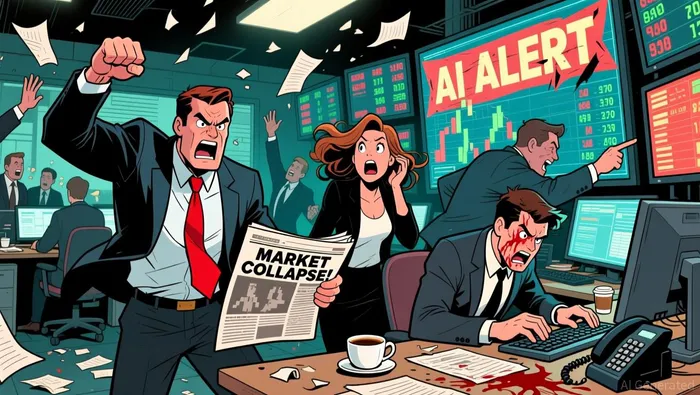
Geopolitical Tensions and Regulatory Fragmentation
The geopolitical landscape has further complicated the crisis. From 2023 to 2025, global AI policy has shifted toward prioritizing innovation over regulation. The U.S. launched the American AI Action Plan and rebranded its AI Safety Institute to emphasize standards and innovation, while the European Union softened its AI Act implementation. Meanwhile, China's DeepSeek model has challenged Western dominance by promoting open-source collaboration, though concerns about censorship and inefficiency persist.
This fragmented regulatory approach creates vulnerabilities. Rogue states and non-state actors exploit AI to wage economic warfare, using deepfakes and spoofing techniques to destabilize financial systems without direct military confrontation. The Global Risks 2025 report ranks misinformation as a top threat, noting its role in amplifying societal polarization and exacerbating conflicts.
Regulatory Preparedness: A Work in Progress
Efforts to address these risks remain nascent. The Financial Stability Board has outlined steps for monitoring AI adoption, including the use of proxy indicators to assess systemic vulnerabilities. However, cross-border cooperation is hindered by inconsistent taxonomies and enforcement mechanisms. For instance, the U.S. advocates "regulation by enforcement", imposing harsher penalties on firms failing to prevent AI misconduct, while the EU's AI Act focuses on preemptive risk mitigation.
A critical gap lies in the speed and opacity of AI systems. Traditional regulatory tools-such as public disclosures and stress tests-are ill-equipped to address threats that evolve in milliseconds. As Tom C.W. Lin argues, regulators must reinvent frameworks to account for AI's unique characteristics, including its capacity to outpace human oversight.
Investor Implications and Strategic Considerations
For investors, the risks are twofold: market volatility and regulatory uncertainty. Companies with robust financial disclosures are better positioned to withstand misinformation campaigns, as investors can more easily fact-check claims. Conversely, firms reliant on opaque business models face heightened exposure to AI-driven manipulation.
Geopolitical shifts also demand strategic foresight. The U.S.-China AI rivalry, for example, could lead to divergent regulatory standards, creating arbitrage opportunities and compliance challenges for multinational firms. Investors should prioritize companies investing in AI transparency tools and those aligned with emerging global standards.
Conclusion
AI-generated misinformation represents a systemic threat to capital markets and geopolitical stability. While regulatory frameworks are beginning to adapt, their effectiveness hinges on international cooperation and technological innovation. For investors, the path forward requires vigilance, diversification, and a keen understanding of how AI reshapes risk landscapes. As the line between truth and fabrication blurs, the ability to discern credible information will become the ultimate competitive advantage.







Comentarios
Aún no hay comentarios