
AI-Driven Marketing Transformation: Unlocking Strategic Synergy and Operational Efficiency in Enterprise Marketing
Strategic Synergy: AI as a Cross-Functional Enabler
AI's ability to unify disparate functions-marketing, sales, operations, and customer service-into a cohesive ecosystem is a cornerstone of its strategic value. For instance, AI-powered customer segmentation tools now analyze behavioral patterns, purchase histories, and real-time interactions to create hyper-targeted campaigns. This approach has reduced customer acquisition costs by up to 30% for enterprises like NetflixNFLX-- and SpotifySPOT--, which use AI to personalize recommendations and boost retention. Such tools eliminate silos between departments, enabling marketing teams to align with sales and product development based on shared data insights.
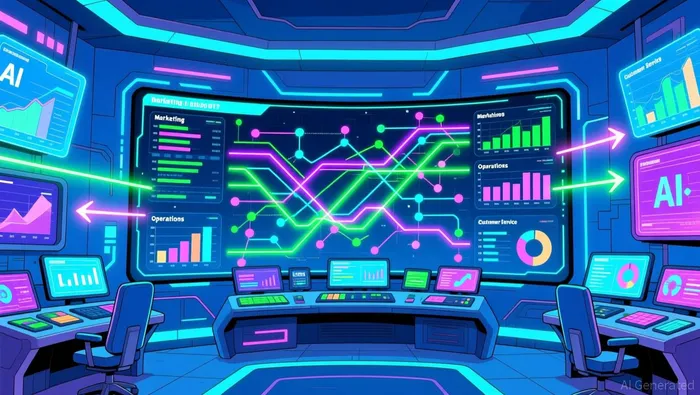 Moreover, AI-driven predictive analytics is reshaping decision-making. A 2025 McKinsey report highlights that 75% of enterprises using AI for marketing are shifting toward strategic, innovation-focused activities. By forecasting demand fluctuations and identifying emerging trends, AI allows companies to proactively adjust inventory, pricing, and resource allocation. For example, a manufacturing firm reduced stockouts by 45% and excess inventory by 30% using AI-driven demand prediction, translating to annual savings of $430,000. This cross-functional alignment underscores AI's role in fostering strategic synergy, where marketing is no longer an isolated function but a driver of enterprise-wide agility.
Operational Efficiency: Automating the Core of Marketing
Operational efficiency gains from AI are equally transformative. Chatbots and virtual assistants, for instance, have automated 40% of customer service inquiries for e-commerce companies, freeing human teams to address complex issues and improving customer satisfaction scores. Similarly, AI-powered content creation tools are slashing the time and cost of generating personalized marketing materials. Amazon's use of AI to craft dynamic email campaigns and product recommendations has increased sales conversions by 20-30%, demonstrating how automation can scale without compromising personalization.
In supply chain management, AI's real-time analytics are closing the gap between marketing and logistics. By tracking shipment patterns and predicting delays, AI ensures that marketing campaigns remain aligned with product availability. For example, AI-driven inventory optimization has enabled companies to reduce excess stock by up to 30%, minimizing waste and capital tied to unsold goods. These efficiencies are not isolated wins but part of a broader operational reengineering that reduces overhead and accelerates time-to-market.
Pricing and Innovation: AI's Role in Driving Margins
Dynamic pricing strategies powered by AI are another area of significant impact. By analyzing competitor pricing, historical sales data, and market conditions, AI systems adjust prices in real-time to maximize margins. This capability is particularly valuable in industries like retail and travel, where demand volatility is the norm. A 2025 industry report notes that companies using AI for pricing see an average margin increase of 5-8%, a critical edge in competitive markets.
Beyond cost savings, AI is fueling innovation. High-performing enterprises, as per McKinsey's 2025 global survey, are 2.5 times more likely to use AI for transformative innovation, such as redesigning customer journeys or launching AI-native products. This shift is not merely about efficiency but about reimagining value propositions. For instance, AI-driven analytics have enabled brands to identify underserved customer segments, leading to the development of niche products that command premium pricing.
Investment Implications: A Strategic Shift in Enterprise Value
For investors, the rise of AI-driven marketing signals a paradigm shift in enterprise valuation. Companies that integrate AI into their marketing strategies are not only achieving cost efficiencies but also building moats through data-driven insights and customer loyalty. The 2025 M1 Project report underscores that enterprises leveraging AI for marketing are 40% more likely to outperform peers in revenue growth, a metric that directly impacts stock performance.
However, the benefits extend beyond short-term gains. AI's ability to foster strategic synergy ensures that enterprises remain adaptable in the face of macroeconomic uncertainties. For example, during supply chain disruptions, AI-driven demand forecasting allows companies to pivot marketing strategies toward available products, minimizing revenue loss. This resilience is a key consideration for long-term investors.
Conclusion
AI-driven marketing is no longer a luxury but a necessity for enterprises seeking to thrive in 2025 and beyond. By harmonizing operational efficiency with strategic innovation, AI is redefining the boundaries of what marketing can achieve. For investors, the message is clear: prioritize companies that are not only adopting AI but embedding it into their core operations. The enterprises that succeed in this transformation will not only capture market share but also set the benchmarks for the next decade of digital evolution.







Comentarios
Aún no hay comentarios