
AI-Driven Industry Transformation and Long-Term Stock Selection: A Strategic Framework for Identifying Industry-Specific AI Leaders
The artificial intelligence (AI) revolution is no longer a distant promise but a present-day reality reshaping industries. As AI transitions from foundational models to tailored applications, investors must recalibrate their strategies to focus on companies that integrate AI into their core operations to drive productivity, margins, and long-term value. This analysis explores how revenue-per-employee benchmarks, industry-specific AI adoption, and data-driven scoring systems like The Motley Fool's AIball framework can guide investors toward resilient, high-impact opportunities.
The Shift from Foundational AI to Industry-Specific Applications
AI's transformative potential is no longer confined to tech giants or pure-play AI firms. Instead, the most compelling opportunities lie in companies that embed AI into industry-specific workflows to solve real-world problems. For instance, in healthcare, CertaraCERT-- and Tempus AITEM-- are leveraging AI to accelerate drug development and precision medicine. Certara's biosimulation platforms, enhanced by AI-powered tools like Certara IQ, enable faster model building and regulatory compliance, while Tempus AI's vast clinical data sets are revolutionizing oncology diagnostics. Similarly, in manufacturing, PTCPTC-- and TrimbleTRMB-- are embedding AI into industrial software to optimize design, production, and supply chain operations, demonstrating how AI can unlock operational efficiency in traditionally labor-intensive sectors.
This shift underscores a critical insight: the future of AI lies not in standalone models but in their ability to enhance industry-specific processes. As Tom Gardner of The Motley Fool notes, AI's true value emerges when it becomes a "force multiplier" for productivity, reducing the need for large workforces while amplifying output.
Revenue-Per-Employee Benchmarks: A Key Metric for Efficiency
Revenue-per-employee (RPE) has emerged as a critical metric for evaluating AI-driven efficiency. In 2025, AI companies across sectors exhibited stark disparities in RPE. For example, Copilot and OpenAI achieved RPE of $4.2 million and $2.87 million, respectively, by leveraging AI to automate high-value tasks. In contrast, Perplexity AI reported a significantly lower RPE of $49,100, highlighting the uneven adoption of AI across the industry.
These benchmarks reflect a broader trend: AI's ability to scale productivity. In retail, AI-driven automation and inventory optimization are projected to boost RPE from $45,000 to $70,000 by 2028, as companies like Amazon and Walmart adopt AI for personalized customer experiences and supply chain efficiency. Similarly, in financial services, AI-powered fraud detection and customer service automation are driving RPE growth, with SaaS spend per employee exceeding $10,000 in 2025.
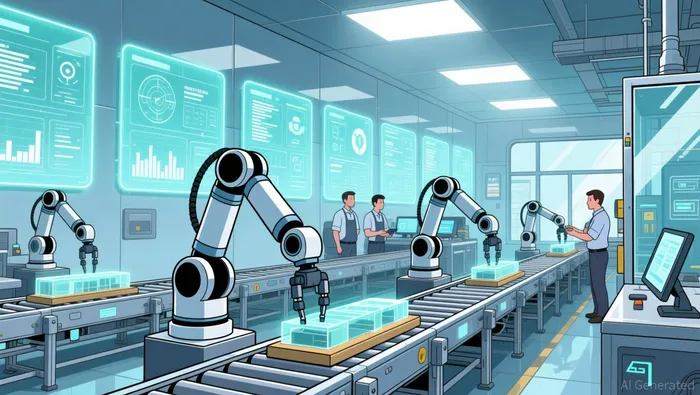
Investors should prioritize companies where AI directly enhances RPE. Those with high RPE and scalable AI applications-such as Copilot's 94 employees generating $400 million in revenue-demonstrate a compelling alignment of efficiency and profitability.
The Motley Fool's AIball Framework: A Data-Driven Lens for AI Leaders
The Motley Fool's AIball database offers a robust framework for evaluating AI readiness and potential. Its nine metrics-ranging from Integration and Execution to Superscore-provide a holistic view of a company's AI capabilities. For example:
- Integration measures how deeply AI is embedded in a company's operations. PTC's AI-enhanced software for industrial systems and Trimble's AI-driven geospatial analytics exemplify strong integration.
- Execution assesses real-world implementation. Tempus AI's partnerships with AstraZeneca and Pathos AI to build oncology foundation models highlight its execution prowess.
- Superscore synthesizes these metrics into a single indicator of AI strength. Tempus AI's 75.4% year-over-year revenue growth and Certara's 34% adjusted EBITDA margin in Q3 2025 suggest high Superscore potential.
By focusing on companies with high Integration and Execution scores, investors can identify firms that are not just experimenting with AI but embedding it into their DNA. For instance, Trimble's shift from hardware to recurring software revenue-driven by AI-has positioned it for mid-teens annualized recurring revenue growth in 2025.
Strategic Investment Approach: Prioritizing AI-Driven Productivity
A long-term portfolio should target companies that leverage AI to improve margins and productivity. Key criteria include:
1. High RPE: Firms like Copilot and OpenAI demonstrate how AI can amplify output per employee.
2. Industry-Specific AI Applications: Certara's drug development tools and Tempus AI's precision medicine platforms show the power of tailored AI solutions.
3. Strong AIball Metrics: PTC's recurring revenue growth and Trimble's free cash flow expansion align with The Motley Fool's framework for AI readiness.
Investors must also remain cautious. While AI adoption is accelerating, challenges like uneven implementation (e.g., managers using AI tools twice as often as frontline staff in retail) and data security risks persist. However, companies that address these challenges-through training programs or secure AI infrastructure-will outperform peers.
Conclusion
The AI-driven transformation of industries is reshaping the investment landscape. By focusing on revenue-per-employee benchmarks, industry-specific applications, and data-driven scoring systems like AIball, investors can identify companies poised to thrive in this new era. The winners will be those that embed AI into their core operations, driving productivity, margins, and long-term value. As AI continues to evolve, strategic investors who act now will reap the rewards of tomorrow's most innovative enterprises.







Comentarios
Aún no hay comentarios