
AI-Driven GDP Growth: Is the Sector Sustaining or Masking Broader Economic Weakness?
The U.S. economy in 2025 is increasingly defined by a paradox: while artificial intelligence (AI) capital expenditures (capex) have become a powerful engine of growth, their dominance raises critical questions about the sustainability of this trajectory and whether they are compensating for deeper structural vulnerabilities. As AI-related investments surge, they are reshaping GDP dynamics, but the long-term implications remain uncertain. This analysis examines the current contribution of AI capex to U.S. economic performance, evaluates its sustainability, and explores whether it is masking broader economic fragilities.
The AI Capex Boom and Its Immediate Impact
AI-related capex has emerged as a dominant force in 2025, contributing approximately 1.1% to U.S. GDP growth in the first half of the year, outpacing traditional drivers like consumer spending. This growth is fueled by a concentrated wave of investment from hyperscalers-Amazon, GoogleGOOGL--, MicrosoftMSFT--, and Meta-which are projected to spend over $364 billion collectively in 2025, generating a $469 billion GDP contribution. The ripple effects of this spending extend beyond tech, stimulating construction, manufacturing, and retail sectors as demand for data centers and supporting infrastructure surges.
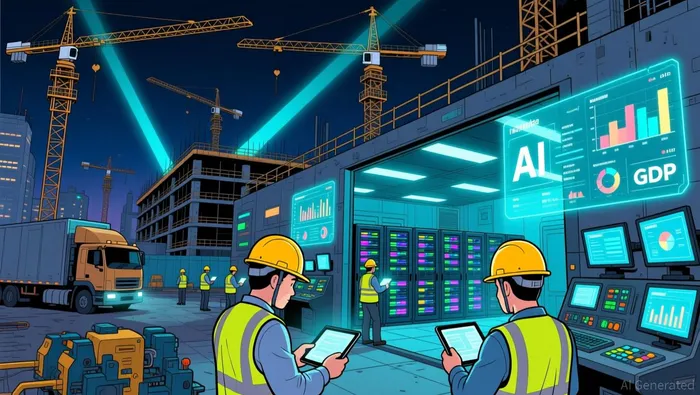 According to Harvard economist Jason Furman, 92% of U.S. GDP growth in H1 2025 was attributed to AI data center investments, underscoring a structural shift toward technology-driven expansion. EY-Parthenon further notes that AI-related business investment grew at an annualized rate of 18% during the same period, adding 1 percentage point to Q2 GDP growth alone. These figures highlight AI's transformative role, but they also reveal a concentration of growth in a narrow subset of the economy.
Sustainability Concerns: Overbuilding, Concentration, and Circular Financing
The sustainability of this AI-driven growth trajectory is under scrutiny. While global AI spending is projected to reach $375 billion in 2025 and $500 billion by 2026, much of this investment is concentrated among a few large tech firms. For instance, Google raised its 2025 capital budget to $92 billion, and Microsoft plans for accelerated growth into 2026. However, the economic benefits of these expenditures are not yet broadly realized. Much of the spending is classified as intermediate goods, limiting its multiplier effect on GDP.
Risks of overbuilding and underutilization are also emerging. OpenAI, for example, is expected to burn through $115 billion in cash through 2029, despite generating $13 billion in revenue in 2025. Historical parallels to the dot-com bubble suggest that speculative cycles in AI infrastructure could lead to systemic fragility. Additionally, circular financing structures-where firms invest in customers who then reinvest in their infrastructure-raise concerns about artificial demand.
Broader Economic Weaknesses: Tariffs, Labor Shortages, and Inequality
While AI capex is driving growth, it may also be masking broader economic vulnerabilities. Elevated tariffs, which peaked at over 13% in early 2026, have contributed to higher inflation and distorted trade dynamics. These tariffs, combined with a rapid decline in immigration, have reduced labor force growth, exacerbating labor shortages in sectors like food preparation, construction, and caregiving. The government shutdown in 2025 further highlighted systemic fragility, disrupting federal operations and increasing reliance on food assistance programs.
Consumer spending, traditionally a cornerstone of U.S. GDP, is also showing signs of strain. While it rose by 2.5% in Q2 2025, this growth is expected to moderate in 2026 due to slower wage growth and higher inflation. AI's role in offsetting labor shortages through productivity gains is limited by the low workforce intensity of data centers and reliance on imported technology.
Implications for Investors and Policymakers
For investors, the AI boom presents both opportunities and risks. Firms at the core of AI infrastructure-such as chip manufacturers and cloud providers-are likely to see significant growth. Goldman Sachs estimates that full AI adoption could lift U.S. labor productivity and GDP by 15%, equivalent to $4.5 trillion in economic value. However, the high concentration of capital and earnings in top tech firms increases vulnerability to a potential correction. Stretched valuations across the sector mean that even modest disappointments could have outsized market effects.
Policymakers must balance the need to foster innovation with the risks of overconcentration. Addressing labor market imbalances, investing in workforce retraining, and mitigating the inflationary pressures from tariffs will be critical to ensuring that AI-driven growth is inclusive and sustainable.
Conclusion
AI capex has undeniably become a cornerstone of U.S. economic performance in 2025, contributing to GDP growth and reshaping industries. However, its sustainability hinges on addressing structural risks such as overbuilding, labor displacement, and systemic fragility. While AI may be compensating for some weaknesses-such as labor shortages and productivity stagnation-it cannot fully offset broader challenges like inflation, inequality, and geopolitical tensions. For investors, the key lies in distinguishing between foundational infrastructure investments and speculative excess, while policymakers must ensure that the AI-driven economy remains resilient and equitable.





Comentarios
Aún no hay comentarios