
AI-Driven Fire Prevention Technologies: A Lucrative Frontier for Infrastructure Resilience and Public Safety Investment
The escalating threat of climate change, coupled with aging infrastructure and rising urbanization, has elevated infrastructure resilience and public safety to critical priorities for governments and investors. At the forefront of this transformation is artificial intelligence (AI), which is redefining fire prevention through smarter detection, predictive analytics, and integrated response systems. For investors, the AI-driven fire prevention market represents a compelling opportunity, combining robust growth projections with tangible societal benefits.
Market Growth: A Booming Sector with Long-Term Potential
The global fire protection systems market, now valued at USD 76.9 billion in 2025, is projected to surge to USD 183.73 billion by 2035, driven by AI and IoT integration. This growth is underpinned by stringent safety regulations, the rise of smart buildings, and the increasing adoption of AI-powered solutions. Notably, the data center fire detection and suppression segment-critical for safeguarding cloud and edge computing infrastructure-is expected to grow at a compound annual growth rate (CAGR) of 8.5% from 2025 to 2034, reaching USD 3.2 billion by 2034.
North America, a leader in AI adoption, already accounts for USD 28.87 billion in fire protection systems, with firms like HoneywellHON-- and Johnson ControlsJCI-- leveraging AI to enhance fire alarm systems and predictive maintenance according to industry reports. Honeywell's NOTIFIER INSPIRE system, for instance, uses AI to streamline regulatory compliance and reduce false alarms, while its Morley-IAS Max system employs machine learning to detect anomalies in heat and smoke patterns according to market analysis.
Technological Advancements: From Predictive Maintenance to Digital Twins
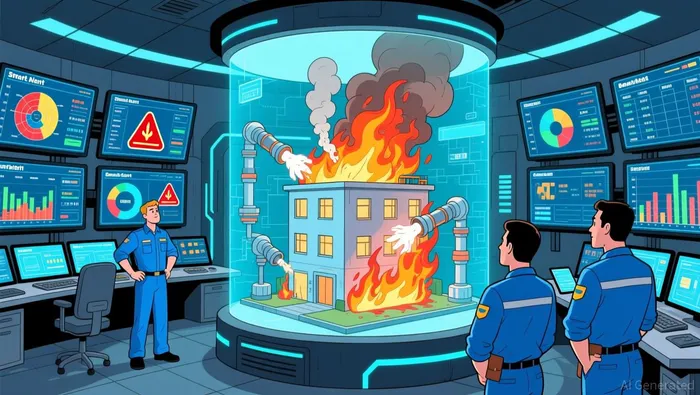 AI's integration into fire prevention is not merely incremental-it is transformative. Predictive maintenance algorithms now analyze sensor data to preempt equipment failures, minimizing downtime and repair costs. Similarly, AI-driven digital twins-virtual replicas of physical infrastructure-are being used to simulate fire scenarios and optimize response strategies. A 2025 Deloitte report estimates that such technologies could reduce natural disaster-related infrastructure losses by 15%, saving $70 billion globally by 2050.
Innovations in fire suppression are equally striking. AI-powered fire sprinkler systems now use multi-sensor technology to target fires with precision, reducing water damage and operational costs. Meanwhile, IoT-enabled fire detection systems are creating interconnected networks that allow real-time monitoring and automated responses, further enhancing infrastructure resilience.
Real-World Impact: Case Studies and ROI
The value of AI in fire prevention is not theoretical. Pano AI's high-tech cameras, deployed in wildfire-prone regions of the U.S., detected over 100 early-stage fires in 2024, enabling rapid containment and averting catastrophic damage. Similarly, FireDome's AI-powered systems have demonstrated efficacy in suppressing spot fires, a persistent challenge in wildfire management according to public safety analysis.
Public-private partnerships are amplifying these efforts. Insurers like Liberty Mutual have incentivized homeowners to adopt AI-driven fire-resistant measures, such as ember-resistant vents and smart sprinklers, resulting in a 63% reduction in fire-related losses in pilot programs. The U.S. Chamber of Commerce underscores the economic rationale: every $1 invested in resilience yields $13 in savings from avoided economic impacts and cleanup costs according to policy research.
Public Safety and Emergency Response: AI's Human Impact
Beyond infrastructure, AI is revolutionizing emergency response systems. AI-powered 911 dispatch platforms, such as those developed by Prepared911 and RapidSOS, are addressing labor shortages and improving response times through automation and voice recognition. GovWorx's AI-driven training tools are also enhancing dispatcher preparedness, ensuring faster, more accurate crisis management. These advancements align with public expectations for real-time, data-driven governance.
Investment Opportunities: Where to Allocate Capital
For investors, the AI-driven fire prevention sector offers multiple entry points. The broader fire protection systems market, growing at a CAGR of 6.8% through 2034, presents opportunities in established players like Honeywell and Johnson Controls. Meanwhile, niche segments such as data center fire suppression and AI-powered IoT platforms are attracting venture capital, given their high-growth potential. Startups specializing in wildfire detection, like Pano AI, also represent high-impact bets, particularly in regions prone to climate-related disasters.
Conclusion: A Future-Proof Investment
AI-driven fire prevention technologies are not just mitigating risks-they are building a safer, more resilient world. With climate-driven disasters becoming the new normal, the ROI from these investments is both financial and societal. For forward-thinking investors, the sector offers a unique convergence of technological innovation, regulatory tailwinds, and urgent demand. As the market matures, early adopters stand to reap substantial rewards while contributing to global public safety.





Comentarios
Aún no hay comentarios