
AI-Driven Financial Software and Strategic Investor Moves: The Emerging Symbiosis Between Fintech Pioneers and AI Innovators
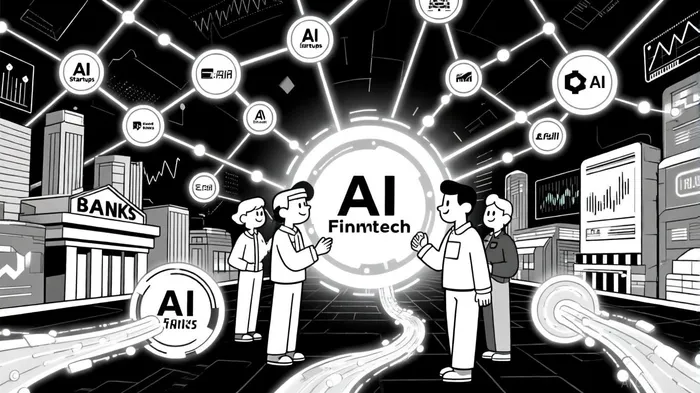
The financial sector is undergoing a seismic shift as artificial intelligence (AI) and fintech converge to redefine traditional models of banking, lending, and wealth management. For investors, this symbiosis presents a unique opportunity to capitalize on a market poised for exponential growth. According to a report by Mordor Intelligence, the AI-driven financial software market is projected to expand from USD 30 billion in 2025 to USD 83.10 billion by 2030, reflecting a compound annual growth rate (CAGR) of 22.60 [1]. Meanwhile, the broader AI in finance market, valued at USD 38.36 billion in 2024, is expected to surge to USD 190.33 billion by 2030, growing at a staggering 30.6% CAGR [2]. These figures underscore a transformative era where AI is not just an enabler but a core driver of financial innovation.
The Strategic Alliances Reshaping Finance
The collaboration between fintech firms and AI innovators is no longer speculative—it is operational. Major banks such as Commonwealth Bank of Australia (CommBank), Wells FargoWFC--, and SantanderSAN-- have partnered with AI leaders like OpenAI and Google Cloud to integrate generative AI into their workflows. These partnerships are streamlining decision-making, automating routine tasks, and personalizing client services [3]. For instance, Algebrik AI's collaboration with Family Financial Credit Union has automated loan origination processes, improving portfolio management and reducing default risks [3].
Agentic AI, a subset of AI capable of autonomous decision-making, is also gaining traction. A 2025 MIT study revealed that 70% of banking executives are deploying agentic AI in fraud detection, security, and cost optimization [4]. These systems are not just reactive but proactive, identifying anomalies in real-time and adapting to evolving threats. Such advancements are redefining the role of AI in financial ecosystems, shifting from niche tools to foundational infrastructure.
Investment Opportunities in AI-Driven Fintech
The surge in AI fintech collaborations has attracted significant capital. In 2024 alone, AI fintech startups raised $7.3 billion, and by mid-2025, total funding had already surpassed $10.3 billion, with AI-focused companies capturing 60% of the capital [5]. North America remains the epicenter of this activity, with the San Francisco Bay Area and New York accounting for 70% of global funding [5].
Notable investments include Anysphere's $900 million Series C round, valuing the AI coding assistant firm at $9.9 billion [5], and Liquid AI's $250 million Series A led by AMD Ventures, focused on compute-efficient models for regulated financial environments [5]. These deals highlight a shift in investor focus from generic automation tools to verticalized AI applications addressing specific financial challenges, such as credit scoring, compliance, and portfolio management.
Strategic investors are also diversifying their portfolios to align with long-term growth. High-yield savings accounts, government bonds, and ETFs are being leveraged to balance liquidity and stability while integrating AI-driven fintech solutions [6]. For example, robo-advisors like Betterment and Wealthfront are using AI to offer hyper-personalized investment strategies, while Upstart's machine learning models have improved loan approval accuracy by 20–30% [5].
Regulatory Evolution and Risk Mitigation
As AI fintech solutions mature, regulatory frameworks are adapting to ensure compliance and trust. The World Bank has documented a rise in regulatory sandboxes—controlled environments for testing innovations—since 2018 [7]. These sandboxes are critical for fostering financial inclusion, enabling underserved populations to access AI-driven services like digital payments and SME financing [7].
AI-powered RegTech solutions, such as those from ComplyAdvantage and Ascent, are automating transaction monitoring and compliance checks, reducing operational costs for institutions [5]. This alignment of innovation with regulatory demands is creating a fertile ground for scalable, customer-centric financial ecosystems.
Strategic Moves for Investors
For investors, the key lies in identifying AI fintech collaborations that address unmet market needs. Startups like Zest AI, which uses explainable AI to reduce loan defaults by 25%, and FundGuard, which streamlines investment management, exemplify the potential of niche applications [5]. Diversification across equity, fixed-income, and cash equivalents remains crucial, as does a focus on companies with clear regulatory alignment and scalable business models.
The future of finance is being written in code—and in partnerships. As AI-driven fintech solutions become embedded in core financial operations, early adopters and strategic investors stand to reap substantial rewards. The question is no longer whether AI will transform finance, but how quickly investors can position themselves to benefit from this inevitable evolution.





Comentarios
Aún no hay comentarios