
AI-Driven Financial Analytics: Revolutionizing Portfolio Management Through Efficiency and Precision
Operational Efficiency: Streamlining Processes and Reducing Costs
AI-driven analytics are delivering measurable improvements in operational efficiency, particularly in cost reduction and workflow optimization. Rekor SystemsREKR--, for instance, reported a 32% year-over-year revenue increase in 2024, alongside a 29.9% improvement in Adjusted EBITDA loss, attributed to AI-powered tools like its Rekor Command® platform, according to a Stock Titan article. The company's strategic realignment, including workforce reductions and executive appointments, further highlights how AI can enhance scale economics, as noted in the same article.
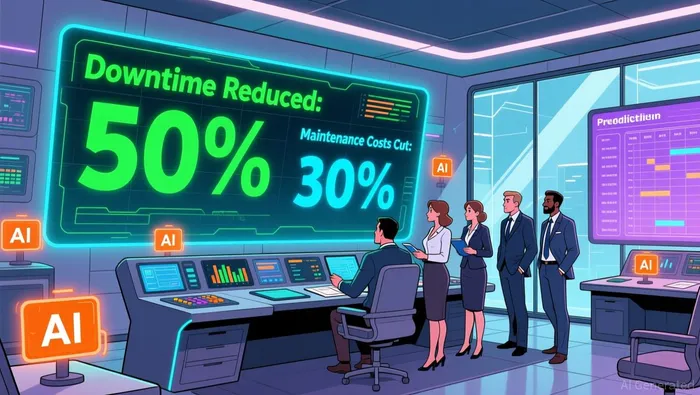
Similarly, C3 AI's Reliability application has demonstrated significant operational gains. By unifying data sources and applying machine learning, the tool reduced unplanned downtime by 50%, cut maintenance costs, and slashed alert triage time by 90%, according to C3 AI's Reliability page. These outcomes illustrate how AI can transform asset-intensive industries, offering insights that minimize disruptions and optimize resource allocation.
Predictive Accuracy: Enhancing Decision-Making and Risk Mitigation
AI's ability to process vast datasets and identify patterns is revolutionizing predictive accuracy in portfolio management. Palantir Technologies, for example, reported a 121% year-over-year surge in U.S. commercial revenue, driven by its AI platforms that optimize decision-making across sectors, as noted in a Market Minute article. In asset management, BigBear.ai's ConductorOS platform supports real-time maritime intelligence and biometric systems, showcasing AI's role in high-stakes environments, as reported in a Nasdaq article.
C3 AI's Financial Services Suite has also delivered notable results. A multinational bank used the suite to predict customer churn 90 days in advance, while a global biopharma company improved supply chain accuracy, as detailed in a C3 AI customer case study. These applications highlight AI's capacity to forecast trends and mitigate risks, enabling proactive rather than reactive strategies.
AI Tools and Measurable Outcomes: A New Era of Portfolio Optimization
Emerging tools are further democratizing access to AI-driven portfolio management. Mezzi, for instance, offers tax optimization and fee analysis for individual investors, leveraging AI to analyze asset correlations, as noted in a Mezzi blog post. Kavout's K Score System, which predicts stock performance using 200+ factors, has historically outperformed benchmarks by 6% annually, according to the same blog post. Meanwhile, PortfolioPilot specializes in risk analysis and scenario modeling, allowing investors to test strategies against economic forecasts, as noted in the same blog post.
UOB Private Bank's discretionary portfolio management (DPM) strategy in 2024 exemplifies institutional adoption. By introducing a bespoke derivative strategy and investing in a five-year tech roadmap, the bank enhanced diversification and client returns, as reported in a Euromoney article. Such initiatives underscore how AI is not just a tool for efficiency but a strategic asset for competitive differentiation.
Challenges and Considerations: Navigating the AI Landscape
Despite these advancements, challenges persist. C3 AIAI--, for example, faced a 16% revenue decline in Q1 2025 and leadership transitions, raising questions about its long-term growth trajectory, as reported in a Fool article. While partnerships with Microsoft and government contracts provided some stability, the company's stock valuation-reflected in a lower forward price-to-sales ratio-suggests a cautious outlook, as noted in the same article. This duality-between AI's promise and its implementation hurdles-highlights the need for rigorous due diligence in AI investments.
Conclusion: A Balanced Approach to AI-Driven Investing
AI-driven financial analytics are undeniably reshaping portfolio management, offering tools that enhance both efficiency and predictive accuracy. However, as demonstrated by C3 AI's recent struggles, the technology's success hinges on execution, adaptability, and strategic alignment. For investors, the key lies in balancing innovation with pragmatism, leveraging AI not as a panacea but as a complementary force in navigating an increasingly complex financial landscape.





Comentarios
Aún no hay comentarios