
AI-Driven Exploration Revolution: Canstar Resources' Strategic Land Expansion and Technological Collaboration in Newfoundland's Buchans Mining District
The mining industry is undergoing a seismic shift as artificial intelligence (AI) redefines exploration paradigms, particularly for junior mining firms seeking to unlock value in underexplored regions. Canstar Resources (TSXV: ROX) stands at the forefront of this transformation, leveraging AI-driven technologies and strategic land acquisitions in Newfoundland's Buchans Mining District to accelerate critical mineral discovery. This analysis examines Canstar's innovative approach, contextualizes its efforts within the broader AI revolution in junior mining, and evaluates the implications for shareholder value creation.
Strategic Land Expansion and AI Integration in Buchans
Canstar's Buchans Mining District strategy combines aggressive land consolidation with cutting-edge AI collaboration. In Q3 2025, the company expanded its mineral claims adjacent to the Mary March project, a high-grade volcanogenic massive sulphide (VMS) deposit that has already yielded exceptional results, including 4.2 g/t gold, 122 g/t silver, 10.1% zinc, 1.8% lead, and 0.64% copper. These acquisitions strengthen Canstar's control over the Buchans VMS corridor, a historically prolific district with untapped potential.
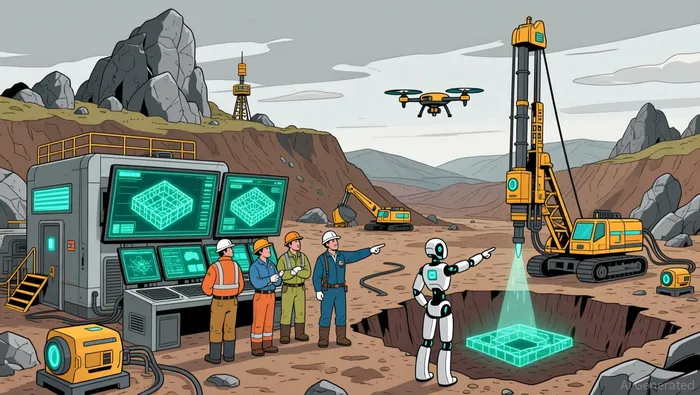
Central to Canstar's exploration strategy is a $11.5 million joint venture with TerraAI, an AI company backed by Khosla Ventures. This partnership deploys AI to analyze geological datasets. By integrating TerraAI's platform with the ongoing Deep IP geophysical survey and historical data, Canstar aims to refine its exploration model and reduce costs. The collaboration also benefits from the expertise of Dr. Harold Gibson, a leading VMS authority, who oversees the integration of AI insights into field operations.
AI as a Catalyst for Operational Efficiency and Cost Reduction
The impact of AI in junior mining extends beyond Canstar. Industry-wide, AI-driven exploration has reduced exploration time by 30-40% and increased ore discovery rates by 25%. For junior firms, where capital efficiency is critical, such advancements directly enhance shareholder value. Canstar's use of AI to prioritize high-potential drill targets-such as the Mary March discovery hole-mirrors broader trends. For example, junior miner Idaho Strategic Resources has similarly adopted AI for rare earth element exploration, achieving faster resource delineation and reduced operational risks.
Moreover, AI's role in predictive maintenance and autonomous equipment is reshaping operational models. Companies like Avino Silver & Gold Mines reported improved Q3 2025 financials, with net income and earnings per share rising due to AI-enhanced mill availability and operational discipline. While Canstar's focus remains on exploration, its strategic use of AI to optimize drilling and reduce manual labor aligns with these efficiency gains, potentially improving its capital deployment and profitability in the long term.
Shareholder Value Creation Through Non-Dilutive Funding and Data-Driven Decisions
Canstar's $11.5 million joint venture with VMS Mining Corporation exemplifies how AI partnerships can secure non-dilutive funding-a critical advantage for junior miners. The initial $500,000 tranche enabled Phase 1 exploration, including trenching that revealed zones with up to 30% zinc, 3% lead, and 4% copper. Such results not only validate the project's potential but also attract further investment, as evidenced by the growing interest in AI-driven junior miners.
Beyond operational efficiency, AI is reshaping investment analysis. Machine learning tools now assess geological reports, financial risks, and market trends, enabling investors to identify undervalued projects. For Canstar, this means its AI-enhanced data-such as 3D geological models and real-time drilling analytics-could attract capital more easily than traditional exploration models. This aligns with industry trends: junior miners leveraging AI have seen EBITDA improvements of 5-25%, driven by reduced exploration risks and faster resource conversion.
Broader Industry Trends and Financial Projections
The mining sector's AI investment is projected to surge from $2.7 billion in 2024 to $13.1 billion by 2029, with junior firms increasingly adopting AI for predictive maintenance, autonomous equipment, and data analytics. This shift is particularly relevant for Canstar, as its Buchans project targets critical minerals like zinc and copper, which are in high demand for clean energy technologies. By aligning with global decarbonization goals, Canstar positions itself to benefit from both commodity price tailwinds and ESG-driven capital flows.
Conclusion: A Model for AI-Driven Junior Mining
Canstar Resources' strategic land expansion and AI collaboration in the Buchans Mining District illustrate a forward-thinking approach to junior mining exploration. By integrating AI into geological analysis, drilling optimization, and data-driven decision-making, the company is not only accelerating discovery but also enhancing operational efficiency and shareholder value. As the industry continues to adopt AI, firms like Canstar that combine technological innovation with strategic land control will likely outperform peers, offering compelling opportunities for investors seeking exposure to the next generation of mining exploration.







Comentarios
Aún no hay comentarios