
AI-Driven ERP as a Strategic Growth Catalyst in Industrial and Enterprise Sectors
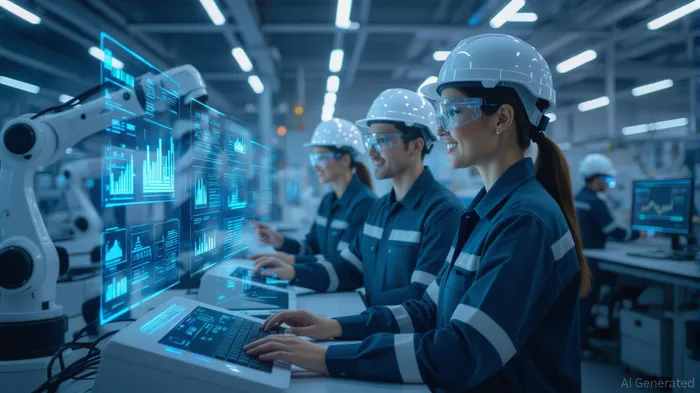
The integration of artificial intelligence (AI) into enterprise resource planning (ERP) systems is reshaping industrial and enterprise operations, delivering measurable efficiency gains, cost savings, and competitive differentiation. As companies across sectors race to future-proof their operations, AI-driven ERP solutions are emerging as a strategic growth catalyst. This analysis identifies high-conviction investment opportunities in SAP and Siemens Energy, two leaders leveraging AI to redefine ERP capabilities and drive operational ROI.
The AI-ERP Revolution: A New Paradigm for Industrial Efficiency
AI-powered ERP systems are transforming traditional workflows by enabling predictive analytics, intelligent automation, and real-time decision-making. According to a 2025 market report, AI-driven ERP solutions have demonstrated up to 70% productivity gains in industries like manufacturing and energy, with companies reporting 30% reductions in operational costs and 25% improvements in user satisfaction[1]. These systems address critical pain points such as supply chain disruptions, energy inefficiencies, and compliance challenges, positioning AI as a cornerstone of Industry 5.0 and sustainable development[4].
SAP: Pioneering AI-Integrated ERP for Enterprise Scalability
SAP has solidified its leadership in AI-driven ERP with innovations like SAP S/4HANA and Joule, an AI copilot enhancing business processes. In Q2 2025, SAP's cloud ERP suite revenue surged 30% year-on-year to €4.42 billion, reflecting strong demand for its AI-augmented solutions[2]. Key case studies highlight SAP's impact:
- Audi's EV Plant in China: Real-time data sharing via SAPSAP-- S/4HANA enabled dynamic inventory adjustments, reducing production delays by 40%[3].
- AI in Finance: SAP's Business AI tools automated accounts receivable and tax compliance, cutting processing times by 50-65% and error rates by 70%[2].
SAP's strategic focus on embedding 400+ AI use cases by 2025—spanning finance, supply chain, and manufacturing—positions it to dominate the $147.7 billion ERP market[6]. Its cloud backlog grew 22% to €18.1 billion, underscoring investor confidence in its AI roadmap[2].
Siemens Energy: AI-Driven ERP for Energy Sector Resilience
Siemens Energy has leveraged AI to optimize energy generation, grid stability, and predictive maintenance. In 2025, its AI-powered control systems reduced energy consumption across manufacturing plants by 10%, while the Siemens Industrial Copilot improved factory-floor decision-making, boosting productivity by 20%[5]. A notable collaboration with Google Cloud enabled Siemens to migrate 274 servers to the cloud, unlocking AI capabilities like SAP Datasphere and Google Cloud Cortex Framework, which enhanced operational efficiency and sustainability[7].
Financially, Siemens Energy reported 5% revenue growth in Q3 2025, with a 28% year-over-year increase in orders, driven by Mobility and Smart Infrastructure segments[8]. Its AI-driven ERP systems also reduced component failure-related downtime by 25% and improved on-time delivery rates by 20%, demonstrating tangible ROI[5].
Competitive Positioning: SAP vs. Siemens vs. Oracle
While SAP and Siemens lead in AI-ERP innovation, Oracle's recent market share gains (6.63% in 2025 vs. SAP's 6.57%) highlight competitive dynamics[9]. However, SAP's dominance in Human Capital Management (HCM) and Supply Chain Management—with 106,000 and 126,000 customers, respectively—cements its enterprise-wide appeal[1]. Siemens, meanwhile, excels in Manufacturing Execution Systems (MES), with 36,000 customers and a 12.6% market share in manufacturing software[10].
Oracle's strength lies in SaaS integration and Procurement & Distribution, but SAP's AI-first strategy and Siemens' energy-sector specialization offer distinct advantages. For instance, SAP's Joule AI and Siemens' digital twin technology provide sector-specific solutions that align with Industry 5.0's emphasis on sustainability and resilience[5][6].
Future-Proofing Industrial Operations: Why SAP and Siemens Matter
The AI-ERP market is projected to grow to $1.5 trillion by 2030, driven by demand for scalable, industry-specific solutions[11]. SAP and Siemens are uniquely positioned to capitalize on this growth:
- SAP is expanding its AI use cases to 400+ by 2025, targeting finance, supply chain, and manufacturing[6].
- Siemens is leveraging AI in energy grids and predictive maintenance, aligning with the $173.46 billion IT spending forecast for the energy sector by 2032[8].
Both companies are also addressing AI implementation challenges—such as data quality and change management—through partnerships (e.g., SAP with NVIDIANVDA--, Siemens with AWS) and modular cloud solutions[4][7].
Conclusion: High-Conviction Investment Opportunities
For investors, SAP and Siemens Energy represent compelling opportunities in the AI-ERP space. SAP's enterprise-wide AI integration and robust cloud growth, coupled with Siemens' energy-sector specialization and operational efficiency gains, position them as leaders in a $147.7 billion market[1][6]. As AI reshapes industrial operations, these companies are not just adapting—they are defining the future of enterprise software.







Comentarios
Aún no hay comentarios