
AI-Driven Equities: Dispelling the Hype and Uncovering Hidden Gems
The artificial intelligence (AI) boom has reshaped global markets, creating a stark divide between overhyped sector leaders and undervalued companies with robust fundamentals. While investors have poured billions into AI darlings like NvidiaNVDA-- and AMDAMD--, the broader market is beginning to question whether these valuations are sustainable. Meanwhile, firms like Mastercard, Texas Instruments, and Meta are quietly building AI-driven growth without the exuberance of speculative frenzy. This analysis examines the financial realities behind these divergent narratives and identifies opportunities for investors seeking long-term value.
The Overhyped Leaders: Valuation vs. Performance
Nvidia and AMD have become poster children for the AI hype cycle. In Q3 2025, Nvidia reported record revenue of $57.0 billion, a 62% year-over-year increase, driven by its dominance in AI infrastructure and data center technologies according to Nvidia's financial report. Its gross margins remained impressive at 73.4%, and its Return on Invested Capital (ROIC) hit 165.04%, far exceeding its cost of capital as reported by AMD. However, such metrics raise questions: Is this growth sustainable, or is the market pricing in speculative optimism?
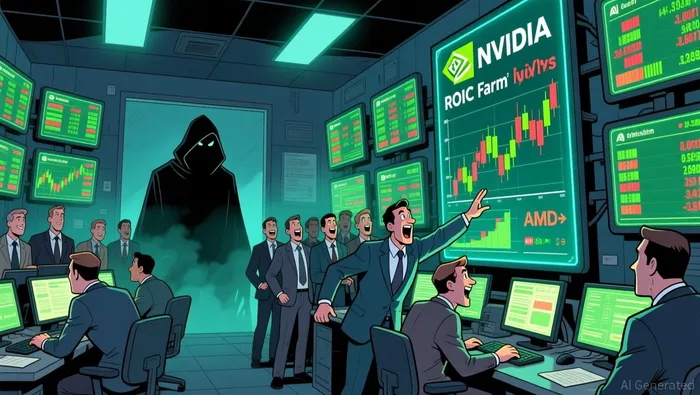 AMD also delivered strong results, with Q3 2025 revenue surging 36% year-over-year to $9.2 billion, fueled by demand for its EPYC and Ryzen processors as reported in AMD's Q3 2025 results. Yet its ROIC of 1.70% for the quarter pales in comparison to Nvidia's, and its trailing twelve-month ROIC of 4.46% suggests uneven capital efficiency according to market analysis. While AMD's Data Center segment is growing, its valuation multiples-like those of Nvidia-appear stretched relative to its fundamentals.
These companies exemplify the AI sector's paradox: exceptional growth metrics coexist with valuations that may not reflect long-term profitability. As one analyst notes, "The market is betting on AI's transformative potential, but not all players can sustain these multiples without delivering consistent returns" as highlighted in market commentary.
Undervalued Fundamentals: The Quiet AI Revolution
In contrast to the hype surrounding chipmakers, companies like Mastercard, Texas Instruments, and Meta are leveraging AI with more grounded valuations and stronger capital efficiency.
Mastercard (MA) reported a 17% year-over-year revenue increase in Q3 2025, with an adjusted operating margin of 59.8%-a testament to its disciplined cost structure according to Mastercard's Q3 2025 presentation. Its value-added services segment grew by 25%, driven by AI-enhanced fraud detection and data analytics. Despite these results, Mastercard's stock underperformed in 2025, partly due to macroeconomic uncertainty and valuation compression as noted in financial analysis. This disconnect between fundamentals and market sentiment presents a compelling case for undervaluation.
Texas Instruments (TXN), though not a direct AI competitor, is a critical enabler of the sector. The semiconductor giant generated 14% of its revenue as free cash flow in Q3 2025, reflecting its dominant margins and efficient capital use according to Seeking Alpha. However, its stock faced a 21% sell-off in the same quarter, driven by concerns over U.S. tariff policies and cyclical demand swings as reported in Seeking Alpha. For investors, this represents a risk-reward asymmetry: a company with essential infrastructure and strong cash flow trading at a discount.
Meta Platforms (META) is another standout. The social media giant is using AI to enhance user engagement and advertising effectiveness, yet its stock remains undervalued compared to peers like Nvidia as reported by Yahoo Finance. Meta's operating margins have improved steadily, and its AI investments are already generating tangible revenue growth. As one report highlights, "Meta's ability to integrate AI into its ecosystem without overextending its balance sheet makes it a compelling long-term play" as highlighted in market commentary.
Macro Factors: Interest Rates and Market Sentiment
The broader economic context is critical to understanding these divergent trajectories. Unlike the dot-com bubble of the early 2000s, today's AI sector benefits from a declining interest rate environment. The Federal Reserve's rate cuts in 2025 have made growth stocks more attractive, allowing overvalued companies to persist longer without immediate profitability according to financial analysis. This dynamic creates a "wait-and-see" scenario: investors are willing to tolerate speculative valuations as long as macroeconomic risks remain low.
However, this environment also amplifies the appeal of undervalued stocks. Companies with strong cash flows and efficient capital use-like Mastercard and Texas Instruments-can capitalize on lower borrowing costs to reinvest in AI-driven growth without relying on speculative financing according to Mastercard's Q3 2025 presentation.
Conclusion: Balancing Hype and Value
The AI equity landscape is a study in contrasts. While leaders like Nvidia and AMD have captured headlines with explosive revenue growth, their valuations may not be justified by long-term profitability. Conversely, firms like Mastercard, Texas Instruments, and Meta are building AI-driven value with disciplined fundamentals and attractive risk profiles.
For investors, the key lies in distinguishing between speculative bets and sustainable growth. As the sector matures, capital efficiency and operational margins will matter more than headline-grabbing revenue figures. In this evolving market, the undervalued stocks may prove to be the most rewarding investments.





Comentarios
Aún no hay comentarios