
The AI-Driven US Economic Boom: Is Double-Digit GDP Growth Within Reach?
The U.S. economy is at a crossroads. In a world where artificial intelligence (AI) is reshaping industries, Elon Musk has made a bold claim: the U.S. could see double-digit GDP growth within 12–18 months and triple-digit growth in five years, driven by AI and robotics according to reports. This forecast, while audacious, sits in stark contrast to more conservative projections from institutions like the OECD, which anticipates a 1.8% GDP growth rate for 2025 and 1.5% for 2026. For investors, the question is not just whether Musk's vision is plausible but how to position capital in an economy increasingly defined by AI-driven disruption.
Musk's Vision: A Future of "Universal High Income"
Musk's optimism hinges on AI's potential to act as a productivity proxy, automating labor and generating wealth at unprecedented scales. He envisions a world where AI and robotics eliminate poverty by creating a "universal high income," rendering traditional savings and employment obsolete according to Musk. This is not mere speculation. Q3 2025 GDP growth hit 4.3%, far exceeding expectations of 3.2%, with AI-related investments accounting for 37% of real GDP growth in the first nine months of 2025. Business investment in AI technologies has surged by 48% since 2020, with software and server expenditures alone contributing a 1 percentage point boost to Q2 2025 GDP growth.
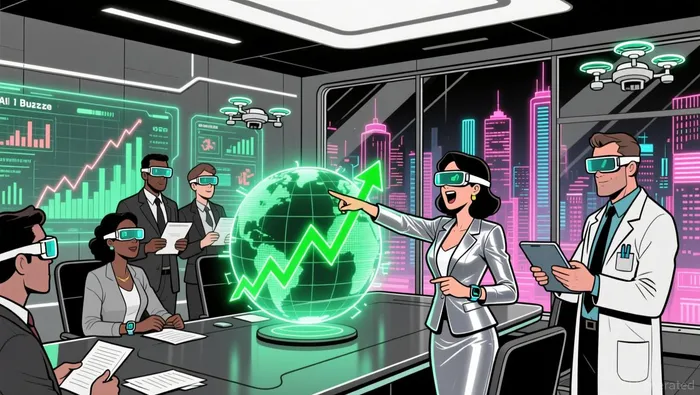
However, Musk's timeline for triple-digit growth-five years-requires a leap of faith. While AI is undeniably a growth engine, its impact is uneven. A K-shaped recovery is emerging, where AI-linked sectors outperform others. For instance, data center investments and semiconductor demand are soaring, but traditional industries remain stagnant according to the global economy report. This duality presents both opportunities and risks for investors.
Institutional Skepticism: The "Realistic" View
Mainstream institutions remain cautious. The OECD projects 2025 U.S. GDP growth at 1.8%, citing trade uncertainties and inflationary pressures. Bank of America (BofA) is slightly more optimistic, forecasting 2.4% growth in 2026, driven by tax incentives and lagged Fed rate cuts. These figures pale in comparison to Musk's double-digit claims.
The disconnect stems from differing timeframes. Musk's predictions assume rapid, widespread AI adoption across all economic sectors-a scenario that hinges on breakthroughs in artificial general intelligence (AGI) and regulatory alignment. Meanwhile, institutions focus on near-term constraints, such as high tariffs and a tightening labor market, which could slow consumer spending growth to 1.6% in 2026.
Investment Implications: Where to Allocate Capital
For investors, the key lies in balancing Musk's long-term vision with near-term realities. Here's how to position capital:
- AI Infrastructure: The backbone of the AI boom-data centers, semiconductors, and cloud computing-is already outperforming. Business investment in AI-related software and servers grew by 48% since 2020. Companies like NVIDIANVDA--, AMDAMD--, and hyperscalers (e.g., AWS, MicrosoftMSFT-- Azure) are prime beneficiaries.
- Robotics and Automation: Musk's focus on robotics aligns with a $150 billion global market expected to grow at 22% annually through 2030 according to market analysis. Startups and established players in industrial automation (e.g., Boston Dynamics, ABB) could see surges in demand as AI-driven productivity gains take hold.
- AI-Driven Sectors: Healthcare, logistics, and manufacturing are early adopters of AI. For example, generative AI is already reducing R&D costs in pharma and optimizing supply chains. ETFs like the AI & Technology ETF (AIQ) or sector-specific funds offer diversified exposure.
Risks and Caveats
Musk's forecast is not without risks. First, concentration risk looms large. AI's growth is hyper-focused on a few sectors, leaving others vulnerable. Second, regulatory headwinds could stifle innovation. The EU's AI Act and U.S. data privacy laws may slow adoption. Third, Musk's timeline assumes AGI breakthroughs by 2030-a timeline many experts deem overly optimistic.
Moreover, the absence of Q4 2025 GDP data creates uncertainty. While Q3 growth was robust, the final quarter's performance remains unknown. Investors must also consider macroeconomic factors: high interest rates and geopolitical tensions could dampen AI-driven momentum.
Conclusion: A "Both/And" Strategy
The AI-driven economic boom is real, but its trajectory is neither linear nor universally beneficial. Musk's vision of a "universal high income" may take decades to materialize, if at all. For now, investors should adopt a both/and strategy: capitalize on near-term AI infrastructure and automation opportunities while hedging against macroeconomic volatility.
As the OECD and BofA suggest, the U.S. economy is on a K-shaped path-AI will accelerate growth in some sectors while others lag. The winners will be those who invest in the tools and talent driving this transformation. Whether Musk's triple-digit growth is achievable or not, the AI revolution is already here-and it's rewriting the rules of economic value.







Comentarios
Aún no hay comentarios