
AI-Driven Digital Transformation in the Insurance Sector: Strategic Partnerships and AI Innovation as Catalysts for Competitive Advantage
Strategic Partnerships in Claims Processing: A New Era of Efficiency
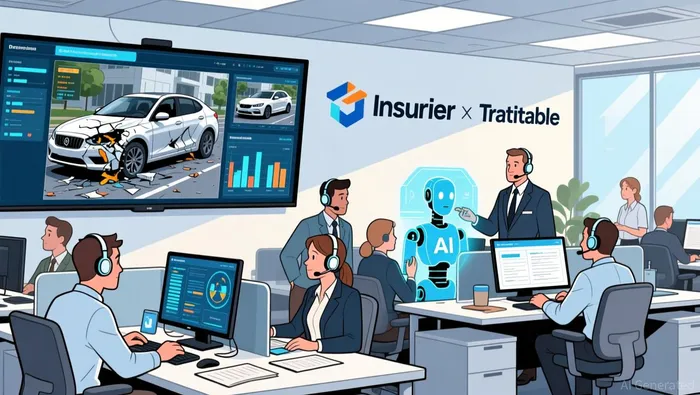
One of the most tangible applications of AI in insurance is claims processing, where partnerships are streamlining workflows and reducing costs. Aviva's collaboration with Tractable, for instance, has revolutionized damage assessment by leveraging AI to analyze photos of property and vehicle damage, enabling remote repair estimates and consistent diagnostics, as noted in a CDP analysis. This innovation reduced liability assessment time for complex claims by 23 days and improved routing accuracy by 30%, saving over £60 million in 2024, according to a McKinsey report. Such partnerships not only enhance operational efficiency but also free up human resources for higher-value tasks, reinforcing Aviva's market position.
Pricing and Personalization: Data-Driven Customer Insights
AI's ability to process vast datasets is reshaping pricing strategies and customer segmentation. UnitedHealth Group and Optum Bank, for example, developed a big data model that boosted one-time contributions by 26% and average balances by 12%, according to the CDP analysis. Similarly, MunichRE's deployment of 45,000 predictive models allows it to anticipate customer behavior and tailor insurance packages, creating a feedback loop of data-driven personalization, as detailed in the CDP analysis. These initiatives highlight how strategic alliances with AI firms enable insurers to move beyond traditional actuarial models, offering hyper-personalized solutions that enhance customer retention and profitability.
Risk Management Innovations: From Reactive to Proactive
AI is also transforming risk management from a reactive to a proactive discipline. AXA XL's AI Digital Risk Engineer, which monitors asset health via connected systems like HVAC, exemplifies this shift, as described in the CDP analysis. By automating the analysis of 10,000+ site survey reports annually, the platform identifies vulnerabilities before they escalate, reducing claims payouts and improving underwriting accuracy. Such innovations are particularly valuable in property and casualty insurance, where predictive analytics can mitigate losses and stabilize margins.
Customer Engagement: AI as a Communication Bridge
In customer-facing operations, AI-powered virtual agents are redefining engagement. Allstate's AI-driven claims response system handles 50,000 daily messages with improved accuracy and empathy, according to the CDP analysis, while Humana Inc.'s partnership with IBM delivers personalized healthcare support to members, as detailed in the CDP analysis. These tools not only enhance customer satisfaction but also reduce operational costs-CNP Assurances, for instance, streamlined document classification processes, cutting procedural delays and improving service quality, according to the CDP analysis.
Market Trends and Competitive Advantage
The insurance sector's AI adoption is outpacing many industries, yet only a minority of firms have scaled AI initiatives to enterprise-wide impact, according to a BCG report. Leading insurers are investing heavily, with annual budgets exceeding $25 million, to secure a first-mover advantage, as noted in the BCG report. North America is expected to dominate AI insurance growth, accounting for 45% of the market by 2029, according to the Technavio report, driven by firms like Munich Re and IBM, whose collaboration on risk assessment tools underscores the region's innovation leadership, as described in the Technavio report.
However, challenges remain. Data privacy, security, and governance issues could hinder adoption if not addressed, according to the Technavio report. For investors, this underscores the importance of backing firms with robust ethical frameworks and transparent AI strategies.
Conclusion: A Lucrative Horizon for Investors
The integration of AI into insurance is no longer speculative-it is a competitive imperative. Strategic partnerships are accelerating this transition, enabling insurers to optimize operations, personalize offerings, and preempt risks. As the market grows, investors who prioritize companies with strong AI alliances and scalable innovation will likely outperform. The next decade will reward those who recognize that in insurance, AI is not just a tool but a transformative force.





Comentarios
Aún no hay comentarios