
AI-Driven Cost Optimization: A Catalyst for Sustainable Shareholder Value in Enterprise Software
The integration of artificial intelligence (AI) into enterprise software has evolved from a speculative experiment to a strategic imperative. By 2025, AI-driven cost optimization has emerged as a cornerstone of corporate financial resilience, enabling companies to slash expenses while simultaneously enhancing operational agility and innovation. For investors, the question is no longer whether AI can reduce costs but how it reshapes long-term shareholder value creation through sustained profitability, improved financial metrics, and competitive differentiation.
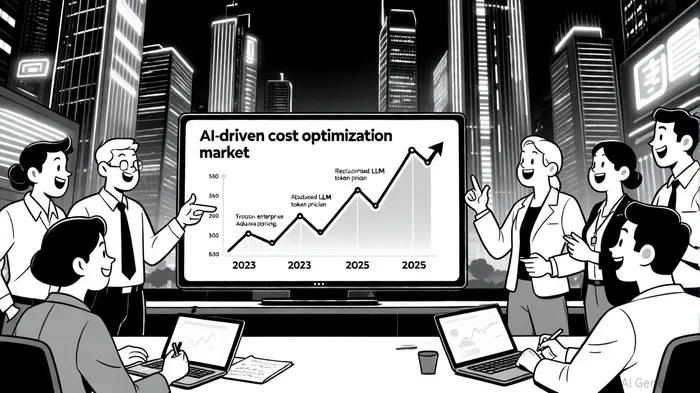
The Market Shift: From Cost-Cutting to Strategic Transformation
According to a report by Boston Consulting Group (BCG), enterprises adopting AI-driven cost optimization are redefining traditional approaches to financial efficiency. Rather than merely trimming budgets, these companies are leveraging AI to automate low-value tasks, reimagine workflows, and unlock productivity gains across functions such as R&D, marketing, and supply chain management [1]. For instance, a global biopharma firm reduced R&D costs by $45 million and accelerated clinical study report drafting by 35% using generative AI (GenAI), while a German energy provider identified tens of millions in overpayment discrepancies through AI-powered invoice reconciliation [1]. These examples underscore a broader trend: AI is enabling cost optimization that is not only immediate but also transformative, creating compounding benefits over time.
The declining cost of large language models (LLMs) has further accelerated adoption. OpenAI, Anthropic, and Google have slashed token pricing, with Google's Gemini 1.5 Flash now costing just $0.075 per million input tokens [3]. This affordability has allowed enterprises to deploy AI for tasks like customer service automation and document summarization without prohibitive computational expenses. Meanwhile, strategies such as model fine-tuning, retrieval-augmented generation (RAG), and parameter-efficient training are helping companies maximize returns on AI investments [4].
From Financial Metrics to Shareholder Value
The financial impact of AI-driven cost optimization is evident in key metrics. A consumer packaged goods company achieved 60%–90% efficiency gains in marketing and business reporting by integrating GenAI, directly boosting earnings per share (EPS) [1]. Similarly, IBM's AI-powered transformation of support functions-legal, IT, procurement, and HR-delivered productivity improvements that translated into long-term cost advantages [1]. These outcomes align with broader industry data: BCG notes that AI leaders-companies with advanced AI integration-achieve 1.5 times higher revenue growth and 1.6 times greater shareholder returns compared to peers [4].
Return on equity (ROE) is another area of significant improvement. JPMorgan Chase's COIN platform, which automates contract analysis, saved thousands of labor hours and enhanced accuracy, contributing to stronger ROE through operational efficiency [2]. In the financial services sector, AI-driven cost optimization has delivered an average ROI of 4.2 times, according to Microsoft's industry-specific analysis [5]. These figures highlight how AI not only reduces expenses but also amplifies capital efficiency, a critical factor for long-term value creation.
Strategic Resilience and Future-Proofing
Beyond immediate financial gains, AI-driven cost optimization fosters strategic resilience. Companies are using AI to future-proof operations against disruptions such as supply chain volatility and regulatory shifts. For example, Apple's relocation of manufacturing to India and Vietnam, guided by AI-powered supply chain analytics, mitigates geopolitical risks while maintaining cost efficiency [2]. Similarly, Microsoft's cloud-based AI tools optimize data center energy consumption, aligning cost savings with sustainability goals-a growing priority for investors [2].
The convergence of AI with FinOps (financial operations) further underscores this resilience. Real-time visibility into AI resource usage enables data-driven decisions that balance cost management with innovation. AWS emphasizes that enterprises adopting FinOps principles can achieve dynamic budgeting and resource allocation, ensuring AI initiatives remain aligned with financial objectives [4].
Challenges and the Path Forward
Despite its promise, AI-driven cost optimization is not without hurdles. Upfront infrastructure costs, the need for skilled talent, and regulatory uncertainties pose challenges. However, these are increasingly offset by the scalability of AI solutions and the compounding returns from early adoption. As Gartner notes, enterprises prioritizing high-value use cases-such as predictive maintenance and demand forecasting-are seeing the most robust ROI amid economic pressures [5].
For investors, the key is to identify companies that treat AI not as a cost center but as a strategic lever for reinvestment. Firms reinvesting savings into AI-enabled innovation, such as enhanced customer experiences or product development, are likely to outperform peers in both cost efficiency and revenue growth [3].
Conclusion
AI-driven cost optimization is no longer a niche experiment but a fundamental driver of long-term shareholder value. By reducing operational expenses, enhancing financial metrics like EPS and ROE, and enabling strategic resilience, AI is redefining what it means to be financially efficient in the digital age. For enterprises that embrace this shift holistically, the rewards are clear: sustained profitability, competitive differentiation, and a foundation for future innovation. As the market matures, investors who align with AI leaders will be well-positioned to capitalize on the next phase of enterprise software evolution.





Comentarios
Aún no hay comentarios