
The AI-Driven Cloud Infrastructure Sector: Oracle's Surging Order Book and Growth Outlook Signal a Strategic Buy Opportunity
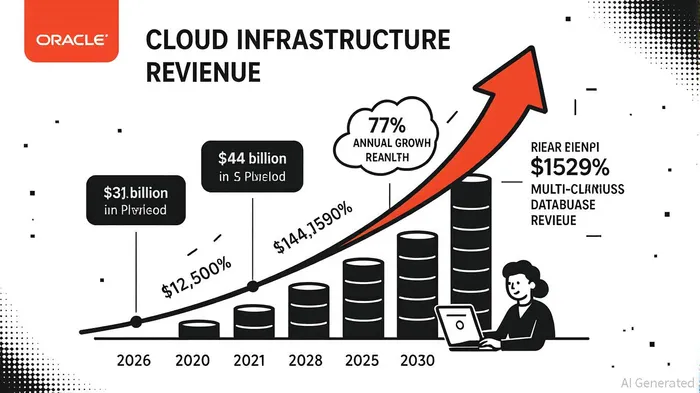
The AI-driven cloud infrastructure sector is undergoing a seismic shift, with Oracle CorporationORCL-- emerging as a standout performer. The company's Q1 2026 earnings report, released on August 31, 2025, revealed a staggering 359% year-over-year increase in remaining performance obligations (RPO) to $455 billion, fueled by four multi-billion-dollar contracts with three hyperscalers[1]. This surge, coupled with a 1,529% growth in multi-cloud database revenue from AmazonAMZN--, Google, and Microsoft[2], underscores Oracle's strategic positioning in the AI infrastructure arms race.
Oracle's Q1 2026: A Blueprint for AI-Driven Growth
Oracle's Cloud Infrastructure (OCI) revenue hit $3.3 billion in Q1 2026, a 55% year-over-year increase[3]. CEO Safra Catz highlighted a bullish long-term outlook, projecting OCI revenue to grow 77% to $18 billion in fiscal 2026, with further escalations to $32 billion, $73 billion, $114 billion, and $144 billion over the subsequent four years[4]. This trajectory is underpinned by Oracle's aggressive expansion of data center capacity, including 37 new facilities delivered to hyperscalers[5].
The 1,529% surge in multi-cloud database revenue[6] is particularly telling. By enabling customers to leverage AI models like Google Gemini and OpenAI ChatGPT directly on Oracle's database systems[7], the company is capturing a critical inflection pointIPCX-- in enterprise AI adoption. This innovation not only enhances data analytics but also solidifies Oracle's role as a bridge between hyperscalers and enterprise clients.
Broader Market Optimism: Nasdaq AI Index and Palantir's Rally
Oracle's momentum aligns with broader market trends. The Nasdaq AI Index, which tracks AI-focused companies, surged 26.65% year-to-date as of August 15, 2025[8], outpacing the S&P 500's decline. This performance reflects robust demand for AI semiconductors, cloud computing, and data storage. For instance, Broadcom's AI semiconductor sales rose 63% year-over-year to $5.2 billion in Q3 2025[9], while PalantirPLTR-- Technologies (PLTR) doubled in 2025, driven by record-breaking revenue and a 93% year-over-year increase in U.S. commercial sales[10].
Global AI infrastructure investment is also accelerating. UBSUBS-- estimates that companies will spend $375 billion on AI infrastructure in 2025, rising to $500 billion in 2026[11]. This spending is concentrated in cloud computing, data centers, and semiconductors—sectors where Oracle's RPO growth and hyperscaler partnerships position it as a key beneficiary.
Strategic Buy Case: Oracle's Long-Term Catalysts
Oracle's multi-year revenue projections and hyperscaler growth rate suggest a compelling long-term investment opportunity. The company's RPO of $455 billion[12] represents a vast backlog of future revenue, while its AI Database product[13] ensures relevance in an era where enterprises prioritize AI-driven analytics. Furthermore, Oracle's ability to secure multi-billion-dollar contracts[14] demonstrates its competitive edge in a market dominated by Amazon, Google, and MicrosoftMSFT--.
The broader AI infrastructure boom, reflected in Nasdaq AI's outperformance and Palantir's rally[15], validates Oracle's growth narrative. With AI spending projected to grow 31.9% annually from 2025 to 2029[16], Oracle's focus on cloud infrastructure and AI integration aligns perfectly with secular trends.
Conclusion
Oracle's Q1 2026 results and forward-looking guidance paint a picture of a company not just adapting to the AI revolution but leading it. The 1,529% hyperscaler growth, 359% RPO surge, and multi-year revenue projections[17] signal a strategic inflection point. For investors seeking exposure to the AI infrastructure sector, Oracle's disciplined execution and market-leading position make it a compelling long-term buy.





Comentarios
Aún no hay comentarios