
The AI-Driven Bubble: Assessing Risk and Opportunity in a Volatile Tech Sector
Stretched Valuations: A Tale of Two AI Firms
The disparity in valuation metrics between AI sector peers underscores the sector's bifurcated reality. C3.ai (AI), once a darling of the enterprise AI space, exemplifies the risks of overvaluation. Despite a $2.1 billion market capitalization, its stock has plummeted by over 45% in the past year, driven by a 19% year-over-year revenue decline and a staggering $117 million net loss in its most recent quarter according to financial analysis. Leadership transitions and operational restructuring further erode confidence, painting a picture of a company struggling to justify its valuation.
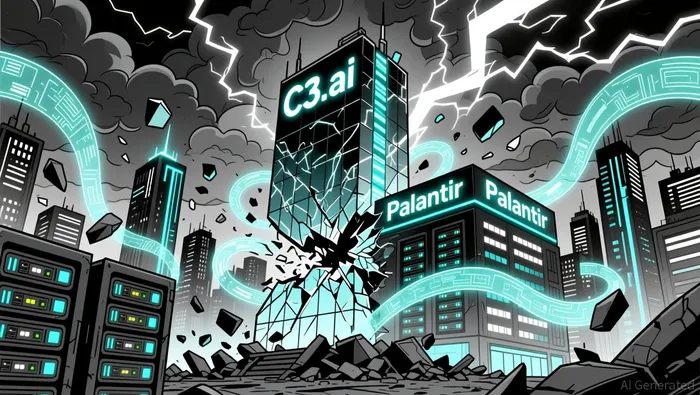
In contrast, Palantir TechnologiesPLTR-- (PLTR) demonstrates how strategic execution and financial discipline can insulate firms from broader sector volatility. For Q3 2025, PalantirPLTR-- reported $1.18 billion in revenue-a 62.8% year-over-year surge-and a 40.3% net margin, alongside $399 million in EBITDA (up 229% YoY). Its cash position of $6.44 billion and expanding partnerships, such as its collaboration with Nvidia, position it as a counterpoint to C3.ai's struggles. Yet even Palantir's forward P/E of 228.5x raises questions about whether its growth can sustain such lofty multiples.
Macro Risks: The Invisible Hand of Global Economics
The AI sector's volatility is not isolated from macroeconomic forces. A mixed September 2025 jobs report and delayed Federal Reserve rate cuts have heightened market uncertainty, contributing to a sharp post-earnings decline in Nvidia's stock despite strong results. This underscores a critical truth: AI firms, for all their technological promise, remain subject to the same macroeconomic pressures as traditional industries. Inflation, interest rates, and employment trends act as invisible levers, amplifying or dampening sector performance.
Investors must also grapple with circular investment structures, where leading AI firms act as both customers and suppliers, creating feedback loops that inflate valuations. This dynamic, coupled with speculative fervor, risks a repeat of past tech bubbles. As one Duke University analysis notes, "The current AI boom mirrors historical patterns", with valuations outpacing tangible productivity gains.
Strategic Positioning: Navigating the Bubble
For investors, the path forward requires a blend of caution and opportunism. Here are three key strategies:
Diversify Across Valuation Metrics: Avoid overconcentration in firms with unsustainable multiples. While Palantir's financials are robust, its forward P/E of 228.5x demands rigorous scrutiny. Conversely, C3.ai's low P/E of 6.4x may signal undervaluation-or a lack of confidence in its long-term prospects. A balanced portfolio should prioritize firms with strong cash flows and defensible market positions.
Prioritize Tangible Value Creation: Firms like C3.ai, despite their struggles, are deepening integrations with Microsoft's Copilot, Fabric, and Azure AI Foundry. Such partnerships can unlock long-term value, but investors must differentiate between strategic innovation and vaporware.
Hedge Against Macro Uncertainty: Given the sector's sensitivity to interest rates and inflation, investors should consider hedging strategies-such as short-term bonds or sector ETFs-to mitigate downside risk.
Conclusion: The Bubble Is Inevitable, But Not Inescapable
The AI sector's current trajectory is a mix of promise and peril. Stretched valuations, macroeconomic volatility, and speculative excess create a volatile cocktail. Yet for investors with a long-term horizon and disciplined approach, opportunities abound. The key lies in identifying firms that can weather the storm while leveraging AI's transformative potential. As the sector matures, those who balance innovation with prudence will emerge ahead.







Comentarios
Aún no hay comentarios