
The AI-Driven App Ecosystem Revolution: How OpenAI's Innovations Are Reshaping Tech Stock Valuations in 2026
The tech landscape in 2026 is being redefined by a seismic shift in app distribution dynamics, driven by artificial intelligence (AI) and software-as-a-service (SaaS) innovations. At the center of this disruption is OpenAI, whose strategic advancements in AI infrastructure and developer tools are challenging Apple's long-standing dominance over the App Store. For investors, this evolution presents both risks and opportunities, with implications for tech stock valuations that demand a reevaluation of traditional portfolio allocations.
OpenAI's AI Infrastructure: A New Paradigm for App Development
OpenAI's 2024 breakthroughs in generative AI and large language models (LLMs) have already demonstrated their potential to decentralize app development. According to a report by Sensor Tower, the AI app market generated $2 billion in revenue during the first eight months of 2024, with ChatGPT alone amassing 160 million downloads and $230 million in revenue. These figures underscore a critical trend: developers are increasingly leveraging AI to create apps that bypass traditional distribution channels, reducing reliance on platforms like Apple's App Store.
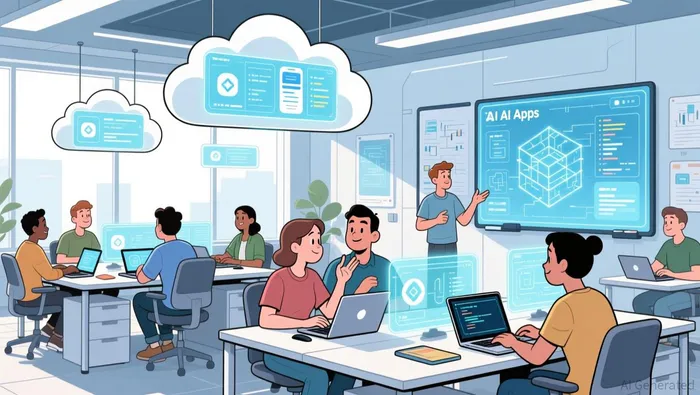
OpenAI's recent focus on infrastructure-such as scalable APIs, fine-tuning tools, and modular AI components-enables developers to build and deploy apps directly through cloud-based workflows. This shift aligns with the rise of SaaS models, where apps are delivered as services rather than discrete downloads. By lowering technical barriers and costs, OpenAI is empowering independent developers and startups to compete with Apple's ecosystem, which has historically favored established players through its curated, commission-based model.
Apple's App Store: Strengths and Vulnerabilities
Apple's App Store remains a cornerstone of the company's ecosystem, generating $406 billion in developer billings and sales in 2024, with 90% of transactions being commission-free for developers. The platform's success lies in its ability to balance user trust, security, and monetization while fostering innovation. However, its dominance is being tested by AI-driven alternatives that prioritize agility and open access.
Apple's 2025 AI strategy, which includes on-device machine learning frameworks and privacy-focused AI tools, is a defensive response to these challenges. Yet, its closed-system approach-while effective for maintaining quality control-struggles to match the scalability and cost efficiency of cloud-native AI solutions. As developers increasingly prioritize flexibility over exclusivity, Apple's 15-30% commission fees and strict approval processes risk alienating a new generation of AI-first creators.
SaaS and AI Infrastructure: The Investment Case for 2026
The convergence of AI and SaaS is reshaping tech stock valuations, with infrastructure providers and platform enablers emerging as key beneficiaries. OpenAI's partnerships with cloud providers and its rumored foray into enterprise AI-as-a-service models suggest a long-term strategy to monetize its infrastructure while indirectly undermining app store gatekeeping. For investors, this points to a structural advantage for companies that facilitate decentralized app distribution, such as cloud computing giants and AI middleware providers.
Conversely, Apple's stock valuation faces downward pressure if its App Store's role as a revenue generator diminishes. While the company's hardware ecosystem and services business remain resilient, the erosion of its app store dominance could impact its ability to sustain high multiples. Analysts project that by 2026, tech stocks tied to AI infrastructure and SaaS will outperform those reliant on traditional app store economics, reflecting a broader industry realignment.
Strategic Recommendations for Investors
To capitalize on these trends, investors should prioritize exposure to:
1. AI Infrastructure Providers: Companies offering scalable AI tools, cloud APIs, and developer platforms.
2. SaaS Enablers: Firms supporting modular, cloud-native app development and distribution.
3. Open-Source Ecosystems: Projects fostering decentralized app creation and interoperability.
Apple remains a formidable player, but its App Store's dominance is no longer a given in an era where AI and SaaS are democratizing access to app development. For 2026, the winners will be those who anticipate this shift and position portfolios accordingly.





Comentarios
Aún no hay comentarios