
The AI Data Center Boom and Its Systemic Risks for Energy and Infrastructure Markets
The artificial intelligence (AI) revolution has ignited a construction frenzy in data centers, driven by unprecedented debt financing and reshaping energy and infrastructure markets. While this boom underscores AI's transformative potential, it also raises critical questions about long-term sustainability, financial stability, and systemic risks.
Debt Financing: A Double-Edged Sword
The rapid expansion of AI data centers has been fueled by a surge in debt issuance. In 2025 alone, major tech firms-including OpenAI, MicrosoftMSFT--, and Amazon- raised over $121 billion in new debt, with UBS estimating AI-related project financing at $125 billion for the same period. Analysts project this trend could escalate to $1.5 trillion in additional borrowing by tech companies for AI infrastructure in the coming years.
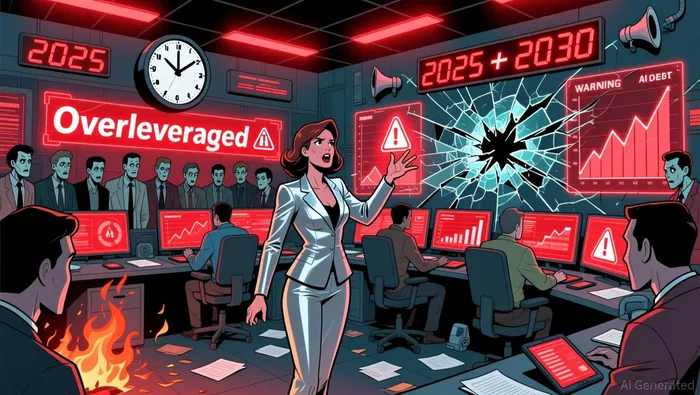
This debt-driven model mirrors speculative patterns seen during the dot-com bubble, raising concerns about overleveraging and asset devaluation. Smaller AI firms are particularly vulnerable, with some pledging expensive computer chips as collateral-assets that depreciate rapidly and could trigger defaults if AI valuations correct.
The Bank of England has warned that such high-growth, debt-laden sectors face heightened systemic risks if market optimism wanes. This is compounded by the fact that AI infrastructure projects often require multi-year timelines to yield returns, creating a mismatch between short-term debt obligations and long-term revenue generation.
Energy Infrastructure: A Bottleneck for Growth
Electricity supply has emerged as the most pressing constraint for AI data center expansion. By 2028, U.S. data centers are projected to consume 12% of the nation's electricity, with northern Virginia already allocating 25% of its state's power to data centers. This demand is straining grids, causing harmonic distortions, and delaying interconnection approvals for new projects. For instance, interconnection queues for generation projects have lengthened to seven years, exacerbating grid stress.
The environmental toll is equally alarming. A Cornell study estimates AI data centers could emit 24–44 million metric tons of CO₂ annually by 2030-equivalent to 5–10 million cars-and consume 731–1,125 million cubic meters of water yearly, rivaling the household usage of 6–10 million Americans. Even with aggressive decarbonization efforts, residual emissions will persist, requiring sustained investments in renewables to meet net-zero targets.
Regional Shifts and Strategic Adaptations
To mitigate energy constraints, data center developers are prioritizing "speed-to-power" over traditional site selection factors. Hyperscalers such as Google and AmazonAMZN-- are securing long-term renewable energy contracts and partnering directly with utilities to access low-cost, reliable power. This has led to a decentralization of data center hubs, with new clusters emerging in Texas, Nevada, and rural Louisiana and North Dakota.
However, this shift is not without challenges. Grid operators like PJM Interconnection and ISO-New England are revising tariffs and load forecasts to accommodate AI-driven demand, while states like Nevada and Oregon are rethinking cost-sharing rules to prevent ratepayer subsidization of grid upgrades. Despite these efforts, 79% of industry respondents in Deloitte's 2025 AI Infrastructure Survey project AI will increase power demand through 2035, outpacing infrastructure development.
Policy Responses and Grid Modernization
Federal and state governments are scrambling to address the AI-energy nexus. Executive Order 14318, issued in July 2025, accelerates permitting for AI data centers by streamlining environmental reviews and promoting the use of federal lands. The Department of Energy's "Speed to Power" initiative aims to fast-track grid upgrades, while FERC Order 2023 streamlines interconnection processes for large loads.
Transmission planning is also evolving. ISO-New England's 2025 update incorporated AI and crypto loads into its 10-year outlook, prompting proposals for new transmission lines. Idaho Power similarly fast-tracked a major transmission project to meet sudden data center demand. Yet, challenges persist: supply chain disruptions, rising material costs, and cybersecurity vulnerabilities threaten the pace and affordability of grid modernization.
Long-Term Sustainability: A Tenuous Balance
The long-term viability of the AI data center boom hinges on balancing innovation with sustainability. By 2035, U.S. data centers could require over 123 gigawatts of power-30 times current levels-straining energy grids and competing with agricultural and municipal water needs. While strategic site selection and grid decarbonization could reduce emissions by 73% and water usage by 86% compared to worst-case scenarios, the reliance on fossil fuels for 40% of new energy demand by 2030 remains a critical hurdle.
Conclusion: Navigating the Risks
The AI data center boom represents a pivotal moment for energy and infrastructure markets. While debt financing has enabled rapid growth, it has also introduced systemic risks that could destabilize both financial and environmental systems.
Policymakers, investors, and industry leaders must prioritize integrated resource strategies, accelerate grid modernization, and enforce cost-sharing equity to ensure sustainable AI development. As the sector evolves, the interplay between innovation and infrastructure resilience will define the next decade of technological progress.





Comentarios
Aún no hay comentarios