
The AI Chip Showdown at CES 2026: Nvidia, AMD, and Intel's Strategic Moves for Dominance
The 2026 Consumer Electronics Show (CES) served as a battleground for the semiconductor industry's most critical rivalry: the race to dominate the AI chip market. As artificial intelligence reshapes computing, NvidiaNVDA--, AMDAMD--, and IntelINTC-- unveiled bold strategies to capture market share, each leveraging distinct strengths while facing unique challenges. For investors, the post-CES landscape offers a clear lens to evaluate their long-term potential in a sector projected to grow at a blistering pace.
Nvidia: Consolidating Dominance with Full-Stack Innovation
Nvidia's position as the AI chip market leader remains unchallenged, with over 80% market share in Q1 2026, driven by its CUDA platform and full-stack solutions. At CES 2026, CEO Jensen Huang introduced the Vera Rubin superchip, promising five times the performance of its Blackwell predecessors for inference tasks. The company also expanded its physical AI vision with Cosmos, a physics-based simulation model, and Alpamayo, an autonomous driving solution integrated into the Mercedes-Benz CLA. These moves underscore Nvidia's ability to monetize AI across training, inference, and edge applications.
Financially, Nvidia's stock rose 39% in 2025, reflecting its dominance in data center demand fueled by hyperscalers like Amazon and Google. Analysts remain bullish, citing its projected $500 billion in free cash flow over three years and leadership in open AI models. However, risks loom: rising interest rates and regulatory scrutiny could pressure margins, while competitors like AMD and Intel gain traction with cost-effective alternatives.
AMD: Aggressively Scaling with Cost-Effective Solutions
AMD's strategy hinges on undercutting Nvidia's pricing while expanding its software ecosystem. The company launched the MI455 GPU and Helios data center system at CES 2026, emphasizing yottaflops-scale computing and a partnership with OpenAI. Its ROCm open software platform is gaining traction, addressing a key weakness in its historically weaker developer ecosystem. AMD also introduced Ryzen AI chips for PCs, targeting the growing AI PC market.
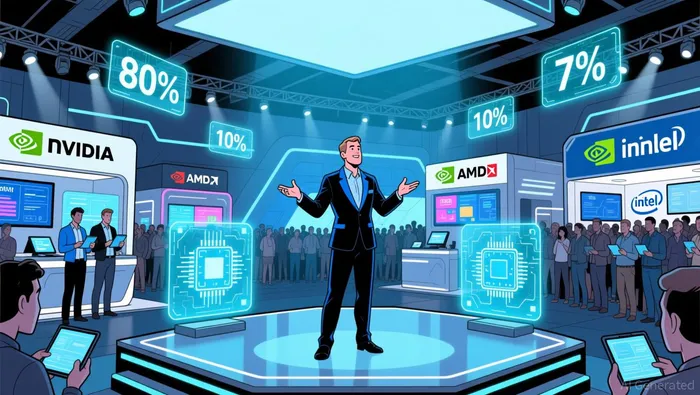
Financially, AMD's stock surged 77% in 2025 but faced a 90-day decline, reflecting volatility in its execution. Despite this, its 1-year total shareholder return of 73.63% and a projected fair value of $270 (vs. $221 current price) suggest undervaluation. Analysts highlight its potential to capture 15–20% of the AI accelerator market in 2026, leveraging lower-cost hardware for hyperscalers seeking alternatives to Nvidia. Yet, scaling production and software adoption remain hurdles.
Intel: Rebuilding Momentum with IDM 2.0
Intel's post-CES narrative centers on its IDM 2.0 strategy, which combines in-house manufacturing with foundry services to regain competitiveness. At CES 2026, it unveiled the Panther Lake (Core Ultra Series 3) AI chip for laptops, emphasizing 18A process technology and high-end gaming devices. While its stock rose 90% in 2025, driven by government funding and partnerships, analysts argue structural challenges persist. The company lacks a clear roadmap to displace Nvidia in data centers and faces skepticism about its ability to innovate in AI accelerators.
Intel's focus on AI PCs and edge computing positions it to benefit from the $3 trillion–$4 trillion data center spending boom by 2030. However, without a major customer win or breakthrough in AI-specific chips, its long-term growth remains uncertain.
Market Dynamics and Long-Term Outlook
The AI chip market is forecasted to grow from $118 billion in 2024 to $293–$295 billion by 2030, driven by AI inference, robotics, and edge computing. Nvidia's dominance is secure for now, but AMD's cost advantages and open ecosystem could erode its lead in price-sensitive segments. Intel's revival depends on executing IDM 2.0 and capturing AI PC demand.
For investors, the key differentiator lies in execution:
- Nvidia offers the most consistent growth but faces valuation risks as multiples expand.
- AMD balances growth and value, with upside potential if it scales software adoption.
- Intel remains a speculative bet, contingent on manufacturing improvements and strategic pivots.
Conclusion
CES 2026 highlighted a sector at an inflection point. Nvidia's full-stack leadership and AMD's aggressive pricing define the current competitive landscape, while Intel's resurgence hinges on operational execution. As AI adoption accelerates, the winner will be determined not just by chip performance but by ecosystem strength, pricing power, and adaptability to shifting demand. For now, Nvidia remains the safest bet, but AMD's momentum and Intel's strategic reinvention warrant close scrutiny in a market where innovation is the only constant.







Comentarios
Aún no hay comentarios