
The AI Chip Gold Rush: How Niche Innovators Like Groq Are Fueling Growth for Industry Titans
The AI chip market is on a trajectory to redefine global technology infrastructure, with a projected compound annual growth rate (CAGR) of 36.6% CAGR from 2025 to 2034. By 2034, the market is expected to balloon from its 2025 valuation of USD 19.67 billion to a staggering USD 326.02 billion. This meteoric rise is driven by the insatiable demand for AI across healthcare, automotive, and cloud computing, where specialized hardware is now a necessity rather than a luxury, according to a FinancialContent analysis. Yet, the most intriguing dynamic in this boom is not just the dominance of industry giants like NVIDIANVDA-- and AMDAMD-- but the disruptive role of niche players such as Groq. These startups are not merely challenging the status quo-they are catalyzing a renaissance in AI hardware innovation, indirectly bolstering the market positions of established leaders.
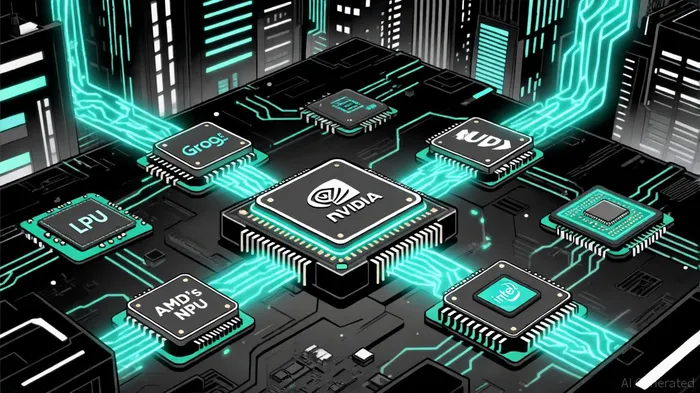
The Niche Revolution: Groq's LPU and the Inference Gold Rush
Groq, a Silicon Valley startup valued at $6.9 billion after a $750 million funding round, has emerged as a formidable contender by targeting a specific pain point: inference. While NVIDIA and AMD have long dominated the AI chip landscape with their GPUs, Groq's Language Processing Unit (LPU) is engineered for low-latency, high-speed inference tasks critical for applications like conversational AI and large language models (LLMs), according to a Motley Fool analysis. According to TechStartups, Groq's LPU outperforms traditional GPUs in inference workloads by up to 10x, offering a 50% reduction in power consumption.
This specialization is not a threat to NVIDIA or AMD but a complementary force. As enterprises increasingly shift from AI model training to deployment, the demand for inference-optimized hardware is surging. Groq's rise has spurred competitors to diversify their portfolios. For instance, AMD has introduced neural processing units (NPUs) tailored for edge AI, while NVIDIA continues to expand its ecosystem with software tools that abstract hardware complexity, as noted in the FinancialContent analysis. The result? A broader market for AI chips, where niche players like Groq act as accelerants, pushing incumbents to innovate and capture new segments.
The Ripple Effect: How Niche Players Benefit Industry Leaders
The AI chip market's growth is not a zero-sum game. Groq's focus on inference has inadvertently expanded the total addressable market for NVIDIA and AMD. As noted in a FinancialContent analysis, NVIDIA's 86% share of the AI GPU segment is sustained by its robust software ecosystem, which integrates seamlessly with emerging hardware. Startups like Groq, despite their specialization, often rely on NVIDIA's CUDA framework or AMD's ROCm for compatibility, creating a symbiotic relationship.
Moreover, Groq's success has intensified competition, driving down costs and accelerating R&D. For example, NVIDIA's recent launch of the H200 GPU-a lower-power variant of its H100-directly addresses the cost and efficiency challenges highlighted by niche players. Similarly, AMD's collaboration with cloud providers to optimize NPUs for inference workloads mirrors Groq's strategy but leverages AMD's existing infrastructure. This competitive pressure benefits investors, as it fosters innovation while maintaining the market leadership of established players.
Future Outlook: Challenges and Opportunities
Despite the optimism, challenges loom. High R&D costs and supply chain bottlenecks remain significant hurdles for startups, as highlighted in the FinancialContent analysis. Groq, for instance, faces the daunting task of scaling its LPU production while ensuring compatibility with existing software stacks. Meanwhile, NVIDIA and AMD must balance their investments in general-purpose GPUs with the need to develop specialized architectures for edge AI and quantum computing.
However, the long-term outlook remains bullish. A 2025 report by BusinessResearchInsights predicts that neuromorphic computing and wafer-scale integration will redefine AI chip performance by 2030. These advancements, coupled with the proliferation of edge AI (which accounts for 60% of new installations), will create opportunities for both niche players and industry leaders. For investors, the key is to identify companies that can adapt to this fragmented landscape-those that innovate without losing sight of ecosystem compatibility.
Conclusion: A Market of Winners
The AI chip industry is entering an era of specialization and collaboration. Niche players like Groq are not disruptors but enablers, driving demand for tailored solutions while reinforcing the dominance of NVIDIA and AMD through indirect means. For investors, this dynamic presents a dual opportunity: to capitalize on the explosive growth of the AI chip market while hedging against risks by diversifying across both innovators and incumbents. As the industry evolves, the true winners will be those who recognize that the future of AI is not a single chip but a constellation of technologies working in harmony.





Comentarios
Aún no hay comentarios