
Is the AI Chip Boom Sustainable Beyond Short-Term Hype?
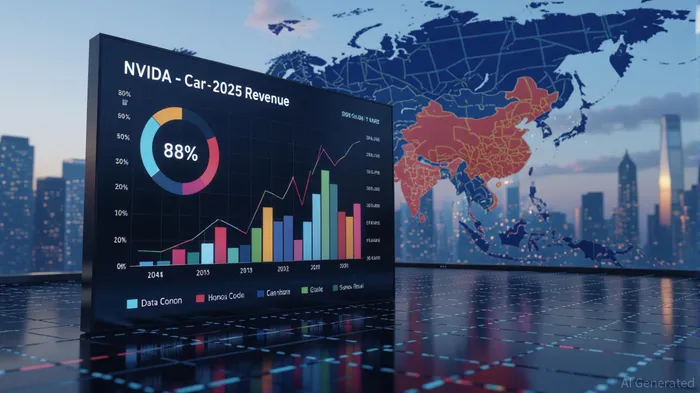
The AI chip industry is at a crossroads. On one hand, Nvidia’s Q2 2025 revenue of $46.7 billion—88% from data center AI chips—proves the sector’s explosive demand [1]. On the other, geopolitical headwinds and market saturation risks threaten to derail long-term growth. For investors, the question is whether this boom is a fleeting frenzy or a durable transformation. Let’s dissect the numbers and narratives.
Geopolitical Risks: A Double-Edged Sword
Nvidia’s dominance in AI chips is undeniable, but its reliance on the Chinese market—a $50 billion opportunity—has been stifled by U.S. export controls. The Trump administration’s 15% tax on H20 chip sales to China, coupled with a ban on H20 exports, forced NvidiaNVDA-- to write off $4.5 billion in excess inventory [3]. This policy, while intended to protect U.S. tech leadership, risks alienating customers and eroding gross margins. Worse, China’s Cambricon and Huawei are surging, with Cambricon’s revenue jumping 4,300% in H1 2025 [2]. If domestic alternatives gain traction, Nvidia’s “land grab” in China could stall.
Yet, Nvidia isn’t standing still. Its modified H20 chip, compliant with U.S. rules but retaining 80% of the original’s performance, shows adaptability [5]. The tentative approval of a China-specific Blackwell variant (B30A) also hints at a potential path forward—if the 15% tax dispute is resolved. For now, though, the company’s Q3 revenue forecast hinges on resolving these uncertainties [6].
Market Saturation: The AI Bubble Debate
The AI chip market’s growth is staggering. By 2030, it could hit $459 billion, driven by generative AI and HPC [3]. But investors are asking: Is this a bubble? Nvidia’s Q2 growth forecast for Q3 2025 dropped to 50-55% from previous 100%+ rates [2]. This moderation reflects two realities:
1. Diminishing returns: Hyperscalers like GoogleGOOGL-- and AmazonAMZN-- are designing custom ASICs (e.g., Google’s TPUs) to cut costs and reduce dependency on third-party chips [5].
2. Competition intensifies: AMD’s Instinct MI300X offers a cheaper alternative to Nvidia’s H100, while startups like Cerebras and Groq are innovating in niche AI workloads [1].
However, Nvidia’s moat remains formidable. Its CUDA ecosystem and Blackwell Ultra’s 15 petaFLOPS NVFP4 performance create a sticky environment for developers [1]. Networking revenue, which surged 98% YoY to $7.3 billion in Q2, also underscores its infrastructure dominance [3].
The Long Game: Innovation vs. Margin Pressures
Nvidia’s Q3 revenue forecast of $54 billion (±2%) suggests demand is far from peaking [6]. But sustaining this growth requires navigating two hurdles:
- R&D costs: The Blackwell platform’s development and upcoming GB300 racks demand heavy investment, which could pressure margins [4].
- Geopolitical volatility: A legal challenge to the 15% tax or a shift in U.S. policy could destabilize revenue streams.
Yet, the company’s strategic pivot—focusing on Networking and HBM3e memory—positions it to capitalize on the “AI factory era” [1]. If the U.S. and China can negotiate a compromise on chip exports, even a fraction of the $50 billion Chinese market could offset near-term losses.
Verdict: A Calculated Buy
Nvidia’s stock is a high-conviction play. While geopolitical risks and market saturation are real, the company’s technological edge and ecosystem dominance give it a fighting chance to outlast rivals. For investors, the key is to balance optimism with caution:
- Buy if you believe in the AI revolution’s longevity and Nvidia’s ability to adapt.
- Wait if you’re wary of margin pressures or a regulatory crackdown.
The AI chip boom isn’t just hype—it’s a structural shift. But whether it sustains itself depends on Nvidia’s agility in a world where geopolitics and innovation collide.
Source:
[1] Nvidia's AI Growth and Geopolitical Risks: A Calculated Play [https://www.ainvest.com/news/nvidia-ai-growth-geopolitical-risks-calculated-play-2025-2508/]
[2] AI Chip Market Size and Forecast | 2025–2030 [https://www.nextmsc.com/report/artificial-intelligence-chip-market]
[3] The Legal and Geopolitical Risks in U.S. Tech Export [https://www.ainvest.com/news/legal-geopolitical-risks-tech-export-deals-china-2508]
[4] Navigating Geopolitical Risk in the AI Chip Sector [https://www.ainvest.com/news/navigating-geopolitical-risk-ai-chip-sector-nvidia-remains-strategic-buy-chinese-restrictions-2508]
[5] Nvidia's strong Q2 results can't mask the ASIC challenge in their future [https://venturebeat.com/ai/nvidias-strong-q2-results-cant-mask-the-asic-challenge-in-their-future/]
[6] NVIDIA Q2 FY 2026 Results: Networking Steals the Spotlight [https://futurumgroup.com/insights/nvidia-q2-fy-2026-earnings-networking-steals-the-spotlight/]





Comentarios
Aún no hay comentarios