
The AI Chip Arms Race: Oracle's Strategic Shift to AMD and Broadcom's New AI Chip
The AI chip arms race has entered a new phase, with OracleORCL-- and BroadcomAVGO-- making bold moves to disrupt the status quo dominated by NvidiaNVDA-- and traditional cloud providers. These strategic shifts-Oracle's partnership with AMDAMD-- to deploy next-generation AI hardware and Broadcom's development of the Thor Ultra networking chip-signal a seismic shift in the competitive and capital dynamics of the cloud computing and AI infrastructure markets. For investors, understanding the implications of these alliances is critical to navigating a rapidly evolving landscape.
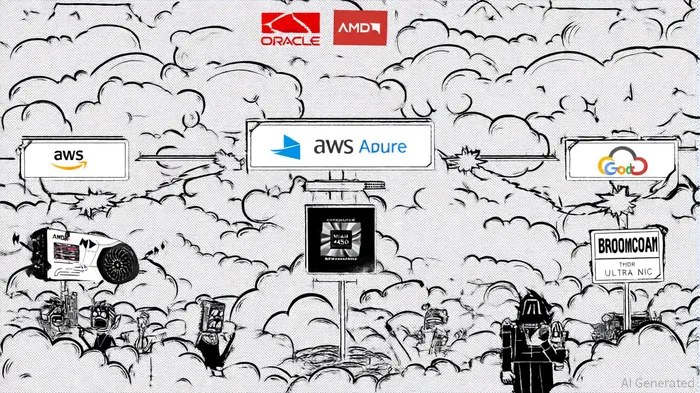
Oracle's Strategic Shift to AMD: Diversification and AI-First Infrastructure
Oracle's collaboration with AMD represents a calculated effort to diversify its AI hardware ecosystem and challenge Nvidia's hegemony. By deploying 50,000 AMD Instinct MI450 GPUs starting in Q3 2026, Oracle is leveraging AMD's Helios rack-scale design, which integrates MI450 GPUs with EPYC Venice CPUs and Pensando networking. This architecture enables Oracle to offer high-performance, energy-efficient AI training and inference capabilities, positioning it as a viable alternative to AWS and Azure [1].
The partnership aligns with Oracle's broader AI-first strategy, which includes a $300 billion multiyear contract with OpenAI and a projected revenue surge from $10 billion in fiscal 2025 to $144 billion by 2030 [2]. Oracle's recent integration of its Autonomous Database and Exadata services into AWS, Azure, and Google Cloud ecosystems further underscores its focus on multicloud flexibility, a key differentiator in an era where enterprises demand workload portability and cost optimization [3].
However, Oracle's success hinges on its ability to scale AI infrastructure rapidly. While the 50,000-GPU deployment is significant, it pales in comparison to AWS's 300,000+ GPU clusters. Yet, Oracle's emphasis on open standards and reduced vendor lock-in could attract enterprises wary of Nvidia's dominance, particularly in sectors like healthcare and finance where cost efficiency and regulatory compliance are paramount [4].
Broadcom's Thor Ultra: Redefining AI Networking and Custom Silicon
Broadcom's entry into the AI chip race with the Thor Ultra 800G Ethernet NIC marks a paradigm shift in networking infrastructure. Designed to interconnect clusters of 100,000+ XPUs, the Thor Ultra addresses critical bottlenecks in AI workloads through advanced RDMA features, programmable congestion control, and line-rate encryption [5]. This innovation is part of Broadcom's broader strategy to support OpenAI's custom "Titan XPU" accelerators, a $10+ billion partnership aimed at reducing OpenAI's reliance on Nvidia GPUs [6].
The Thor Ultra's integration with Broadcom's Tomahawk 6 and Jericho4 switches positions the company as a pivotal player in the AI networking stack. For cloud providers, this means access to a scalable, secure, and interoperable infrastructure that can support trillion-parameter models-a necessity as AI workloads grow in complexity. The partnership with OpenAI also signals a broader industry trend: the shift toward custom silicon tailored to specific AI applications, a move that could erode margins for general-purpose GPU vendors like Nvidia [7].
Competitive and Capital Implications
The Oracle-AMD and Broadcom-OpenAI alliances are reshaping the competitive landscape in three key ways:
Vendor Diversification: Oracle's move to AMD and Broadcom's collaboration with OpenAI reduce the cloud industry's reliance on Nvidia, fostering a more fragmented but innovative market. This diversification could drive down costs for enterprises while accelerating R&D in alternative architectures like AMD's Instinct and Broadcom's XPUs [8].
Capital Intensity and ROI: Both partnerships require substantial upfront investment. Oracle's AI infrastructure expansion and Broadcom's Thor Ultra production involve significant R&D and manufacturing costs. However, the potential ROI is immense: Oracle's projected $144 billion in AI cloud revenue by 2030 and Broadcom's $10+ billion OpenAI deal highlight the financial stakes [9].
Market Positioning: Oracle's AI-first cloud and Broadcom's networking expertise position them to capture market share from AWS and Azure. Oracle's multicloud strategy, in particular, challenges the dominance of AWS and Azure by offering seamless integration across ecosystems-a critical advantage for enterprises adopting hybrid cloud models [10].
Conclusion: Navigating the AI Infrastructure Revolution
The AI chip arms race is no longer a niche battle-it's a defining investment opportunity of the 2020s. Oracle's strategic shift to AMD and Broadcom's Thor Ultra exemplify how cloud providers are redefining their hardware alliances to secure competitive advantages. For investors, the key questions are: Can Oracle scale its AI infrastructure to rival AWS and Azure? Will Broadcom's networking solutions become the backbone of next-generation AI clusters? And how will these developments impact Nvidia's dominance?
The answers lie in execution. Oracle's ability to deliver on its AI revenue projections and Broadcom's success in scaling the Thor Ultra will determine whether these alliances translate into sustainable market leadership. In the meantime, the capital influx into AI infrastructure-driven by partnerships like these-ensures that the race will only intensify.





Comentarios
Aún no hay comentarios