
The AI Bubble and Its Implications for Long-Term Tech Equity Exposure
The current frenzy around artificial intelligence has created a paradox: unprecedented optimism about AI's transformative potential coexists with growing concerns about speculative excess. For investors, the question is no longer whether AI will reshape the economy but whether the market's exuberance has priced in too much of the future too quickly. As valuation metrics for leading AI-driven tech equities stretch historical norms, the debate over whether this represents a buying opportunity or a cautionary risk has intensified.
Valuation Metrics: A Sector on the Edge
The S&P 500 Information Technology Sector's price-to-earnings (P/E) ratio of 40.35 as of December 3, 2025, far exceeds its five-year average range of [27.27, 34.97], signaling a market that many analysts deem "expensive". This is not merely a sector-wide phenomenon but a concentration of value in a handful of AI-focused giants. NVIDIANVDA--, for instance, commands a price-to-book (P/B) ratio of 29.5, while MicrosoftMSFT-- and AlphabetGOOGL-- trade at 10.9 and 6.79, respectively according to market analysis. These figures dwarf the S&P 500's weighted average P/B ratio of 5.2 according to Vanguard data, underscoring the premium investors are willing to pay for perceived leadership in AI.
Enterprise value-to-EBITDA (EV/EBITDA) ratios further highlight the divergence. NVIDIA's LTM EV/EBITDA of 38.6x in 2025, while down from its peak of 57.6x, remains significantly higher than the sector's average. Alphabet's EV/EBITDA of 13.16, by contrast, appears undervalued relative to its peers, suggesting divergent market expectations for AI integration across the sector. 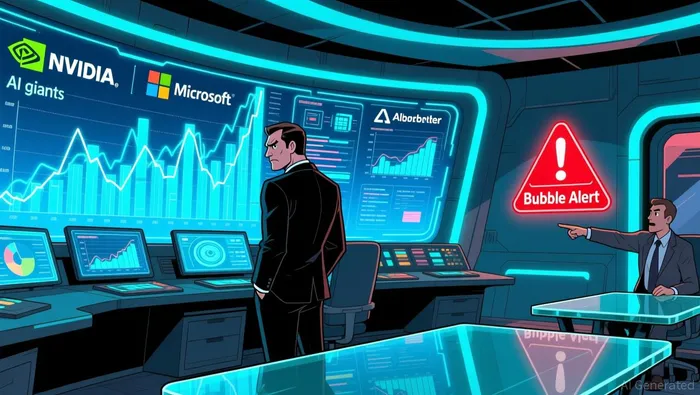
Growth vs. Sustainability
The justification for these valuations rests on robust growth metrics. Microsoft's cloud revenue grew 26% year-over-year in the most recent quarter, with analysts projecting a 13.5% compound annual earnings growth rate. NVIDIA's market cap recently surpassed $5 trillion, a historic milestone for a publicly traded company, driven by its dominance in AI chip manufacturing. Yet, as the S&P 500 Tech Sector's contribution to total earnings declined slightly to 20.8% in Q3 2025 from 22.8% earlier in the year, the sustainability of this growth remains in question.
The disconnect between investment and returns is another red flag. AI-related capital expenditures have become a primary driver of economic growth in 2025, but many organizations report no meaningful return on these investments. This mismatch between spending and outcomes raises concerns about overinvestment, with some analysts comparing the current AI frenzy to the dot-com and housing bubbles.
Expert Warnings: A Cautionary Consensus
The warnings are coming from all corners. The International Monetary Fund (IMF) and the Bank of England have both flagged the risks of an AI-driven equity bubble. Andrew Bailey, the Bank of England Governor, emphasized the uncertainty surrounding future earnings from technology companies, even as they contribute to productivity gains. Goldman Sachs CEO David Solomon has warned of a likely 10-20% drawdown in equity markets within two years.
Critics argue that the current AI boom differs from past bubbles in key ways. Unlike the speculative tech markets of the 1990s, today's AI investments are often backed by multi-year enterprise contracts and infrastructure demand. However, this does not eliminate risk. The systemic concentration of power among a few major players-Microsoft, Apple, Google, Amazon, Meta, and Nvidia-means that a single misstep could trigger cascading failures across interlinked AI and infrastructure companies according to Bloomberg analysis. A data-center lease cancellation, for example, could ripple through financiers, investors, and utility providers, creating broader economic shocks.
Strategic Implications for Investors
For long-term investors, the challenge lies in balancing the transformative potential of AI with the risks of overvaluation. The sector's growth is undeniably real, but the question is whether current prices reflect not just near-term momentum but also the long-term value of AI's integration into global industries.
A prudent approach would involve diversifying exposure across the AI ecosystem. While leading equities like NVIDIA and Microsoft offer growth potential, their valuations leave little room for error. Investors might also consider under-the-radar players in AI infrastructure, data management, or niche applications, where valuations are less stretched and innovation is still emerging.
Moreover, the macroeconomic context cannot be ignored. As AI-related capital expenditures drive growth, central banks and regulators must navigate the tension between fostering innovation and preventing systemic instability. Investors should monitor policy shifts and sector-specific regulations that could reshape the landscape.
Conclusion
The AI bubble, if one exists, is not a monolith. It is a complex interplay of speculative fervor, genuine innovation, and structural risks. For investors, the key is to avoid binary thinking. AI is not a passing fad, but the current valuation metrics suggest that the market is pricing in a future that may not materialize for years-or at all. The opportunity lies in discerning which companies are building durable value and which are merely riding the hype. In the words of one analyst, "The real risk is not in the bubble itself but in how correlated market players might react to incremental failures in the AI narrative" according to Bloomberg analysis. For now, patience and discipline may be the best strategies.





Comentarios
Aún no hay comentarios