
Is the AI Boom a Structural Revolution or a Cyclical Bubble?
The artificial intelligence (AI) boom of 2025 has ignited a frenzy of investment, innovation, and speculation. With generative AI spending surging to $37 billion in 2025-a 3.2x jump from 2024-and 78% of enterprises integrating AI into at least one business function, the sector appears to be on a trajectory of irreversible transformation. Yet, beneath the surface of this optimism lies a critical question: Is this AI-driven growth a structural revolution or a cyclical bubble primed to burst?
Parallels with the Dot-Com Bubble
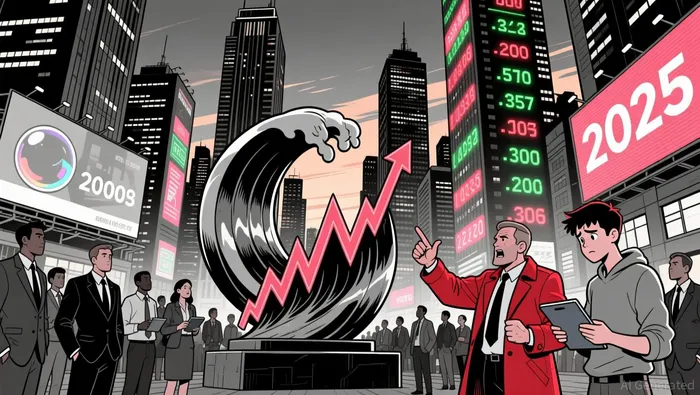
The echoes of the 1999 dot-com bubble are impossible to ignore. Rajiv Jain of GQG Partners, a firm known for its contrarian stance, has sounded the alarm, comparing today's AI valuations to the speculative excesses of the late 1990s. "The circular pattern of financial engineering-vendor financing, speculative spending, and extreme valuations-mirrors the dot-com era," Jain warned, noting that 5,000 Chinese AI firms now exist, many of which are unprofitable.
Historical data reinforces these parallels. During the dot-com bubble, the Nasdaq-100's price-to-sales (P/S) ratio peaked at 2.87 in 2000, while the S&P 500's P/S ratio in late 2025 has surpassed this at 3.23. Moreover, 13% of the S&P 500 by index weight trades at over 20x P/S, a figure higher than the 11% peak in 2000. These metrics suggest a market increasingly driven by speculative bets on future growth rather than current profitability.
Valuation Metrics: Structural Potential vs. Cyclical Risks
While the parallels are striking, key divergences exist. Unlike the dot-com era, where many companies lacked revenue, today's AI leaders-such as NVIDIANVDA--, Microsoft, and Apple-are profitable. NVIDIA, for instance, dominates 92% of the discrete GPU market in 2025, a critical asset for AI infrastructure. However, the sector's valuation remains precarious. GQG Partners has exited its remaining tech positions, citing "limited evidence of meaningful returns" from AI projects.
Capital allocation patterns further highlight the tension between structural and cyclical forces. In 2025, over half of enterprise AI spending is directed toward applications rather than infrastructure, reflecting a focus on immediate productivity gains. Yet, this shift contrasts with the dot-com era, where infrastructure (e.g., fiber optics) was built to last decades. Today's AI infrastructure, particularly GPU-driven data centers, depreciates rapidly-GPUs lose value within one to two years. This short lifecycle raises questions about the sustainability of current capital expenditures.
GPU Trends and Infrastructure Efficiency
The GPU market, a cornerstone of AI infrastructure, reveals both promise and peril. Hyperscalers alone are projected to spend over $300 billion on AI infrastructure in 2025, with NVIDIA's dominance (92% market share) underscored by its Rubin architecture, which claims a 40% improvement in energy efficiency. However, inefficiencies persist: enterprises report GPU utilization below 70%, inflating costs and stifling innovation.
Emerging trends, such as the rise of application-specific integrated circuits (ASICs), may disrupt NVIDIA's hegemony. Custom processors from Broadcom and Marvell are gaining traction, offering better power efficiency for specific tasks. By 2026, ASIC shipments are projected to grow 44%, outpacing GPU growth of 16%. This shift signals a maturing AI hardware landscape but also underscores the risk of overinvestment in legacy infrastructure.
Capital Allocation: Applications vs. Infrastructure
The current AI boom mirrors the dot-com era's speculative fervor in capital allocation. Venture capital funding for AI startups reached 58% of global VC investments in early 2025, echoing the 80% of VC capital directed to internet companies in 1999–2000. However, unlike the dot-com era, today's AI applications are more integrated into the global economy. Over 70% of companies use AI by 2024, suggesting a broader, more durable foundation than the dot-com era's niche internet businesses.
Yet, the sector's reliance on speculative spending remains a concern. For example, 78% of enterprise AI adoption in 2025 is driven by immediate productivity gains, but many projects fail to deliver scalable returns. This dynamic mirrors the dot-com era's "get big fast" strategy, where growth metrics trumped profitability.
A Contrarian Valuation Framework
To navigate this duality, investors must adopt a contrarian lens. Structural potential lies in AI's ability to transform industries-from healthcare to manufacturing-via automation and data-driven decision-making. NVIDIA's dominance in GPUs, the rise of HBM (high-bandwidth memory), and the integration of AI into mixed reality and autonomous systems all point to long-term value.
However, cyclical risks are equally pronounced. The global memory chip shortage, driven by AI demand, has pushed DRAM and NAND prices to unsustainable levels. PC prices are projected to rise by 8% in 2026, and AI PCs with NPUs require costly 16GB–32GB RAM configurations. These pressures could trigger a correction if demand outpaces supply.
Conclusion: Balancing the Revolution and the Bubble
The AI boom is neither a pure structural revolution nor a straightforward cyclical bubble. It is a hybrid phenomenon, where transformative potential coexists with speculative overreach. For investors, the key lies in hedging against overvaluation while capitalizing on AI's durable applications.
Rajiv Jain's warnings serve as a cautionary note: "The risks of an AI bubble blow-up are growing," he stated. Yet, the sector's integration into core industries and the emergence of energy-efficient hardware (e.g., NVIDIA's Rubin, ASICs) suggest a path to sustainable growth. The challenge is to distinguish between AI's foundational innovations and the froth of speculative hype-a task requiring rigorous valuation analysis and a contrarian mindset.







Comentarios
Aún no hay comentarios