
AI in Banking: Labor-Neutral Efficiency Gains and Long-Term Profitability Drivers
The integration of artificial intelligence (AI) into banking is reshaping the industry's operational and financial landscape. As institutions increasingly adopt AI-driven tools, the focus has shifted from isolated use cases to systemic efficiency gains and profitability enhancements. This analysis examines how AI is delivering labor-neutral productivity improvements-where output increases without proportional workforce expansion-and how these advancements are translating into long-term financial metrics for banks.
Labor-Neutral Efficiency Gains: A Productivity Revolution
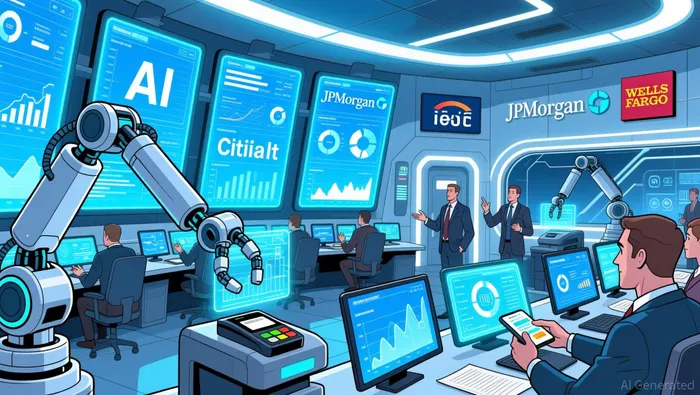
AI is enabling banks to achieve significant productivity gains without immediate reductions in headcount, a critical factor for institutions navigating regulatory and labor market constraints. JPMorgan Chase has reported doubling productivity in certain operational functions, with expectations of 40–50% gains as AI becomes embedded in routine workflows. Similarly, Citigroup has observed a 9% productivity increase in software development, driven by AI-assisted coding and documentation. Wells Fargo CEO Charlie Scharf noted that the bank is accomplishing more work with the same number of employees, signaling a shift toward efficiency-driven growth.
 These gains are not limited to large institutions. PNC Financial's CEO Bill Demchak emphasized that AI acts as an accelerant to the bank's decade-long automation efforts, maintaining stable staffing levels despite significant business growth. The broader trend, as highlighted by PwC Strategy&, is that banks fully embracing AI could see a 15-percentage-point improvement in their efficiency ratio-a key indicator of operational health. This transformation is driven by automating routine tasks (e.g., document processing, loan underwriting) and leveraging AI to personalize customer interactions, generating new revenue streams.
Long-Term Profitability: From Cost Savings to Strategic Advantage
Beyond immediate cost reductions, AI is redefining long-term profitability through enhanced risk management, customer insights, and revenue diversification. Santander's use of AI-driven predictive analytics to proactively manage loan defaults has reduced default rates and optimized resource allocation. Meanwhile, JPMorgan's AI-powered contract analysis tool has saved 360,000 work hours annually, directly contributing to cost savings.
McKinsey's 2025 Global Banking Annual Review estimates that AI could unlock $2 trillion in global economic value for banks through improved efficiency and customer insights. However, the effectiveness of AI investments varies: only 4 out of 50 banks analyzed in 2025 reported measurable ROI from their AI initiatives. This disparity underscores the importance of strategic implementation. Banks that successfully integrate AI-such as those leveraging generative AI for hyper-personalized customer service or real-time fraud detection-are likely to see a competitive edge in cost optimization and customer retention.
Challenges and Risks: Scaling AI Responsibly
Despite the promise, challenges persist. Fragmented data infrastructures and macroeconomic uncertainties pose risks to scaling AI at industrial levels. Additionally, the rise of agentic AI introduces operational and financial risks, including herding behaviors and privacy concerns. While automation reduces the need for routine roles, it also increases demand for technical expertise, necessitating workforce reskilling.
Conclusion: A Strategic Imperative for Investors
AI adoption in banking is no longer experimental but strategic. Institutions that prioritize precision in AI integration-focusing on high-friction workflows and customer-centric innovations-are poised to outperform peers in both efficiency and profitability. For investors, the key differentiator will be banks that balance short-term productivity gains with long-term strategic alignment, ensuring sustainable value creation in an increasingly AI-driven financial landscape.







Comentarios
Aún no hay comentarios