
The AI Automotive Divide: Why Only a Few Automakers Will Lead the Next Era of Innovation
The automotive industry stands at a crossroads. For years, the promise of artificial intelligence has driven a wave of optimism, with nearly all automakers-legacy and new alike-pouring resources into AI-driven innovation. But as the dust settles, a stark reality emerges: the future of the industry will be defined not by broad participation, but by a narrow cohort of leaders with the software expertise, leadership vision, and long-term commitment to AI that others lack. According to a report by Gartner, by 2029, only 5% of automakers will sustain strong AI investment growth, a precipitous drop from the current 95% of companies actively pursuing AI. This shift signals the emergence of an "AI automotive divide," where the winners will be those who treat AI not as a buzzword but as a foundational pillar of their business.
The AI Maturity Gap: Software as the New Engine of Competition
The root of this divide lies in software capabilities. Legacy automakers, long built on mechanical engineering and physical manufacturing, are now racing to catch up with tech-native competitors like TeslaTSLA-- and BYD, which have embedded software into their DNA from the outset. Gartner analysts argue that only automakers with "robust software foundations" will thrive in this new era. For example, Tesla's over-the-air updates and data-driven vehicle improvements have set a benchmark that traditional manufacturers struggle to match. Meanwhile, Volkswagen and others face internal obstacles, including outdated mindsets and fragmented organizational structures, that hinder their ability to scale AI initiatives.
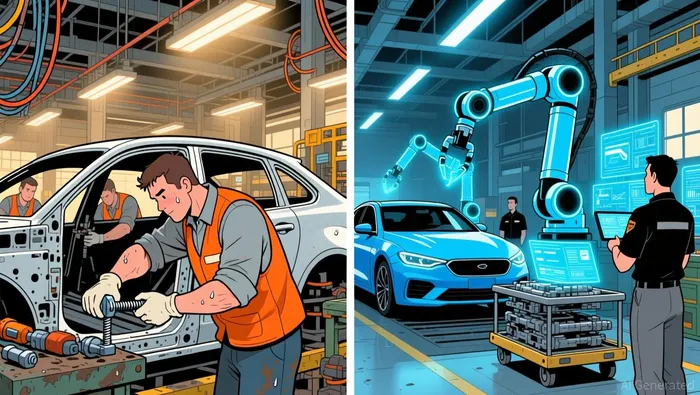 This gap is not merely technical-it is cultural. As Pedro Pacheco, a Gartner analyst, notes, success in AI requires automakers to become "digital-first" organizations, where software leaders report directly to CEOs and technology decisions are prioritized at the highest levels according to Gartner analysis. Legacy firms, however, often treat software as a siloed function, delaying integration and stifling innovation. The result? A widening chasm between those who can leverage AI to optimize everything from autonomous driving to supply chain management and those who cannot.
The Investment Implications: Where to Allocate Capital
For investors, the implications are clear: the next decade will reward those who back automakers with long-term AI strategies and penalize those clinging to short-term, fragmented approaches. Gartner's prediction that only 5% of automakers will sustain AI investment growth by 2029 underscores the urgency of this decision. Consider the data: organizations adopting an "AI-first" strategy are projected to achieve 25% better business outcomes than their peers by 2028 according to Gartner research. This is not just about incremental improvements-it is about redefining competitive advantage in an industry where software now rivals hardware in importance.
The contrast between Tesla and legacy automakers is instructive. Tesla's stock has consistently outperformed traditional automakers, driven by its ability to monetize software through features like Full Self-Driving and its vast data trove. In contrast, companies like Volkswagen, despite significant investments, remain hampered by bureaucratic inertia and a lack of cohesive digital strategy. For investors, the lesson is straightforward: prioritize exposure to firms where AI is not an afterthought but a core competency.
The Road Ahead: A Call for Strategic Patience
The automotive AI race is not for the faint of heart. It demands not only capital but also the willingness to disrupt legacy business models and embrace a culture of continuous innovation. Yet for those who recognize the scale of the opportunity, the rewards are immense. As the industry transitions from combustion engines to code, the automakers that will dominate the next era are those that have already built the software foundations to lead it.
In this context, the Gartner forecast is not a warning but a guidepost. It reminds us that the future belongs to the few who are willing to bet big on AI-and to bet even bigger on the people and processes needed to make it work. For investors, the question is no longer whether to invest in AI-driven automakers, but which ones to back before the divide becomes insurmountable.





Comentarios
Aún no hay comentarios