
Ahold Delhaize: Navigating Macroeconomic Headwinds Through Strategic Pricing, Digital Resilience, and E-Commerce Profitability
In an era marked by inflationary pressures, geopolitical tensions, and currency volatility, Ahold Delhaize (AHDX) has emerged as a standout example of how strategic pricing, digital transformation, and e-commerce profitability can drive long-term shareholder value. The company's 2025 “Growing Together” initiative has not only stabilized margins but also positioned it to outperform peers in a challenging macroeconomic landscape. By balancing short-term margin pressures with long-term market share gains, Ahold Delhaize is proving that resilience and innovation can coexist in the grocery sector.
Strategic Pricing: A Balancing Act Between Competitiveness and Margin Resilience
Ahold Delhaize's pricing strategy in 2025 reflects a disciplined approach to navigating inflation and consumer sensitivity. In the U.S., brands like Giant Food and Stop & Shop have rolled out targeted price reductions on hundreds of own-brand products, while Albert Heijn in Europe expanded its AH Terra line to 350 products, with 20% offered at everyday low prices. These initiatives are not mere cost-cutting measures but calculated investments to strengthen customer loyalty and market share.
The results are evident in the company's Q1 2025 performance: despite a 0.2 percentage point decline in U.S. operating margins (to 4%), the strategic pricing actions have accelerated growth and offset supply chain pressures. Europe's stable margins (3.7%) and the U.S.'s 4.4% operating margin demonstrate the effectiveness of this balanced approach. Ahold Delhaize's ability to absorb margin dilution while expanding its customer base underscores its operational scale and pricing agility.
Digital Transformation: The Engine of E-Commerce Profitability
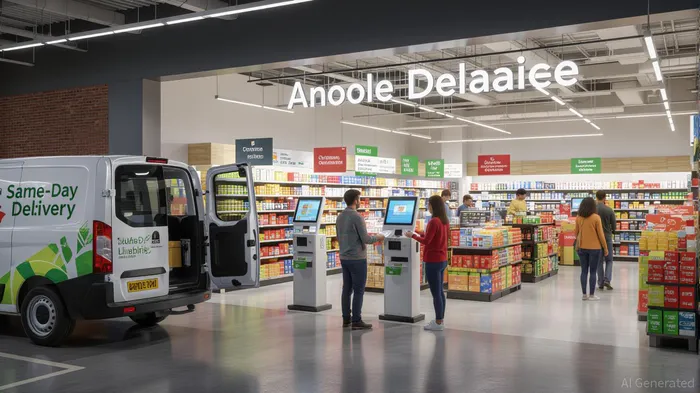
Ahold Delhaize's digital transformation has been a cornerstone of its resilience. In Q2 2025, the company achieved a landmark milestone: e-commerce profitability on a fully allocated basis. Online sales surged 14.4% at constant exchange rates, driven by 16.4% growth in the U.S. and 12.7% in Europe. This success stems from strategic shifts such as adopting less asset-intensive same-day delivery models, automating operations, and leveraging retail media propositions.
The rollout of PRISM, a proprietary e-commerce platform, at Food Lion and its planned expansion to Hannaford, exemplifies the company's commitment to scalable digital infrastructure. In Europe, Delhaize doubled its e-commerce capacity in Belgium with a new distribution center in Vorst, while Albert Heijn's B2B e-commerce sales grew by over 10%. These investments have not only improved efficiency but also enhanced customer convenience, a critical factor in retaining shoppers during economic uncertainty.
Margin Resilience and Capital Allocation: Building a Foundation for Growth
Ahold Delhaize's margin resilience is further supported by cost-saving initiatives and disciplined capital allocation. The company's €2.7 billion investment in 2025 for store modernization, e-commerce integration, and technology upgrades is expected to offset near-term margin pressures. These expenditures align with its 4% underlying operating margin target and €2.2 billion free cash flow guidance for the year.
Moreover, Ahold Delhaize has maintained a robust shareholder return strategy, including a 6.4% dividend increase and a €1 billion annual share buyback program. These actions signal confidence in the company's ability to generate sustainable cash flows despite macroeconomic headwinds.
Investment Implications: Ahold Delhaize as a Long-Term Play
For investors, Ahold Delhaize's strategic focus on pricing, digital innovation, and e-commerce profitability offers a compelling case for long-term value creation. The company's ability to navigate macroeconomic challenges while expanding its omnichannel footprint positions it as a leader in the evolving grocery sector. Key metrics to monitor include:
- E-commerce contribution to operating margins: As online sales grow, their impact on profitability will become increasingly significant.
- Exchange rate exposure: Ahold Delhaize's European operations provide a natural hedge against U.S. dollar volatility.
- Capital efficiency: The €2.7 billion investment in digital and physical infrastructure must translate into scalable returns.
Conclusion: Ahold Delhaize's Path to Sustainable Growth
Ahold Delhaize's 2025 strategy exemplifies how a retailer can thrive in a volatile environment by prioritizing customer value, digital agility, and operational efficiency. While short-term margin pressures persist, the company's long-term vision—rooted in omnichannel innovation and strategic pricing—positions it to deliver consistent shareholder returns. For investors seeking exposure to a resilient, digitally driven retail giant, Ahold Delhaize offers a compelling opportunity to capitalize on the future of grocery retail.







Comentarios
Aún no hay comentarios