
Agricultural Tech Adoption in the Midwest: Opportunities and Risks
Cybersecurity: A Critical Input for Modern Farms
As digital tools become foundational to agriculture-from precision irrigation to livestock monitoring-cybersecurity has emerged as a core input, akin to seeds or water. Chris Sherman of Tech Support Farm, a key speaker at the Ag Day event, emphasized this shift in his keynote, "Cyber: U.S. Ag's Next Big Storm," warning of escalating threats like ransomware and phishing attacks. His firm's free tool, Fence Check, allows farmers to assess digital vulnerabilities through a survey, generating personalized risk reports with actionable insights.
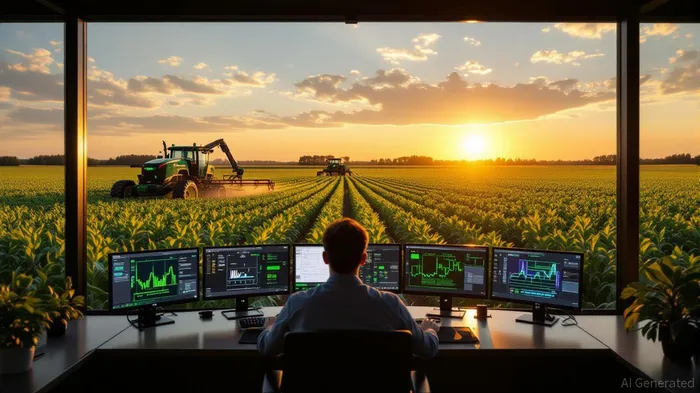 The stakes are high: A 2025 report by Tech Support Farm notes that IT support now extends beyond connectivity to include data governance, ERP integration, and workforce training, ensuring resilient operations. For investors, this signals a growing market for cybersecurity services tailored to agriculture. However, adoption remains uneven, with smaller farms often lagging due to cost and complexity. Policymakers must prioritize education and subsidies to bridge this gap, as highlighted by Sherman's breakout session on improving cybersecurity postures.
Robotic Weeding: Precision and Sustainability in Action
Robotic weeding technologies, showcased at the Ag Day by Noel Anderson of Grand Farm, represent a dual solution to labor shortages and herbicide resistance. NDSU's Smart Weeder X1, a three-row mechanical system with site-specific weed control (SSWC), reduces soil disturbance while conserving resources. Meanwhile, companies like Carbon Robotics-which raised $20 million in 2025-are advancing AI-powered systems capable of 98% weed detection accuracy and significant herbicide reduction.
The market for such technologies is expanding rapidly. A 2025 industry report projects the U.S. autonomous robot weeder market to grow from $1.5 billion in 2024 to $5.2 billion by 2033, driven by sustainability mandates and labor constraints. However, high upfront costs and maintenance demands remain barriers. For instance, the RobInHighTs project, funded by USDA/NIFA with $975,000, aims to automate high-tunnel farming but underscores the need for public-private partnerships to scale solutions.
Funding Trends and Policy Implications
The agtech funding landscape in the Midwest reveals both promise and volatility. While venture capital for farm robotics declined 36% in Q3 2025 compared to Q3 2024, targeted investments persist. Carbon Robotics' $20 million raise and the I-FARM initiative's $3.9 million USDA grant highlight strategic bets on autonomy. For investors, these trends suggest a focus on companies with proven scalability and government-backed R&D partnerships.
Policymakers, meanwhile, face the challenge of balancing innovation with accessibility. The Smart Weeder X1's development by NDSU engineering students, mentored by industry partners like AMITY Technology, exemplifies the role of academia in fostering adoption. Yet, without subsidies or tax incentives, many farmers may delay adopting these tools despite long-term benefits.
Opportunities and Risks for Stakeholders
Investment Opportunities:
- Cybersecurity SaaS: Tech Support Farm's Fence Check and similar tools cater to a sector increasingly aware of digital risks.
- Robotic Weeding Hardware: Companies like Carbon Robotics and NDSU's Smart Weeder X1 team are positioned to capitalize on sustainability-driven demand.
- Government Grants: Programs like I-FARM and RobInHighTs offer avenues for investors to align with public funding.
Key Risks:
- High Capital Costs: Robotic systems and cybersecurity upgrades require upfront investment, deterring small-scale adopters.
- Technical Complexity: Maintenance and training demands may outpace rural infrastructure capabilities.
- Cyber Threat Evolution: Rapidly evolving attack vectors could render current defenses obsolete without continuous updates.
Conclusion
The Midwest's agtech revolution hinges on bridging the gap between innovation and adoption. Events like NDSU's Central Dakota Ag Day underscore the urgency of integrating cybersecurity and automation into mainstream farming practices. For investors, the path forward lies in supporting scalable, sustainable solutions while advocating for policies that reduce barriers to entry. As Sherman and Anderson's presentations illustrate, the future of agriculture is not just about yield-it's about resilience in the face of digital and environmental storms.







Comentarios
Aún no hay comentarios