
U.S. Agricultural Sector Poised for Growth: Strategic Opportunities Amid Rising Farmer Sentiment and Export Optimism
The U.S. agricultural sector is navigating a pivotal inflection point, driven by a confluence of favorable trade agreements, surging crop prices, and renewed export optimism. While the sector faces headwinds such as a widening trade deficit and retaliatory tariffs, key players in agricultural inputs, equipment, and commodity trading are leveraging these dynamics to strengthen their market positions. This analysis identifies strategic opportunities for investors in companies best positioned to capitalize on the evolving landscape.
Trade Agreements: A Catalyst for Export Recovery
The U.S.-China trade agreement announced in November 2025 has emerged as a critical turning point for U.S. agricultural exports. Under the deal, China committed to purchasing 12 million metric tons of U.S. soybeans in the final two months of 2025 and at least 25 million metric tons annually through 2028. While this falls short of pre-2018 levels, it represents a partial rebound for a sector that lost significant market share to Brazil and Argentina during trade tensions. For companies like Corteva, Inc. (CTVA), this agreement bolsters demand for advanced seed technologies and crop protection solutions, particularly in soybean production. Corteva's third-quarter 2025 results underscored this trend, with a 27% increase in seed volume sales driven by early safrinha corn deliveries to Brazil.
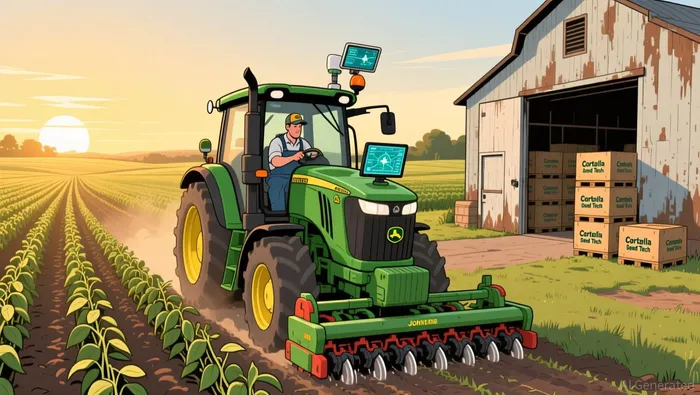
Similarly, John Deere (DE) benefits from renewed export optimism. The company's Precision Upgrades strategy, which retrofits advanced technologies onto existing equipment, aligns with U.S. farmers' need to enhance productivity amid volatile markets. Deere's fiscal 2025 performance reflected this demand, with strong sales in production and precision agriculture segments despite a 15–20% projected decline in large machinery sales due to tariffs.
Rising Crop Prices and Input Costs: A Double-Edged Sword
Global supply constraints and strong demand from emerging economies have driven crop prices to multi-year highs. U.S. corn prices surged by nearly 20% in 2025, fueled by droughts in South America and floods in the Midwest. This surge has directly benefited Archer-Daniels-Midland (ADM), a key player in grain processing and commodity trading. However, ADM's 2025 outlook was tempered by delays in U.S. biofuel policies and trade uncertainties, particularly with China.
For Mission Produce, Inc. (AVO), the story is more nuanced. While the company reported a 10% increase in avocado volumes in 2025, a 5% drop in average per unit sales prices pressured margins. Mission Produce's strategic pivot into mangoes and blueberries, coupled with its vertically integrated supply chain, positions it to mitigate price volatility and capture growth in high-demand fruit categories.
Export Optimism and Strategic Reforms
The U.S. agricultural trade deficit of $49 billion in 2025 highlights the sector's reliance on imports for high-value products like fresh produce and processed foods. However, new markets in Southeast Asia, Africa, and the Middle East are offering fresh opportunities. Corteva is capitalizing on this shift through its planned separation into two independent entities: New Corteva (crop protection) and SpinCo (seed business), expected to be finalized by mid-2026. This restructuring aims to enhance operational efficiency and focus on innovation, particularly in next-generation seed traits and sustainable crop protection.
Deere is also adapting to export-driven demand. The company's investment in digital agriculture tools and construction equipment has diversified its revenue streams, with construction and forestry sales rising despite agricultural sector headwinds.
Investment Thesis: Positioning for Long-Term Growth
The U.S. agricultural sector's resilience in 2025 is underpinned by strategic corporate initiatives and favorable macroeconomic trends. Corteva and Mission Produce exemplify how innovation and diversification can offset price pressures and trade uncertainties. Meanwhile, Deere and ADM are leveraging technological advancements and market access to navigate a complex trade environment.
For investors, the key lies in identifying companies that balance short-term challenges with long-term growth drivers. Corteva's separation into two focused entities, Mission Produce's expansion into complementary crops, and Deere's precision agriculture investments all signal strong alignment with the sector's evolving needs.





Comentarios
Aún no hay comentarios