
Agricultural Land as a Strategic Asset in a Climate-Driven Economy
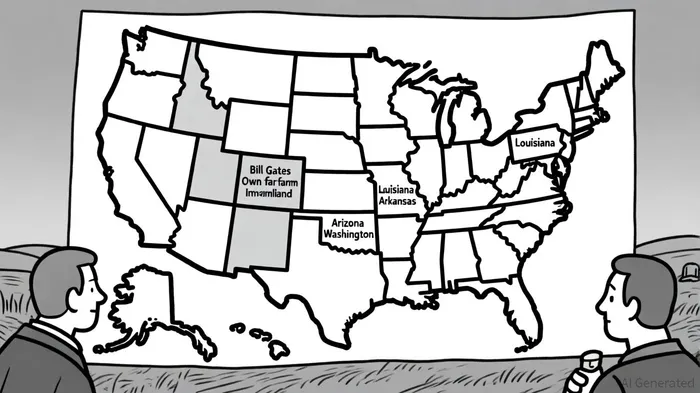
In an era marked by climate volatility and economic uncertainty, agricultural land has emerged as a critical asset class. Bill Gates' extensive farmlandFPI-- holdings offer a compelling case study in how strategic land investments can align financial prudence with global sustainability goals. As of 2025, Gates owns approximately 275,000 acres of farmland across 19 U.S. states, making him the largest private farmland owner in the country [1]. His portfolio includes significant holdings in Louisiana (70,000 acres), Arkansas (48,000 acres), and Washington, with operations spanning high-productivity regions like the Mississippi Delta and the Pacific Northwest [2]. This scale of ownership is not merely a financial play but a calculated move to address macro-level challenges such as food security, climate resilience, and technological innovation in agriculture.
The Strategic Rationale Behind Gates' Farmland Empire
Gates' farmland investments are managed by Cascade Investment, his private firm, and Cottonwood Ag Management, a subsidiary that collaborates with tenant farmers to optimize productivity [4]. The rationale for these acquisitions is multifaceted. First, farmland serves as a tangible asset that historically appreciates in value and acts as a hedge against inflation. According to a report by Nri Globe, Gates' holdings are valued at over $5.2 billion, generating income through crop sales, land leases, and government subsidies [1]. This diversifies his portfolio, which is dominated by Microsoft stock, and mitigates risks tied to tech sector volatility.
Second, Gates' approach integrates cutting-edge agricultural technologies. Precision farming, climate-smart practices, and sustainable crop production are central to his operations [4]. These innovations not only enhance yields but also reduce environmental footprints, aligning with the Bill & Melinda Gates Foundation's mission to improve global food security. For instance, Gates' farms supply crops to major brands like McDonald's, demonstrating how large-scale landowners can influence supply chains while promoting sustainable practices [3].
Farmland as a Macro-Level Investment Signal
Gates' strategy reflects broader trends in land ownership. As stated by Daily Galaxy, billionaires and corporations are increasingly acquiring agricultural land to secure resources amid climate change and geopolitical instability [2]. This trend is driven by the dual role of farmland as both a financial asset and a platform for innovation. For example, Gates' use of $700 million in loans secured against his land—a common tactic among the ultra-wealthy—highlights how farmland can be leveraged to access capital while deferring taxes [5].
Moreover, farmland's resilience in a climate-driven economy is underscored by its ability to adapt to shifting conditions. Gates' focus on high-productivity regions and sustainable practices positions his portfolio to withstand droughts, soil degradation, and regulatory changes. A 2025 analysis by Flavor365 notes that his holdings incorporate no-till farming and cover cropping, which enhance soil health and carbon sequestration [3]. These practices not only mitigate climate risks but also align with global efforts to reduce agriculture's environmental impact.
Concerns and Criticisms
Despite its strategic appeal, large-scale farmland ownership raises concerns about resource concentration. Critics argue that billionaires like Gates may exacerbate inequalities in rural communities and threaten food security by prioritizing profit over equitable access [6]. While Gates emphasizes that his investments are managed by professional teams rather than personal interests [5], the scale of his holdings inevitably influences local economies. For instance, his Louisiana operations, which span 70,000 acres, could displace smaller farmers or drive up land prices, limiting opportunities for new entrants [2].
Implications for Investors
For investors, Gates' farmland strategy underscores the growing importance of agricultural assets in a climate-driven economy. Farmland's dual role as a financial hedge and a sustainability lever makes it an attractive option for portfolios seeking long-term stability. However, success requires careful management of environmental and social risks. As Gates' example shows, integrating technology and sustainable practices can enhance returns while addressing global challenges.





Comentarios
Aún no hay comentarios