
Agricultural Commodity Positioning: Navigating Relative Strength and Portfolio Rebalancing Ahead of Key U.S. Crop Reports
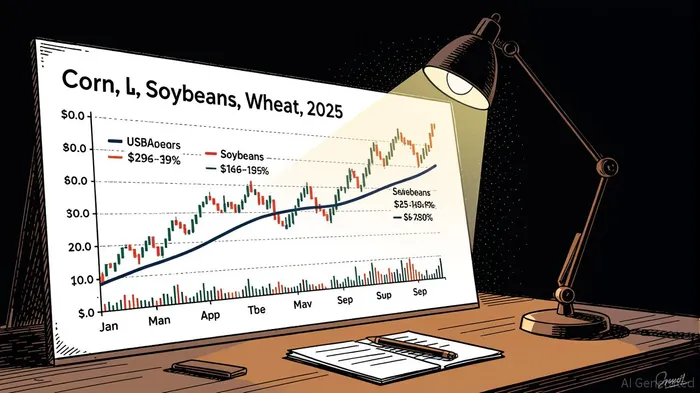
The U.S. agricultural commodity markets are entering a pivotal phase as traders brace for the August 2025 USDA World Agricultural Supply and Demand Estimates (WASDE) report. With corn, soybeans, and wheat prices exhibiting divergent trajectories, investors must navigate a landscape shaped by global oversupply, shifting planting intentions, and geopolitical dynamics. This analysis examines relative strength metrics and portfolio rebalancing strategies to position for the volatility ahead.
Corn: Resilience Amid Oversupply Concerns
Corn prices have declined 15–30% year-to-date, settling at $4.20 per bushel in July 2025, driven by record U.S. harvests and Brazil’s competitive 2024/25 output [1]. However, relative strength analysis reveals pockets of optimism. December corn futures rebounded to $4.12 1/4 in mid-July, supported by favorable Midwest weather and robust ethanol demand [2]. The USDA’s Prospective Plantings report projects a 4–5% increase in corn acreage to 94.0–94.5 million acres for 2025, outpacing soybean planting declines [3]. This shift reflects corn’s stronger price-to-profitability ratio, with the soybean-to-corn ratio currently below the critical 2.5 benchmark [3].
Investors should monitor commercial hedging pressure as the October harvest approaches, which could cap short-term gains. However, the 59% probability of a positive price reaction to the August 12 WASDE report suggests strategic entry points for undervalued futures [1].
Soybeans: Volatility and the Crush Spread Strategy
Soybean prices have been the most volatile, hitting a 3.5-month low of $10.15 per bushel in July amid weak soybean meal demand and speculative shorting [2]. The USDA forecasts a 2–3% reduction in soybean plantings to 83.5–84.0 million acres, but China’s hesitancy to purchase new-crop soybeans remains a wildcard [3]. The “Crush Spread” strategy—hedging soybean futures with soybean meal and oil contracts—offers a way to mitigate processing margin risks [1].
Relative strength indicators remain bearish, with technical indicators favoring sellers despite short-term rebounds from corn strength [2]. However, the 2026 price projection of $10.30 per bushel hints at long-term policy-driven demand, particularly if the One Big Beautiful Bill Act (OBBBA) boosts agricultural support payments [4].
Wheat: Downtrends and Export-Driven Recovery
Wheat markets face a dual challenge: declining domestic demand and geopolitical uncertainty. Futures dropped $0.15–$0.20 in July after the USDA’s Flour Millings Report reduced domestic use by 5 million bushels [1]. The August WASDE report further dampened sentiment by projecting tighter U.S. supplies and smaller ending stocks for 2025/26 [1]. Yet, reduced commercial hedging pressure and Bangladesh’s U.S. wheat purchase offer potential support [2].
Portfolio managers should consider wheat’s longer-term outlook, as planted acres could contract significantly unless prices rally. The 2025/26 marketing year’s export projections will be critical, with global demand potentially offsetting domestic weaknesses [1].
Portfolio Rebalancing: Balancing Risk and Opportunity
With $40–200 billion in institutional equity rebalancing flows anticipated in Q3 2025, agricultural investors must prioritize liquidity and diversification [3]. Corn and soybean futures offer tactical opportunities, particularly for those leveraging ETFs like the Invesco AgricultureDBA-- Fund (GSG) and the Coffee, Sugar & Grains Fund (CRA) to hedge volatility [1]. Wheat, while riskier, could benefit from a “wait-and-see” approach, given its sensitivity to export demand and geopolitical shifts.
The key is aligning positions with USDA report outcomes. For example, a 10–18¢ per bushel price swing post-WASDE underscores the need for dynamic hedging [1]. Traders should also consider the soybean-to-corn ratio as a barometer for inter-commodity shifts, adjusting allocations based on planting data and global weather patterns [3].
Conclusion
The August 2025 WASDE report will act as a fulcrumFULC-- for agricultural markets, testing the resilience of corn, the volatility of soybeans, and the recovery potential of wheat. By leveraging relative strength analysis and rebalancing strategies, investors can navigate the uncertainty while capitalizing on policy-driven demand and export dynamics. As the U.S. harvest season progresses, vigilance in monitoring planting intentions, global supply chains, and institutional flows will remain paramount.
Source:
[1] Grain Market Oversupply and Price Volatility: Strategic Entry Points in a Global Agricultural Glut (2025-08-25) [https://www.ainvest.com/news/grain-market-oversupply-price-volatility-strategic-entry-points-global-agricultural-glut-2508/]
[2] Monthly Grain Market Outlook | Weekly Crop Update (2025-08-20) [https://sites.udel.edu/weeklycropupdate/?p=27048]
[3] BitcoinBTC-- Futures, Coffee vs Cotton, and Corn & Soybean Plantings (2025-08-15) [https://www.topstep.com/blog/bitcoin-futures-coffee-vs-cotton-and-corn-soybean-plantings/]
[4] 2026 Illinois Crop Budgets (2025-08-10) [https://farmdocdaily.illinois.edu/2025/08/2026-illinois-crop-budgets.html]






Comentarios
Aún no hay comentarios