
Agricultural Bank of China's Q3 Earnings Signal Resilience in a Challenging Lending Environment
Asset Quality: A Mixed Picture Amid Sector-Wide Pressures
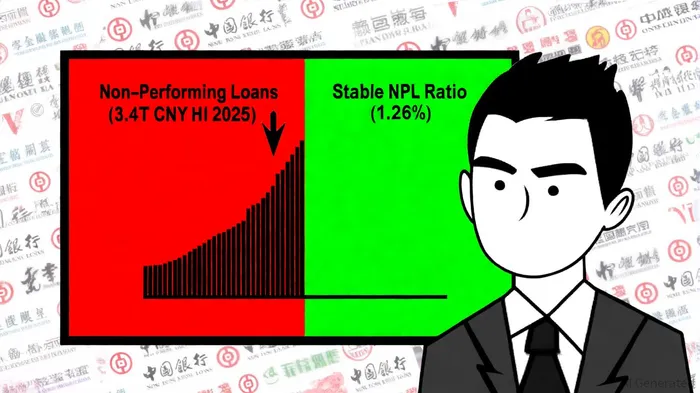
Non-performing loans (NPLs) remain a focal point for Chinese banks. According to a Bloomberg report, Bank of China's NPL ratio stabilized at 1.26% in Q3 2025, unchanged from June's levels. This stability suggests disciplined risk management, a trait likely shared by state-owned peers like ABC. However, the sector as a whole reported record-high NPLs of 3.4 trillion yuan in the first half of 2025, Reuters reported, underscoring systemic vulnerabilities. For ABC, which operates in rural and small-business lending segments particularly exposed to economic slowdowns, maintaining a low NPL ratio will be a key indicator of operational strength.
Profitability: Navigating Margin Constraints
Profit growth for Chinese banks has been tempered by narrow margins and subdued lending activity. Bank of China, a benchmark for state-owned lenders, reported a 5.09% year-over-year increase in net profit to 60.069 billion yuan ($8.43 billion) in Q3 2025, as Reuters reported. This modest gain reflects a sector-wide struggle to offset declining interest margins. For ABC, which has historically lagged peers in ROA and ROE metrics, the challenge will be to demonstrate efficiency improvements. Investors will scrutinize whether ABC's Q3 results show progress in cost management or fee-based income diversification, both critical for sustaining profitability in a low-growth environment.
Macroeconomic Headwinds: A Test of Resilience
The broader economic context cannot be ignored. China's trade tensions with the U.S. and domestic consumption slowdown have dampened credit demand, forcing banks to prioritize asset quality over aggressive lending. As noted by Reuters, Chinese commercial banks collectively earned 1.24 trillion yuan in H1 2025-a 1.2% decline year-over-year. For ABC, which serves a large agricultural and SME clientele, these macroeconomic pressures could amplify credit risks. However, its extensive branch network and government-backed risk-mitigation programs may provide a buffer, enabling it to outperform smaller regional banks.
Looking Ahead: What Investors Should Watch
ABC's Q3 results, expected alongside those of Industrial & Commercial Bank of China and China Construction Bank Corp., will offer clarity on its strategic priorities. Key metrics to monitor include:
- NPL Ratio: A stable or declining ratio would signal effective risk controls.
- Net Profit Growth: A positive year-over-year trend, even modest, would highlight operational resilience.
- ROA/ROE: Improvements in these metrics would indicate enhanced capital efficiency.
While the absence of ABC's specific data necessitates reliance on sector trends, the performance of peers like Bank of China suggests that state-owned banks are better positioned to weather macroeconomic turbulence than their private counterparts.







Comentarios
Aún no hay comentarios