
Agnico Eagle Mines: Navigating Valuation Dislocation and Strategic Resilience in a Gold Sector Rebound
In the ever-shifting landscape of global markets, Agnico Eagle MinesAEM-- (AEM) has emerged as a paradox: a standout performer against the S&P 500 yet a relative laggard within its own sector. From 2023 to 2025, AEMAEM-- delivered a cumulative total return of 247.87%, dwarfing the S&P 500's 59.79% over the same period [1]. Yet, in the past quarter, the gold sector index (GDX) surged 127.46% year-to-date, outpacing AEM's 119.86% return [2]. This dislocation raises critical questions about valuation, strategy, and the broader forces reshaping the gold market.
Valuation Dislocation: A Tale of Two Metrics
AEM's valuation metrics reveal a nuanced story. While its trailing P/E ratio of 25.8 as of September 2025 exceeds the gold sector average of 24.77, it remains below peers like Franco-Nevada (P/E: 46.39) and comfortably above value-oriented players such as Newmont (P/E: 13.68) and Kinross Gold (P/E: 17.83) [3]. This suggests AEM is priced for growth but not at a premium to the sector's most speculative names. Meanwhile, its enterprise value to EBITDA (13.63) and price-to-book (3.79) ratios underscore a balance sheet fortified by disciplined cost management and reserve expansion [4].
The dislocation becomes clearer when juxtaposed with the gold sector's broader revaluation. Central banks, driven by geopolitical uncertainty and a flight from U.S. dollar exposure, have purchased over 1,000 tonnes of gold annually since 2023, with 95% of surveyed institutions expecting this trend to continue [5]. This demand has propelled gold prices to record highs, with forecasts predicting $4,000 per ounce by mid-2026 [5]. Yet AEM's stock has not fully capitalized on this tailwind. Analysts attribute this to investor skepticism about the company's ability to sustain its 3.3–3.5 million-ounce production guidance amid rising capital expenditures for projects like the Canadian Malartic expansion [6].
Strategic Positioning: Quality Over Quantity
AEM's strategy has long prioritized high-grade, low-cost assets in politically stable regions-a stark contrast to peers reliant on volatile jurisdictions. This approach has yielded operational efficiency, with AEM's volatility (6.57%) trailing the gold sector index (7.95%) and a Sharpe Ratio of 3.25 versus GDX's 2.77 [2]. However, the same discipline may now be a double-edged sword. As gold prices surge, investors are pivoting toward high-growth junior miners with exploration upside, leaving mid-tier producers like AEM in the middle.
The company's recent foray into net cash positions and debt repayment further complicates its narrative. While these moves strengthen balance sheets, they also reduce leverage to gold's rally-a trade-off that may underwhelish momentum-driven investors [6]. "AEM is a fortress, but not a rocket ship," notes one analyst, highlighting the tension between stability and growth in a sector increasingly defined by speculative fervor [7].
The Road Ahead: Realigning Expectations
For AEM to close the valuation gap, it must demonstrate that its production growth and reserve additions can outpace sector-wide inflation. The Detour Lake expansion, expected to add 500,000 ounces annually by 2026, could tip the scales [4]. Yet execution risks remain, particularly as gold prices climb into uncharted territory.
Investors should also consider macroeconomic catalysts. With central banks accounting for 30% of annual gold demand in 2025, AEM's focus on long-life, high-margin assets positions it to benefit from sustained price strength [5]. However, the stock's current valuation-trading at a 10% discount to its 10-year average P/E-suggests the market is pricing in conservative assumptions about reserve growth and operational scalability [3].
Conclusion: A Dislocation Worth Monitoring
Agnico Eagle Mines occupies a unique crossroads: a high-quality operator in a sector undergoing structural transformation. Its recent underperformance against the gold sector index reflects a shift in investor priorities toward speculative growth rather than operational excellence. Yet, as central bank demand and gold's role as a geopolitical hedge solidify, AEM's disciplined approach may yet prove prescient. For now, the valuation dislocation offers a compelling case study in the tension between short-term momentum and long-term resilience.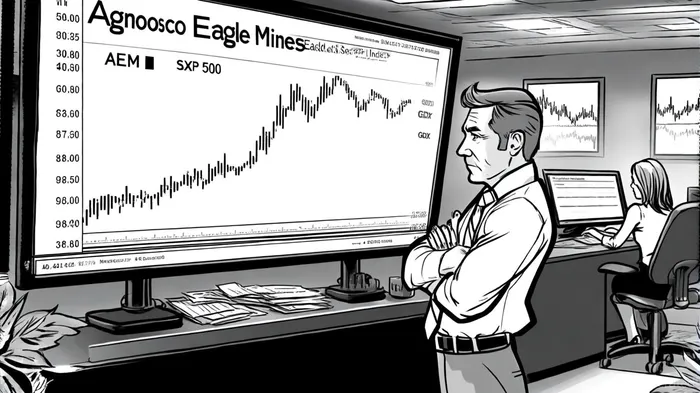





Comentarios
Aún no hay comentarios