
AGD's Premium Puzzle: Justifying the Price in a High-Yield Hunt
In the ever-shifting landscape of income investing, the abrdn Global Dynamic Dividend Fund (AGD) has emerged as both a beacon and a conundrum. As 2026 unfolds, the fund trades at a 1.12% premium to its net asset value (NAV), a stark departure from its 52-week average discount of -2.16% and a 3-year average discount of -9.41%. This valuation divergence raises a critical question: Does AGD's current premium reflect justified optimism about its income-generating prowess, or does it signal overreach in a market starved for yield?
The Allure of AGD: Yield and Performance
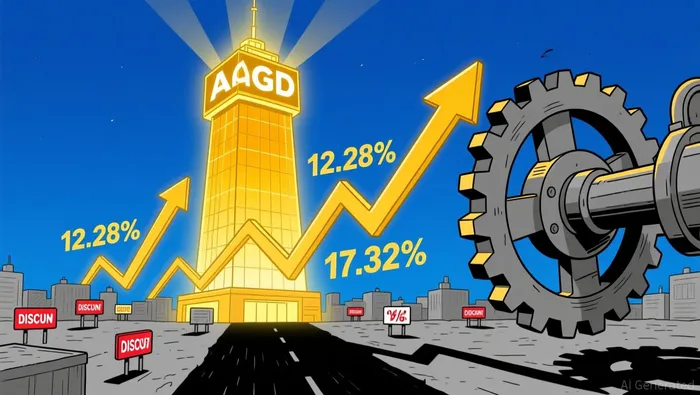
AGD's appeal lies in its ability to deliver a 12.28% yield, a figure that dwarfs the median closed-end fund and positions it as a top-tier option for income-focused investors. This yield, coupled with a 12-month total return on NAV of 17.32%, underscores its capacity to generate both income and capital appreciation. Over the past five years, AGDAGD-- has outpaced the median peer CEF, delivering a total return that exceeds the 54.39% benchmark. Such performance, particularly in a low-interest-rate environment, has naturally drawn demand, pushing its share price above NAV.
However, the fund's expense ratio of 1.21%-comprising a 1.01% management fee and 0.15% in other expenses-casts a shadow over its cost-effectiveness. While this is in line with industry averages for dividend-focused CEFs, it remains a drag on net returns, especially for investors sensitive to fees. The question then becomes whether AGD's premium reflects a willingness to pay for its track record or a mispricing of its risks.
Historical Context and Risk Considerations
AGD's current premium is anomalous when viewed through a historical lens. For much of the past decade, the fund traded at significant discounts, with a 5-year average discount of -9.66%. The shift to a premium suggests a re-rating driven by its recent performance and the broader market's hunt for yield in a post-pandemic world. Yet, this optimism must be tempered by AGD's history of volatility. During the 2008 financial crisis, the fund suffered substantial losses, a reminder that high yield often comes with high risk.
Moreover, AGD's leverage-effective leverage of 5.89% as of December 2025-introduces additional complexity. While leverage can amplify returns in rising markets, it magnifies losses during downturns. For a fund already trading at a premium, this dynamic raises concerns about downside protection.
Peer Comparisons and Market Realities
AGD's performance relative to peers further complicates the valuation debate. While direct comparisons are limited by restricted data access, the fund has consistently outperformed the median CEF in yield and total return. This suggests that AGD's premium may be justified by its ability to deliver superior risk-adjusted returns. However, the absence of granular peer expense ratios and performance metrics leaves room for skepticism. Investors must ask whether AGD's premium is a reward for outperformance or a reflection of market exuberance in a niche sector.
Conclusion: A Calculated Bet for Income Portfolios
AGD's 1.12% premium to NAV in 2026 is a double-edged sword. On one hand, its 12.28% yield and robust performance metrics make it a compelling option for investors prioritizing income over capital preservation. On the other, the premium implies that much of its future potential is already priced in, leaving little margin for error. For a diversified income portfolio, AGD could serve as a high-conviction satellite holding, provided investors are prepared to tolerate its risks-high fees, leverage exposure, and historical volatility.
Yet, the fund's valuation remains precarious. If market conditions deteriorate or AGD's performance falters, the premium could swiftly invert into a discount, eroding gains. In this sense, AGD is not a passive buy but a calculated bet-one that demands rigorous due diligence and a clear-eyed assessment of its place in a broader portfolio strategy.





Comentarios
Aún no hay comentarios