
Africa's Digital Renaissance: How Human Capital Development is Fueling Fintech and Blockchain Growth for Investors
The Human Capital Catalyst
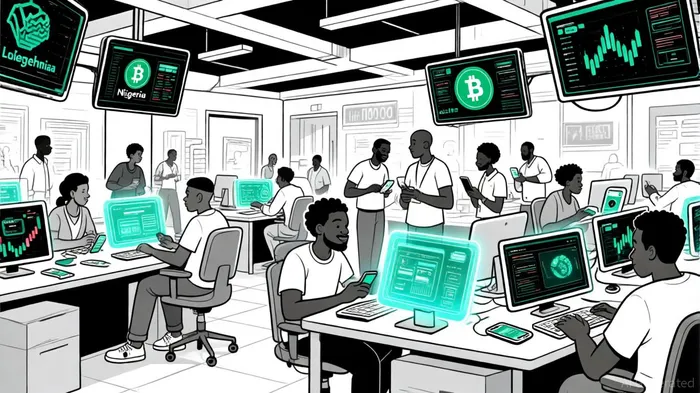
Africa's demographic dividend-over 60% of its population under 25-provides a fertile ground for innovation. However, raw talent alone is insufficient without targeted education and mentorship. Bitnob's Code and Chain: The BitcoinBTC-- Developers Meetup in Lagos, held in October 2025, exemplifies this approach. By bringing together developers, startup founders, and Bitcoin enthusiasts, the event focused on practical skills like building Bitcoin wallets and node monitoring, directly addressing gaps in technical expertise, as highlighted in Building Africa's Bitcoin Future. Such initiatives are critical: they transform abstract concepts like blockchain into tangible solutions for cross-border payments, remittances, and financial inclusion.
The economic impact is already measurable. Nigeria's crypto market alone processed $59 billion in transactions from July 2023 to June 2024, while stablecoins have slashed remittance fees for Kenyan freelancers from 29% to 2%, according to Tech in Africa. These gains are not accidental-they are the result of deliberate investments in human capital. As stated by a report from Tech in Africa, "Africa's most promising sectors in 2025 are those where education and innovation intersect."
Investment Implications: Edutech and Early-Stage Tech
The success of Africa's fintech and blockchain sectors hinges on sustained workforce development. Startups like M-Pesa and Jobberman have already demonstrated how AI and mobile money can bridge gaps in financial access and workforce readiness, as noted in an SHRM article. However, the next wave of innovation will require deeper integration of edutech platforms that align with industry needs.
Investors should prioritize ventures that combine technical training with real-world application. For instance, Bitnob's emphasis on mentorship and local talent development mirrors the strategies of successful Silicon Valley incubators. A SAGE article notes that key markets like Kenya, Nigeria, and South Africa have attracted over $4 billion in fintech investments since 2015, with startups leveraging agent-based models to reach rural populations. These models are not just scalable-they are sustainable, as they create jobs and foster entrepreneurship.
Yet challenges persist. Energy poverty remains a critical barrier, a ScienceDirect study finds. This underscores the need for parallel investments in infrastructure. For edutech ventures, partnerships with governments and energy providers could mitigate this risk while expanding market reach.
Regulatory Tailwinds and Long-Term Growth
Regulatory progress is another tailwind. Nigeria's Accelerated Regulatory Incubation Program (ARIP), which approved two local crypto exchanges in September 2024, and South Africa's Financial Advisory and Intermediary Services Act are examples of frameworks that balance innovation with compliance, according to Fintech News Africa. These policies reduce uncertainty for investors and signal a maturing market.
Looking ahead, Tech in Africa projects the cross-border payments market in Africa will reach $329 billion by 2025, growing at a 12% compound annual rate. The same analysis suggests AI-driven fintech solutions could contribute $2.9 trillion to the continent's economy by 2030. For early-stage investors, this means backing ventures that not only solve immediate problems but also position themselves to capitalize on these macro trends.
Conclusion: A Call for Strategic Investment
Africa's fintech and blockchain sectors are no longer on the periphery of global innovation-they are central to the future of finance. The continent's success will depend on continued investment in human capital, from coding bootcamps to regulatory sandboxes. For venture capitalists and edutech investors, the opportunity is clear: support the builders of Africa's digital economy, and reap the rewards of a market poised for exponential growth.






Comentarios
Aún no hay comentarios