
Africa's Defense Tech Boom: Why Terra Industries' Strategic Growth Signals a Hedge Against Global Instability
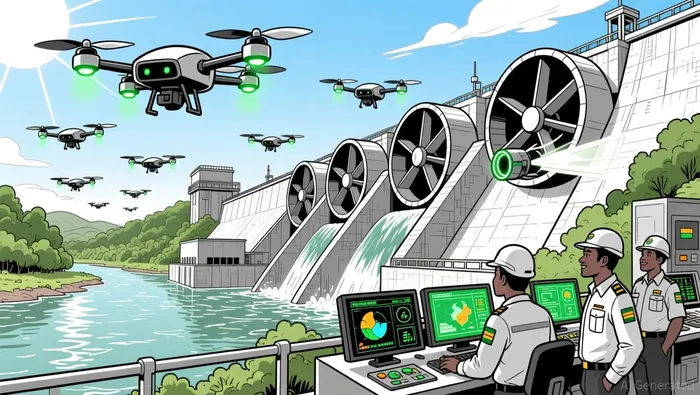
Africa's startup ecosystem is no longer a footnote in global innovation. In 2025, the continent's tech sector has surged, with over $1 billion raised in the first half of the year alone-a 40% jump from 2024-driven by sectors like fintech, climate tech, and defense technology. At the heart of this transformation is TerraLUNA-- Industries, a Nigerian startup that has redefined what it means to build "homegrown" security innovation. By securing a $1.2 million contract to deploy drone security solutions for hydropower plants-outperforming international competitors-Terra exemplifies how African startups are not just adapting global technologies but solving critical local and regional challenges. For investors, this signals more than just growth; it highlights a strategic opportunity to hedge against geopolitical instability by backing a sector that is both resilient and mission-critical.
The Rise of Defense Tech in Africa: A Convergence of Need and Innovation
Africa's defense tech startups are emerging at the intersection of urgent infrastructure needs and technological leapfrogging. Terra Industries, co-founded by two 22-year-olds, has built a business model inspired by Silicon Valley's defense tech playbook: scalable, software-driven solutions with long-term revenue streams. Its drone fleets, paired with proprietary operating software, address security gaps in critical infrastructure like hydropower plants-a sector increasingly vulnerable to sabotage and climate-related disruptions.
This trend is not isolated. Across the continent, startups are leveraging AI, robotics, and renewable energy to tackle security and infrastructure challenges. For instance, Terra's recent partnership with RAIT 88, an Italian defense engineering center, to commercialize its SOLO™ micro-modular reactor technology underscores how African innovators are now collaborating with global players to scale solutions for NATO-aligned nations. These partnerships are not just about technology transfer; they reflect a growing recognition of Africa's role in addressing global security and energy needs.
Defense Tech as a Geopolitical Hedge: Why Now?
The global investment landscape is rife with volatility. From U.S.-China tensions to the war in Ukraine, traditional markets are increasingly unpredictable. In contrast, Africa's defense tech sector offers a unique combination of high-growth potential and low-correlation with traditional asset classes. Here's why:
- Decentralized Innovation: Unlike centralized tech hubs in the U.S. or China, Africa's startup ecosystem is fragmented yet diverse. This decentralization reduces exposure to single-point geopolitical risks. For example, Terra's operations in Nigeria are insulated from U.S. regulatory shifts or Chinese supply chain disruptions.
- Local-First Solutions: African startups like Terra are solving problems that are both hyperlocal and globally relevant. Hydropower security, for instance, is a critical issue in Africa but also resonates with energy-starved regions in Europe and Asia. This dual relevance makes the sector attractive to investors seeking diversified portfolios.
- Policy Tailwinds: Governments across Africa are incentivizing tech entrepreneurship through special economic zones and startup-friendly policies. These initiatives create a stable regulatory environment, even as global markets fluctuate.
Terra Industries: A Case Study in Scalable Defense Innovation
Terra's partnership with RAIT 88 is a masterclass in strategic scaling. By integrating Italy's expertise in robotics and AI with its own reactor technology, Terra is positioning itself to serve defense and humanitarian missions in NATO-aligned nations. The collaboration includes training programs aligned with U.S. and IAEA nuclear standards, ensuring compliance with global regulations-a critical factor for investors wary of geopolitical entanglements.
Moreover, Terra's focus on micro-modular reactors (MMRs) taps into a global energy security trend. As nations diversify away from fossil fuels and large-scale nuclear projects, MMRs offer a compact, flexible alternative. Terra's ability to commercialize this technology in Europe and Asia suggests a path to cross-border revenue streams, further insulating it from regional economic shocks.
The Investment Thesis: Balancing Risk and Reward
While Africa's defense tech sector is nascent, its growth trajectory is compelling. The $1.2 billion raised in H1 2025 indicates strong investor confidence, particularly in startups that blend social impact with commercial viability. For Terra, the key differentiator is its ability to monetize both hardware (drones, reactors) and software (security platforms), creating recurring revenue streams.
However, risks remain. Regulatory hurdles, infrastructure gaps, and political instability in some regions could hinder scaling. Yet, these challenges are mitigated by the sector's inherent resilience. Defense tech startups often operate in high-stakes environments, making them adept at navigating uncertainty-a trait that aligns with the goals of investors seeking stable returns in turbulent times.
Conclusion: A New Frontier for Geopolitical Diversification
Africa's defense tech boom is more than a regional story-it's a global opportunity. Startups like Terra Industries are proving that innovation can thrive in markets long dismissed as risky. By investing in these enterprises, global investors gain exposure to a sector that is both future-proof and geopolitically insulated. As the world grapples with instability, the lesson from Africa is clear: the next frontier of innovation lies not in avoiding risk, but in redefining it.







Comentarios
Aún no hay comentarios