
AES Corporation: A Golden Opportunity in Renewable Energy M&A Arbitrage
AES Corporation (NYSE:AES) stands at a pivotal crossroads in the global energy transition, presenting a compelling case for valuation arbitrage. With its $40.68 billion enterprise value (EV) significantly undervaluing its $31.14 intrinsic value per share renewable portfolio, the company is a prime target for strategic buyers. This article explores how the confluence of private equity's infrastructure pivot, a post-halving stock price, and asymmetric risk-reward dynamics creates a rare opportunity for investors.
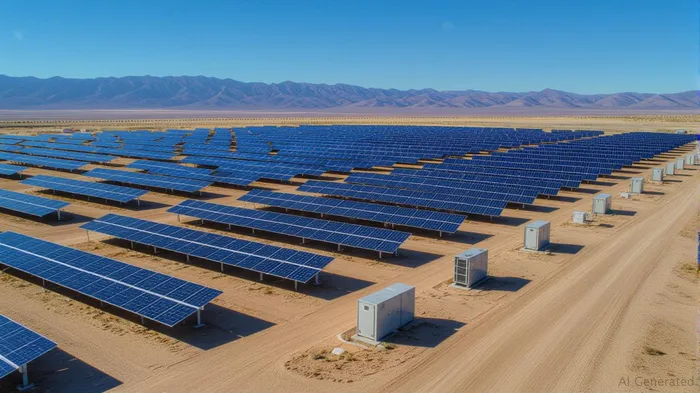
Valuation Discrepancy: The Undervalued Renewable Engine
AES's EV of $40.68 billion as of July 2025 masks the true worth of its renewable energy assets. The company's 50% renewable generation portfolio (16GW of wind, solar, hydro, and storage) is underpriced by 64% versus its intrinsic value. A Discounted Cash Flow (DCF) analysis estimates the fair value at $20.38 per share, compared to its current $11.07 price—a 49% undervaluation. Key metrics highlight this disconnect:
- EV/Revenue Ratio: 3.34 vs. an industry median of 2.51, suggesting premium pricing for renewables-heavy peers.
- Renewable Project Pipeline: A 11.7GW backlog of contracted projects, including 5.3GW under construction, underscores the asset-rich nature of its portfolio.
- DCF vs. Market: The $13.92 DCF value alone exceeds the current price by 27%, with relative valuation multiples pointing to $48.36 per share—triple the current price.
Catalysts: Strategic Buyers and Feasible Leverage
Two catalysts amplify the arbitrage opportunity:
Private Equity's Infrastructure Shift:
Infrastructure funds are pivoting to renewables, with AES's scale (operations in 15 countries) and diversified portfolio aligning with their long-term yield targets. The $400-500 million in asset sales (e.g., AGIC stake) demonstrate management's willingness to monetize non-core assets, improving liquidity for potential buyers.Leveraged Buyout (LBO) Feasibility:
AES's stock price has halved in 12 months, reducing the equity stake required for a buyout. With $1.75 billion in cash and a $30.6 billion debt load, a strategic buyer could refinance via low-cost green bonds or tax equity partnerships. The improved credit ratings post-AES Ohio stake sale (30% sold to CDPQ) signal investor confidence in its balance sheet.
Risks: Debt and Volatility, But Asymmetric Upside
AES's risks are clear but manageable:
- High Leverage: Debt/Equity of 351.4% poses refinancing risks, but asset sales and renewables' stable cash flows provide a buffer.
- Earnings Volatility: Q1 2025's $73M net loss (vs. $278M in 2024) reflects one-time costs and tax attribute timing, not core weakness.
- Regulatory Hurdles: Crossvine solar project approvals and PPA contracts in regulated markets are critical to execution.
The asymmetric return profile is compelling: a potential acquisition or asset sale could unlock $20-$30 per share, while downside is limited by the $5.05 analyst price target floor.
Investment Strategy: Play the Arbitrage, Protect the Downside
Option 1: Long AES Equity with Put Protection
- Buy AESAES-- shares at $11.07, paired with a 6-month put option at $9.00. This limits downside while capturing 80% of upside to $20.38.- Risk-Return: Potential 85% gain vs. 20% loss.
Option 2: Overweight Energy Transition ETFs
- Invest in funds like Invesco S&P 500 Equal Weight Utilities ETF (RUTY) or iShares Global Clean Energy ETF (ICLN), which include AES and peers. These offer diversification while capitalizing on sector momentum.
Conclusion: A Rare Confluence of Value and Momentum
AES's undervalued renewable assets, strategic buyer interest, and feasible LBO dynamics create a high-conviction opportunity. While risks like debt and earnings volatility exist, the 64% undervaluation and potential catalysts (asset sales, PPA monetization) justify a bullish stance. Investors seeking exposure to energy transition M&A should position now—before the market corrects this glaring pricing dislocation.
Positioning: *Overweight AES equity with put protection; alternatively, overweight energy transition ETFs.







Comentarios
Aún no hay comentarios