
AeroVironment's Skyfall Mars Helicopter Mission: Pioneering Autonomous Systems in the New Space Economy
The commercial space market is no longer a niche sector—it's a $1 trillion juggernaut by 2030, driven by satellite constellations, lunar ambitions, and Mars exploration. At the forefront of this revolution is AeroVironment (AVAV), a company that has quietly positioned itself as a critical player in autonomous systems for space. With its Skyfall Mars Helicopter Mission, AV is leveraging decades of expertise in robotics, avionics, and AI-driven flight systems to carve out a defensible leadership position in the race to explore and commercialize the Red Planet.
The Skyfall Revolution: A Leap Beyond Ingenuity
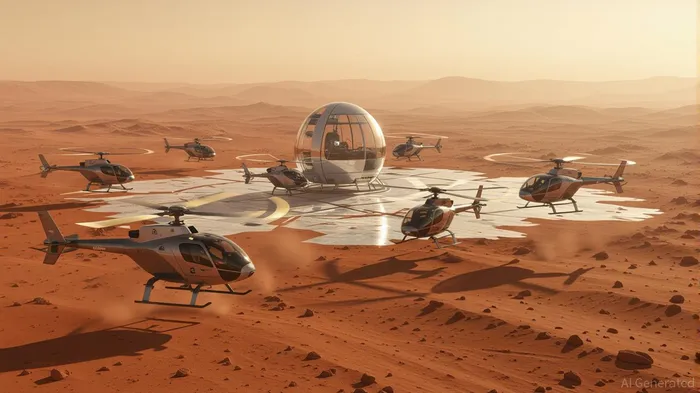
AeroVironment's journey to Mars began with the Ingenuity Mars Helicopter, a marvel of engineering that achieved the first powered flight on another planet. Ingenuity's 72 flights, far exceeding its initial 5-flight mission, proved that autonomous rotorcraft could survive and operate in Mars' thin atmosphere. Now, AV is building on that legacy with Skyfall, a next-generation mission concept designed to deploy six autonomous scout helicopters by 2028.
The Skyfall Maneuver—a radical departure from traditional Mars landings—eliminates the need for a bulky, costly landing platform. Instead, the helicopters deploy from their entry capsule during descent, flying to the surface under their own power. This innovation reduces mission costs by up to 40% while enabling the helicopters to operate independently, collecting high-resolution surface imaging and sub-surface radar data. The goal? To identify safe, resource-rich landing sites for future human missions, particularly areas with water and ice.
AV's Technological Edge: From Earth to Mars
AeroVironment's dominance in autonomous systems isn't accidental—it's built on decades of innovation. The company's expertise in lightweight aircraft structures, real-time data processing, and AI-driven flight control directly translates to the challenges of Mars exploration. By commercializing components from the Ingenuity program—such as avionics, flight software, and modeling techniques—AV is creating a scalable, reusable technology stack for future missions.
This approach mirrors the broader trend in space: modular, cost-effective solutions that accelerate development cycles. For example, NASA's Artemis program and private lunar landers rely heavily on autonomous systems for navigation and resource mapping. AV's Skyfall mission is a natural extension of this ethos, positioning the company as a key supplier for both robotic and human-led Mars missions.
Financials and Strategy: A Rocket Ship with Legs
AeroVironment's financials tell a story of rapid growth and strategic foresight. In fiscal 2025, the company reported $820.6 million in revenue, up 14% year-over-year, with non-GAAP adjusted EBITDA reaching $146.4 million. The Loitering Munitions Systems (LMS) segment, a cash cow for AV, grew 87% in 2025, while international revenue accounted for 52% of total sales.
But the real game-changer is AV's $4.1 billion acquisition of BlueHalo, a defense tech firm specializing in space, cyber, and directed energy. This move bolsters AV's AV_Space portfolio, which includes advanced communication systems like BADGER and WASP phased array antennas, critical for high-speed data transmission in deep space. BlueHalo's expertise in satellite servicing and orbital debris removal also aligns with the growing demand for space sustainability—a $5 billion market by 2030.
The Investment Case: Defensible Leadership in a High-Growth Sector
AeroVironment's Skyfall mission isn't just a scientific endeavor—it's a strategic play to dominate the autonomous systems segment of the space economy. By 2030, the Mars economy alone could reach $100 billion, with exploration, resource extraction, and habitat construction driving demand. AV's first-mover advantage in Mars rotorcraft, combined with its BlueHalo acquisition, creates a moat that's hard to replicate.
Moreover, AV's $726.6 million funded backlog as of April 2025 provides visibility into future revenue, while its $1.2 billion in fiscal 2025 bookings underscores strong customer demand. The company's focus on long-haul laser communication and multi-domain autonomous systems also positions it to benefit from the broader shift toward AI-driven space operations.
Risks and Rewards
No investment is without risk. The commercial space market is still nascent, with high R&D costs and regulatory hurdles. AV's UxS segment (which includes uncrewed systems) saw a 35% revenue decline in Q2 2025, highlighting potential volatility in defense spending. However, the company's pivot to high-growth areas like LMS and AV_Space, coupled with its BlueHalo integration, suggests a disciplined approach to risk management.
For investors, the key is to focus on AV's long-term vision: a world where autonomous systems unlock the economic potential of Mars. With a 2028 launch window for Skyfall and a $1 trillion space market on the horizon, AeroVironmentAVAV-- is not just riding the wave—it's creating the tide.
Final Thoughts: Buy and Hold for the Red Planet Era
AeroVironment's Skyfall mission is more than a technical milestone—it's a blueprint for the future of Mars exploration. By combining its heritage in autonomous systems with strategic acquisitions and a focus on commercialization, AV is building a defensible leadership position in a sector that's poised for explosive growth.
For the patient investor, AVAVAVAV-- represents a unique opportunity to bet on the democratization of space—where autonomous systems bridge the gap between science fiction and reality. As the company prepares for a 2028 Mars launch and expands its footprint in lunar and orbital markets, the sky is no longer the limit—it's just the beginning.







Comentarios
Aún no hay comentarios