
Aehr Test Systems: Navigating Semiconductor Shifts with Strategic Resilience and AI-Driven Growth
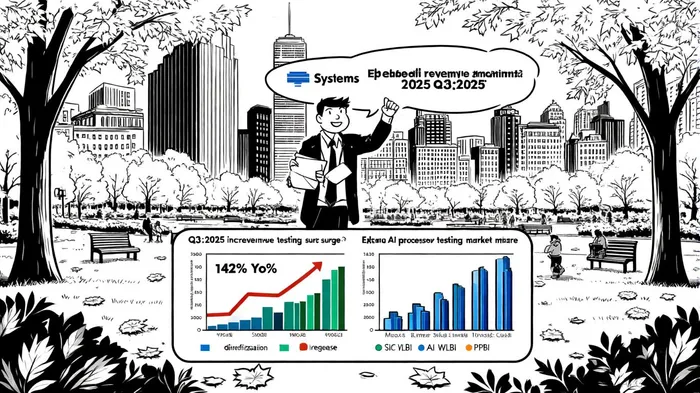
The semiconductor industry is in the throes of a transformation, driven by the twin forces of artificial intelligence (AI) and the electrification of global industries. Amid this upheaval, Aehr Test SystemsAEHR-- has emerged as a case study in operational agility and strategic foresight. The company's Q3 2025 results-$18.3 million in revenue, a 142% year-over-year increase, and a Non-GAAP EPS of $0.07 versus a $0.03 loss in the prior year-underscore its ability to capitalize on niche but high-growth segments, as detailed in Aehr's Q3 report. This outperformance is not accidental; it reflects a calculated pivot toward AI processor testing and a diversification strategy that insulates the firm from the volatility of its traditional silicon carbide (SiC) burn-in business.
Strategic Reorientation: From Niche to Necessity
Aehr's recent success hinges on its pivot to AI-driven semiconductor testing. The company's FOX-XP high-power wafer-level burn-in (WLBI) systems, designed for AI processors, have become a linchpin of its growth. According to the firm's Q3 report, AI processor testing now accounts for over 35% of revenue, up from negligible levels just two years ago. This shift is more than a product update-it is a response to a seismic industry trend. The AI semiconductor testing market is projected to grow at a 19% CAGR through 2029, reaching $7.9 billion, according to a Technavio report. Aehr's acquisition of Incal Technology in 2025 further solidified its position, enabling it to offer both wafer-level and packaged-part burn-in solutions for AI processors-a unique value proposition in a market dominated by broader but less specialized competitors, as noted in a StockTitan report.
Competitive Positioning: Small Share, Big Ambitions
Aehr's market share in the semiconductor test equipment industry remains modest-1.98% in the IT Infrastructure segment and 0.02% in the Technology Sector, according to CSIMarket data. Yet this small footprint belies its strategic relevance. While giants like Teradyne (89.16% IT Infrastructure market share) and Advantest dominate the broader testing landscape, AehrAEHR-- has carved out a defensible niche in AI and SiC testing. Its ability to adapt quickly to customer-specific needs-such as customizing WLBI systems for high-volume AI processors-creates a moat against larger rivals. As one industry analyst at Yole Group noted, "Aehr's agility allows it to respond to the rapid iteration cycles of AI chipmakers, a dynamic that slower, more bureaucratic competitors struggle to match."
Industry Tailwinds: AI and SiC as Dual Catalysts
The growth of Aehr's AI testing business is inextricably linked to the broader semiconductor industry's AI adoption. By 2025, 70% of semiconductor firms are expected to integrate AI into their R&D processes, while AI-powered process optimization has already reduced manufacturing costs by 15% in 2023, according to Gitnux data. For Aehr, this means sustained demand for its high-precision testing solutions. Meanwhile, the SiC market-though now contributing less than 40% of Aehr's revenue-remains a critical pillar. The global SiC device market is forecast to grow at a 20% CAGR through 2030, driven by 800V EV platforms and the transition to 8-inch wafers, a projection also highlighted by Yole Group. Aehr's WLBI systems for SiC power devices, though less flashy than its AI offerings, provide a stable cash flow and technical expertise that underpin its credibility in the AI space.
Risks and Mitigations: Navigating Uncertainty
Aehr's optimism is tempered by macroeconomic headwinds. The company temporarily withdrew full-year guidance in Q3 2025 due to U.S. tariff uncertainties and supply chain disruptions, as noted in Aehr's Q3 report. However, management has proactively built buffers, including diversified supplier contracts and inventory pre-positioning, to mitigate potential delays. These measures, while costly, demonstrate a commitment to operational resilience-a trait that could prove invaluable as global trade dynamics remain volatile.
Conclusion: A High-Beta Play on AI and Electrification
Aehr Test Systems is not a household name in the semiconductor industry, but its Q3 2025 results and strategic repositioning suggest it is becoming a critical enabler of the AI revolution. While its market share remains small, its ability to align with high-growth subsectors-AI testing and SiC-positions it as a high-beta play on two of the most transformative trends in technology. For investors, the key question is whether Aehr can scale its niche expertise into a broader competitive advantage. The answer may lie in its capacity to maintain its agility while scaling, a challenge that will test the mettle of even the most resilient firms in the semiconductor ecosystem. Historically, a simple buy-and-hold strategy around AEHR's earnings releases from 2022 to 2025 has shown mixed results, with win-rates hovering around 45–55% and minimal cumulative excess returns relative to the benchmark. This suggests that while the company's fundamentals are strong, short-term price movements tied to earnings events may not provide clear directional signals.





Comentarios
Aún no hay comentarios