
Aehr Test Systems: Navigating the AI Semiconductor Supercycle with Strategic Precision
The semiconductor industry is in the throes of a transformation driven by artificial intelligence, and Aehr Test SystemsAEHR-- finds itself at the intersection of this seismic shift. While the company's recent financial results have been mixed-marked by a fiscal 2025 GAAP net loss of $3.9 million compared to $33.2 million in 2024, according to Aehr's fiscal 2025 report-its strategic pivot toward AI-driven testing solutions has positioned it to capitalize on a multi-year supercycle. The question for investors is whether Aehr's current challenges are temporary hiccups or early warning signs of deeper structural issues. The answer, as the data suggests, lies in its ability to translate strategic visibility into sustainable revenue.
Strategic Visibility: A Portfolio Reimagined for AI
Aehr's shift from silicon carbide (SiC) to AI semiconductor testing is not merely a diversification play-it is a recalibration of its entire value proposition. In fiscal 2024, SiC wafer-level burn-in (WLBI) accounted for over 90% of revenue. By fiscal 2025, that figure had plummeted to less than 40%, with AI processors now representing over 35% of business, per the company filing. This transition was catalyzed by the launch of the FOX-XPTM WLBI system, the first production tool designed explicitly for AI chips. Capable of testing nine 300mm AI processor wafers simultaneously and delivering 3,500 watts per wafer, the system addresses the unique thermal and power demands of high-performance computing.
The company's acquisition of Incal Technology further solidified its foothold in the AI space, enabling packaged-part qualification and production burn-in for hyperscalers. A leading data center operator, which develops its own AI processors, has already entered into an evaluation phase for high-volume adoption, the company said. Such partnerships are critical, as they align AehrAEHR-- with customers whose production ramps could drive multi-year revenue streams.
Revenue Sustainability: Balancing Near-Term Pains with Long-Term Gains
Aehr's financials tell a story of near-term pain but long-term promise. The fiscal 2025 GAAP net loss was largely attributable to the absence of a $20.7 million tax benefit that boosted 2024 results, as the company disclosed. However, the company's Q1 2026 performance offers a more optimistic outlook: net revenue of $11.0 million and bookings of $11.4 million, driven by follow-on orders for its Sonoma systems from a "world-leading hyperscaler," according to Aehr's Q1 2026 results. This suggests that the initial investments in AI testing infrastructure are beginning to bear fruit.
The sustainability of this growth hinges on two factors: the scalability of AI processor production and the diversification of Aehr's customer base. The company's recent expansion into gallium nitride (GaN) power semiconductors and silicon photonics-markets with robust roadmaps from AMD, Intel, and TSMC, according to a Seeking Alpha analysis-adds layers of resilience. GaN, in particular, offers a broader application set than SiC, with automotive and industrial clients already placing production orders, the company reported.
Risks and Realities
No analysis would be complete without acknowledging the risks. Aehr's reliance on a handful of hyperscalers and OSATs (outsourced semiconductor assembly and test providers) introduces concentration risk. A slowdown in AI chip production or a shift in customer preferences could disrupt its revenue trajectory. Additionally, the capital intensity of developing next-generation testing systems-such as those for silicon photonics-requires sustained R&D investment, which could strain margins if demand lags expectations.
Yet, the broader market dynamics favor Aehr. The AI semiconductor testing market is projected to grow at a compound annual rate exceeding 20% through 2030, driven by the need for reliability in mission-critical applications, as noted in the Seeking Alpha analysis. Aehr's early mover advantage in AI-specific testing solutions, coupled with its strategic partnerships, provides a moat against competitors.
Conclusion: A High-Stakes Bet with High Rewards
Aehr Test Systems is a case study in strategic reinvention. While its recent financial results are underwhelming, the company's pivot to AI-driven testing has unlocked access to a trillion-dollar semiconductor supercycle, according to the Seeking Alpha analysis. The key for investors will be monitoring the cadence of follow-on orders from hyperscalers and the success of its GaN and silicon photonics initiatives. If Aehr can convert its technological innovations into recurring revenue, it may yet prove that its current challenges are a small price to pay for a dominant position in the AI era.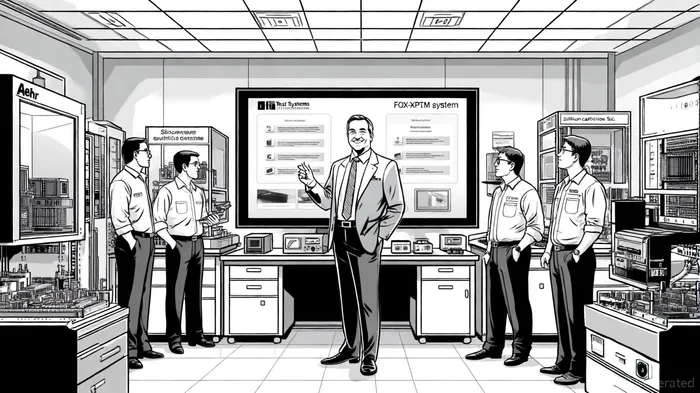





Comentarios
Aún no hay comentarios