
Aehr Test Systems: A Value Investor's Look at a Transitioning Business
Aehr Test Systems operates at a crossroads, with its historical strength in a cyclical market now being challenged, while a new, high-growth opportunity begins to take shape. The company's core business has long been wafer-level burn-in (WLBI) test solutions for the silicon carbide (SiC) market, a sector dominated by electric vehicle development. This alignment drove revenue booms when automakers invested heavily, but also led to declines when they pulled back. This creates a classic business cycle vulnerability.
Management is actively diversifying to reduce this risk. The clearest evidence is a paid evaluation order from a leading supplier of artificial intelligence (AI) processors for a wafer-level burn-in application. This is more than a hopeful prospect; it's a paid engagement to benchmark Aehr's technology against a critical new market. The company is also seeing increasing demand for its package-level burn-in systems, including its Echo line, which complements its high-power Sonoma systems. This dual-track approach-targeting both wafer-level and package-level test for AI chips-signals a deliberate push into a sector with longer-term growth visibility.
A crucial asset underpinning this transition is its installed base. AehrAEHR-- has over 100 Echo systems across more than 20 semiconductor companies worldwide. This foundation provides a built-in customer base for recurring revenue from service and support, and creates a natural pathway for cross-selling new solutions like its AI-focused WLBI systems. The installed base acts as a moat of its own, fostering customer relationships and trust that new entrants must overcome.
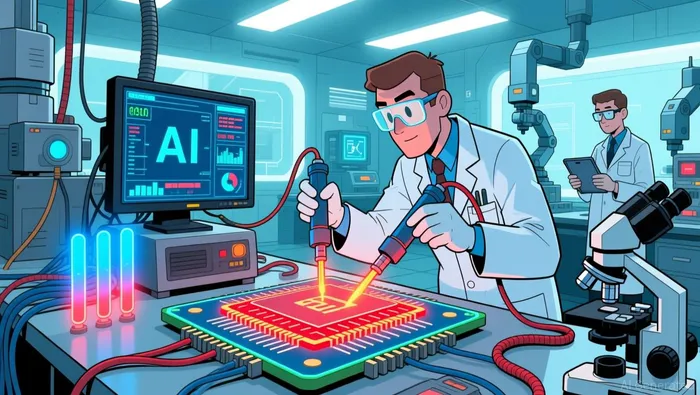
The strategic shift from a cyclical EV market to a high-growth AI market has the potential to widen Aehr's competitive moat over time. The AI and data center test equipment market is characterized by rapid scaling and high capital intensity, favoring established suppliers with proven technology and customer relationships. Success in securing production orders from the AI processor supplier, following this paid evaluation, would validate Aehr's technological capability in a high-margin segment. More broadly, the company's expertise in high-power, fine-pitch wafer contact and thermal management is directly applicable to next-generation AI processors. If Aehr can leverage its existing customer base and technical reputation to capture a share of this expanding market, it could transform from a cyclical niche player into a more resilient, high-growth supplier. The journey is just beginning, but the direction points toward a wider moat.
Financial Health and the Path to Compounding
The company's financials for the recent quarter show a business in transition, with a clear cyclical downturn pressuring the top line while a strong balance sheet provides the runway to navigate it. For the second quarter of fiscal 2026, revenue came in at $9.9 million, a 26% year-over-year decline. This drop is a direct reflection of the softening silicon carbide market, which has weighed heavily on the core business. The bottom line followed suit, with a non-GAAP net loss of $1.3 million for the quarter. The broader six-month picture is even more telling, with revenue of $20.9 million and a non-GAAP net loss of $1.0 million, underscoring the persistent pressure.
Yet, the critical factor for a value investor is not the current loss, but the financial runway to fund the pivot. Here, Aehr's position is robust. The company ended the quarter with a cash and equivalents total of $31.0 million. This war chest, bolstered by a $6.3 million increase from the prior quarter, provides a significant buffer. It is enough to fund operations and strategic initiatives-like the paid AI evaluations and Sonoma system orders-without the immediate need for dilutive financing. This liquidity is the fuel for the transition.
Management's decision to reinstate H2 fiscal 2026 guidance is a key signal of confidence in the path forward. The projection of revenue between $25 million and $30 million for the second half, coupled with a non-GAAP net loss per share of $(0.09) to $(0.05), implies a substantial improvement from the first half. This guidance is not a guess; it is anchored in increased visibility from AI processor, data center, silicon photonics, memory, and PPBI demand, including recent Sonoma orders totaling more than $5.5 million. The company is betting that the new growth engines are beginning to offset the old cycle.
The bottom line for compounding is that Aehr has the financial wherewithal to weather the downturn. The cash position provides a multi-quarter runway, allowing the company to invest in AI opportunities without sacrificing its balance sheet. The guidance, while still projecting a loss, points to a clear inflection. If management can convert the promising AI engagements into production orders as forecast, the company is positioned to exit this fiscal year with a stronger, more diversified revenue base. The financial health is solid enough to support the long-term bet.
Valuation and the Margin of Safety
The stock's recent volatility underscores the market's struggle to price this transition. Shares fell 12.1% in December, a move that coincided with a broader flight from riskier AI-themed names. The stock has since found a range, recently trading around $23.02. This price action reflects a classic value investor's dilemma: the market is punishing the company for its current cyclical weakness and losses, while simultaneously questioning the viability of its new growth story.
To assess the margin of safety, we must look past the headline price to the underlying business. The company's market capitalization is approximately $681 million. Against this, the balance sheet holds a cash and equivalents position of $31.0 million. This means the market is valuing the entire business-its cash, its backlog, and its future prospects-at about $650 million. The key question for a disciplined investor is whether this valuation adequately discounts the risk of a prolonged downturn in the silicon carbide market, while also pricing in the uncertain but potentially massive opportunity in AI and data center test equipment.
The opportunity is framed by the sheer scale of the AI processor market. Projections show this sector is set to grow from $73.01 billion in 2026 to approximately $467.09 billion by 2034, expanding at a compound annual rate of 26.11%. For Aehr, success in securing production orders from the AI processor supplier is not just about incremental revenue; it's about gaining a foothold in a market that is expected to be worth nearly half a trillion dollars in a decade. The company's paid evaluation order is a tangible step toward that goal.
The margin of safety, therefore, hinges on the balance between these two forces. On one side, there is the tangible risk of continued revenue decline from the EV market, which has already driven the company to a non-GAAP net loss. On the other, there is the potential for exponential growth if Aehr can convert its AI engagements into production revenue. The current valuation, by pricing the company at a discount to its cash position and ignoring the backlog growth, appears to be heavily weighted toward the downside risk. It discounts the high-growth potential of the AI market. For a patient investor, this creates a potential opportunity. The stock price seems to be pricing in a failure of the transition, while the financial runway and strategic direction suggest a path to success. The margin of safety is not in the current price, but in the conviction that the company can navigate the downturn and capture a share of the AI boom.
Catalysts and Risks: What to Watch
The investment thesis for Aehr Test SystemsAEHR-- now hinges on a clear sequence of events. The primary catalyst is the execution on its recent AI processor evaluation programs. The company has already secured a paid evaluation order from a leading AI processor supplier, a tangible step that must now convert into a production purchase order. This is the linchpin. Success here would validate the strategic pivot, provide a near-term revenue tailwind, and significantly de-risk the long-term outlook. The market will be watching for announcements of production orders from this or other AI engagements as the clearest signal that the new growth engine is firing.
A key risk, however, remains the continued weakness in the silicon carbide market. The company's recent financials show the direct impact, with revenue down 26% year-over-year. While the broader EV semiconductors market is projected to grow at a compound annual rate of 9.1% through 2032, the near-term trajectory for Aehr's core SiC business is uncertain. If this segment remains soft, it will pressure margins and accelerate cash burn, testing the runway provided by the company's $31 million cash position. The risk is not that the SiC market will vanish, but that its growth may not resume quickly enough to offset the transition costs.
For investors, the near-term metrics to monitor are straightforward. Quarterly bookings and backlog trends are critical indicators of demand visibility. The company's bookings of $6.2 million in the last quarter and an effective backlog of $18.3 million are positive signs, but the focus must be on whether these numbers accelerate, particularly from the AI and data center segments. More importantly, management must demonstrate its ability to control losses and hit the reinstated revenue guidance of $25 million to $30 million for the second half of fiscal 2026. Achieving this will show operational discipline during the downturn and build credibility for the forward-looking forecast.
The bottom line is a race between two forces. On one side is the tangible risk of a prolonged SiC slump, which could deplete the cash buffer before the AI transition gains full momentum. On the other is the potential for a sudden inflection if AI production orders materialize. The stock's current price seems to be pricing in the former, while the company's guidance and strategic direction suggest the latter is possible. The next few quarters will determine which narrative wins.







Comentarios
Aún no hay comentarios