
Aehr Test Systems and the AI Semiconductor Manufacturing Boom
Aehr Test Systems and the AI Semiconductor Manufacturing Boom
The AI semiconductor manufacturing boom is reshaping global technology markets, and Aehr Test SystemsAEHR-- (AEHR) has emerged as a critical enabler of this transformation. As artificial intelligence (AI) workloads surge, demand for high-performance chips-particularly AI accelerators, GPUs, and high-performance computing (HPC) processors-has outpaced traditional semiconductor production capabilities. Aehr's specialized testing and burn-in solutions are now at the forefront of addressing these challenges, leveraging supply chain innovation and scalability to meet the unprecedented demands of the AI era.
Strategic Partnerships and Technological Edge
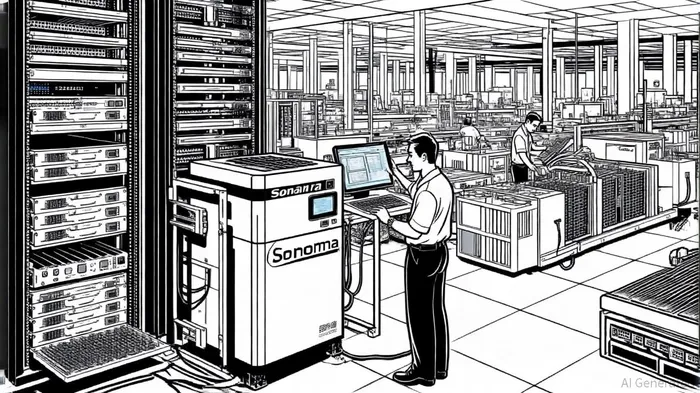
Aehr's recent partnerships with a major hyperscaler and a leading AI processor supplier underscore its pivotal role in the AI semiconductor supply chain. In Q3 2025, the company secured additional orders for eight Sonoma ultra-high-power systems, designed for volume production testing and burn-in of AI processors. These systems, tailored for chips operating at power levels exceeding 1000W, feature active liquid-cooled conductive temperature control, dynamic test parameters, and real-time device monitoring-capabilities essential for ensuring reliability in high-stakes AI applications, as noted in an Aehr press release.
The hyperscaler, a key player in AI infrastructure, is actively expanding its production capacity and plans to ramp AI processor output over the next year. Aehr's FOX-XP and Sonoma systems are uniquely positioned to streamline wafer-level and packaged-part testing, reducing manufacturing costs while improving yield. This aligns with the hyperscaler's need for scalable, cost-effective solutions to meet its aggressive growth targets, according to a FinancialContent article.
Market Dynamics and Scalability
The AI semiconductor market is projected to grow from $623 billion in 2025 to $1.07 trillion by 2035, at a compound annual growth rate (CAGR) of 5.08%, according to a GlobeNewswire report. This expansion is driven by AI servers, which require GPUs accounting for a third of the semiconductor die area in such systems. Meanwhile, annual wafer demand is expected to grow by 4% through 2027, but AI server volumes are rising at a staggering 40–50% CAGR, creating a supply chain bottleneck for advanced node chips, as noted by the FinancialContent article.
Aehr's solutions directly address these bottlenecks. Its wafer-level burn-in (WLBI) technology allows for simultaneous testing of up to 18 wafers, with 3500W per wafer capacity, ensuring rigorous reliability checks without compromising throughput. This scalability is critical as semiconductor manufacturers grapple with the dual challenges of advanced packaging technologies (e.g., TSMC's CoWoS) and the need for high-bandwidth memory (HBM) in AI systems, according to an IDC forecast.
Financial Performance and Future Prospects
Aehr's financials reflect its strong market position. In Q3 2025, the company reported revenue of $18.3 million, a 142% increase compared to the same period in 2024, with a robust backlog of $18.2 million, as detailed in the company's earnings highlights. AI-related revenue is projected to account for up to 40% of fiscal 2025 earnings, highlighting the company's deep integration into the AI supercycle.
The company is also diversifying into adjacent high-growth markets, such as silicon photonics and gallium nitride, reducing reliance on silicon carbide and broadening its addressable market. This strategic pivot positions AehrAEHR-- to capitalize on emerging applications in data centers, telecommunications, and energy systems.
Conclusion: A Strategic Investment in the AI Supply Chain
Aehr Test Systems is not merely a supplier but a cornerstone of the AI semiconductor supply chain. Its tailored solutions for high-power testing, coupled with strategic partnerships and financial momentum, position it to benefit from the AI supercycle. As the industry races to meet the 40–50% CAGR in AI server demand, Aehr's innovations in scalability and reliability will be indispensable. For investors, this represents a compelling opportunity to capitalize on the intersection of AI-driven demand and supply chain resilience.
However, historical performance data from earnings events suggests caution. A backtest analysis of AEHR's stock behavior following earnings releases from 2022 to 2025 reveals that the stock has underperformed the benchmark by an average of –3.5% over 30 days post-announcement, with most of the drag occurring within the first two weeks. Only ~33% of events delivered positive returns, indicating that timing investments around earnings releases may not be optimal. Investors should weigh these historical patterns against the company's strong fundamentals and long-term growth trajectory.





Comentarios
Aún no hay comentarios