
Adobe's Institutional Dominance and Insider Moves: A Risk-Reward Crossroads?
Adobe Inc. (ADBE) has long been a darling of institutional investors, with over 90% of its shares held by institutions as of Q1 2025. Yet this near-ubiquitous ownership raises critical questions: How might this concentration amplify volatility? And what does the surge in insider selling—exceeding $1.2 billion in 2025—say about the stock's future?
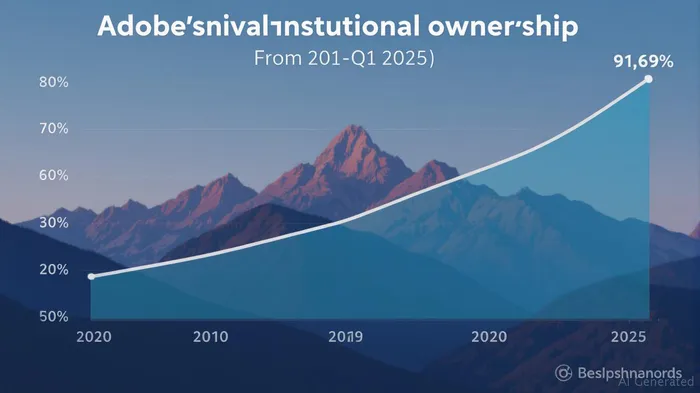
Institutional Ownership: A Double-Edged Sword
Institutional investors now hold 91.69% of Adobe's shares, down slightly from prior quarters but still staggeringly high (see ). Major holders like Vanguard and BlackRockBLK-- dominate, with passive funds like the Vanguard Total Stock Market Index Fund and InvescoIVZ-- QQQ Trust anchoring long-term positions.
This concentration presents both opportunity and risk. On one hand, institutional backing often signals confidence in Adobe's long-term growth trajectory—driven by its cloud-based Creative Cloud and Document Cloud platforms. The company's Q2 2025 10-Q report highlighted 24% year-over-year subscription revenue growth, underscoring its transition to a recurring-revenue model.
On the flip side, such high ownership creates vulnerability. If a handful of large institutions decide to reduce stakes—due to portfolio rebalancing, sector rotation, or macroeconomic concerns—the resulting sell-off could amplify volatility. For instance, the $385.83 price tag as of June 2025 already reflects a 30.55% decline from its June 2024 peak.
Insider Selling: A Sign of Skepticism or Strategic Liquidity?
While institutions are in it for the long haul, Adobe's insiders have been aggressive sellers in 2025. Notable transactions include:
- Jillian Forusz, an officer, offloading $130.1 million in shares across two sales (January and May).
- Scott Belsky, a former CEO, selling $883.6 million in shares in January 2025.
- Daniel Durn, the CFO, unloading $198.3 million in March 2025.
Combined, these sales total over $1.2 billion (see ). While insiders may have personal financial needs or tax considerations, such large-scale selling by top executives can spook investors. The $30.63 million figure cited in summaries (likely excluding Belsky's massive transaction) understates the scale of concern.
Risk vs. Reward: Where Does the Balance Lie?
Risks:
- Institutional Sell-Off: A coordinated exit by key holders could pressure the stock further, especially if broader market conditions sour.
- Valuation Pressure: Adobe's price-to-sales ratio of 8.5x (vs. 10x in 2024) suggests some skepticism about its growth sustainability.
- Regulatory Risks: As a tech giant, AdobeADBE-- faces ongoing scrutiny over data privacy and antitrust issues, which could weigh on sentiment.
Opportunities:
- Undervalued Potential: Adobe's subscription model and 24% revenue growth indicate strong fundamentals. The stock's 30% decline may have created a buying opportunity for long-term investors.
- Balance Sheet Strength: With $4.5 billion in cash and no debt, Adobe is well-positioned to weather downturns or acquire competitors.
- Institutional Loyalty: Many funds hold Adobe as a core tech holding, meaning a sell-off would likely be gradual, not catastrophic.
Investment Considerations
- Time Horizon: Investors with a 3–5-year horizon may find Adobe's fundamentals compelling despite near-term volatility.
- Dollar-Cost Averaging: Given the stock's recent decline, spreading investments over time could mitigate downside risk.
- Monitor Insider Activity: Continued selling by executives like Forusz or Belsky could signal deeper issues, while stabilization might indicate confidence is returning.
- Stop-Loss Strategy: Set a trailing stop-loss (e.g., 15% below recent highs) to limit losses if institutional sentiment turns.
Conclusion
Adobe's dominance in creative and document solutions positions it as a tech leader, but its institutional concentration and insider selling create a precarious balance. While the stock's fundamentals remain robust, investors must weigh the risks of a potential exodus by large holders. For now, Adobe appears to be a “high-conviction” play—ideal for those willing to bet on its cloud transition outperforming market skepticism.
This analysis is for informational purposes only and not financial advice. Always conduct thorough research or consult a professional before making investment decisions.





Comentarios
Aún no hay comentarios