
Adobe's AI-Driven Growth: Is the Stock a Buy Ahead of Q3 Earnings Amid Heightened Competition and Monetization Concerns?
Adobe Inc. (NASDAQ: ADBE) stands at a crossroads as it prepares to report Q3 2025 earnings on September 11. The stock, trading at $356.90—a five-year valuation low—has drawn mixed analyst sentiment, with price targets ranging from $460 to $605[1]. This dislocation reflects broader investor skepticism about Adobe's ability to monetize its AI-driven innovations while fending off competition from AI-native platforms like Canva and Figma[2]. To assess whether the stock is a buy, we must dissect its valuation metrics, strategic execution risks, and the transformative potential of its AI bets.
Valuation Dislocation: A Discounted Leader in a Crowded Space
Adobe's current valuation multiples suggest a significant disconnect from its historical premiums. The company trades at 14x estimated 2026 free cash flow and a forward P/E of 15.0x[3], far below its historical range of 25–35x[4]. By comparison, the SaaS industry median EV/Revenue multiple stands at 6.0x[5], while Adobe's LTM EV/Sales multiple is 12.2x[6]. This premium is justified by Adobe's robust 89% gross margin and 30.4% net profit margin[7], but it also highlights the market's demand for stronger growth proof.
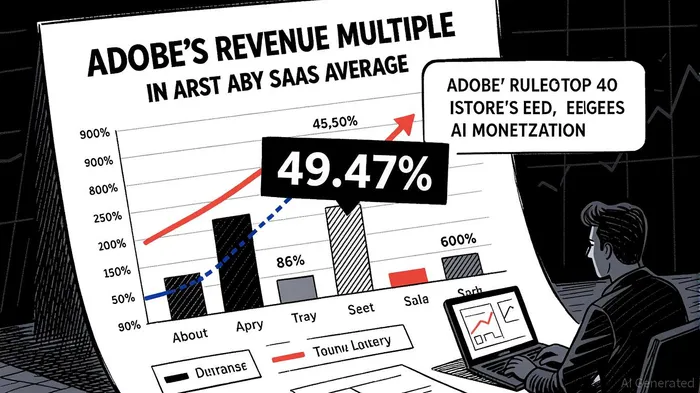
The compression in Adobe's multiples mirrors broader SaaS sector trends. Public SaaS valuations have declined from 7.3x in January 2025 to 6.0x in July 2025[8], while private deals trade at 4.8x[9]. Adobe's ability to maintain its premium hinges on its Rule of 40 score—a metric combining growth and profitability—which currently stands at 49.47%[10]. This is derived from a projected 9–10.6% revenue growth[11] and a 48.79% EBITDA margin[12], comfortably exceeding the 40% threshold. However, as the company scales, growth rates naturally decelerate, and the market demands clearer monetization pathways for AI tools like FireflyFLY-- and GenStudio.
Strategic Execution Risks: AI Monetization and Competitive Pressures
Adobe's AI strategy is its most critical lever. The company has already generated over $250 million in ARR from Firefly and GenStudio[13], with CEO Shantanu Narayen noting AI-related revenue is “ahead of schedule” and in the “billions”[14]. Yet, monetization remains a work in progress. Firefly's $24 billion in generated assets[15] is impressive, but converting this into recurring revenue requires pricing discipline and ecosystem lock-in. Meanwhile, AI-native competitors are closing the gapGAP--. Canva's free-tier model and Figma's design collaboration tools threaten Adobe's Creative Cloud dominance, particularly in small-to-midsize businesses[16].
The company's recent pricing adjustments—global Creative Cloud subscription changes expected to add $440 million in net new ARR[17]—signal a defensive stance. While these moves align with Digital Media growth expectations, they also highlight the need to offset slowing organic growth (projected 8.6–9.5% in Q3 2025[18]). Analysts at RBC and UBSUBS-- see upside potential, but Rothschild Redburn's “Sell” rating underscores the risks of over-reliance on legacy revenue streams[19].
Balance Sheet Strength and Buyback Flexibility
Adobe's financial position remains a tailwind. The company generated $9.6 billion in annual operating cash flow[20] and has spent $6.75 billion on buybacks in FY2025's first half[21]. While debt has risen to $6.6 billion, its $8.32 billion in annual free cash flow[22] provides ample flexibility to service obligations and fund innovation. This balance sheet strength could become a key differentiator if Q3 results exceed the $5.16 EPS and $5.89 billion revenue consensus[23], potentially reigniting investor optimism.
Investment Thesis: A Cautious Buy with Conditional Upside
Adobe's valuation dislocation offers an entry point for investors who believe in its AI monetization playbook. The stock's 12.2x EV/Sales multiple[24] is justified by its Rule of 40 performance and 89% gross margin[25], but the market demands execution. A strong Q3 report—particularly in AI-driven ARR growth and enterprise deal wins—could catalyze a re-rating toward historical multiples. Conversely, missing guidance or failing to articulate a clear AI monetization roadmap may deepen the discount.
For now, AdobeADBE-- remains a “buy” for long-term investors who can tolerate near-term volatility. However, the stock's success hinges on its ability to defend its creative software moat while accelerating AI-led revenue streams—a dual challenge that will define its next phase of growth.





Comentarios
Aún no hay comentarios