
Adecco and Salesforce's r.Potential: A Strategic Play to De-Risk the AI Bubble and Capture Workforce Transformation Value
Strategic Alignment: Bridging the AI Implementation Gap
The Adecco Group, a leader in workforce solutions, has long recognized the challenges enterprises face in integrating AI into their operations. As CEO Denis Machuel noted, r.Potential was launched to address the "disconnect between the rapid supply of AI solutions and their concrete implementation in core business processes." This initiative leverages Salesforce's Agentforce, a digital labor platform that automates routine tasks, and Adecco's real-time global labor data to create enterprise intelligence tools. These tools enable organizations to simulate workforce configurations, test automation scenarios, and make data-driven decisions about human-digital labor integration according to Adecco.
The strategic partnership is not merely about automation; it is about reimagining work. By using AI to handle repetitive tasks-such as resume screening, job posting distribution, and administrative workflows-r.Potential allows human workers to focus on roles requiring creativity, leadership, and emotional intelligence as Salesforce reports. This approach aligns with broader market trends: McKinsey's 2025 report highlights that while 92% of companies plan to increase AI investments, only 1% consider their adoption "mature," underscoring the urgent need for frameworks like r.Potential to guide responsible AI integration according to McKinsey.
Technology as a Catalyst: Agentforce and Data-Driven Workforce Planning
At the heart of r.Potential is Salesforce's Agentforce, a platform that enables enterprises to deploy autonomous AI agents to augment human teams. 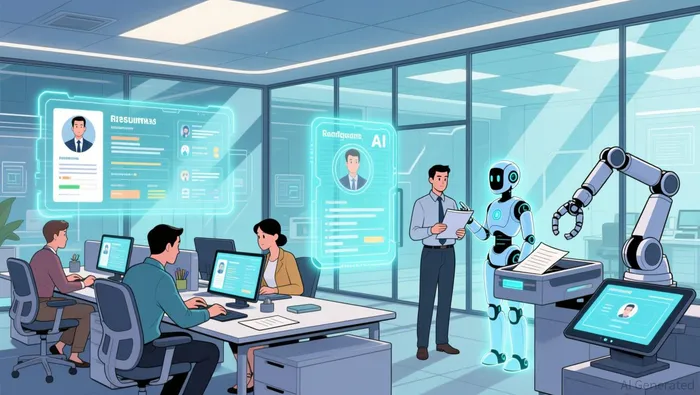 For example, Engine, a Salesforce customer, saved $2 million annually by using Agentforce to handle routine support cases, allowing representatives to focus on high-value interactions according to Salesforce. Similarly, PepsiCo streamlined sales operations by automating small-store support, enabling teams to prioritize larger opportunities according to Salesforce. These examples illustrate how Agentforce's capabilities-when paired with Adecco's labor insights-can drive operational efficiency while preserving the human element of work.
r.Potential also integrates Salesforce's Data Cloud, which aggregates and analyzes workforce data to identify trends and optimize talent strategies. By leveraging this data, enterprises can predict labor demand, reduce attrition, and align AI adoption with business objectives. For instance, the Adecco Group's own recruitment processes have seen improved efficiency through AI-driven tools, with productivity gains of up to 30% per employee and 23% of the workforce redeployed into strategic roles according to Salesforce. Such outcomes validate the potential for r.Potential to scale similar benefits across industries.
Market Validation: AI's Role in Workforce Transformation
The urgency for solutions like r.Potential is underscored by the evolving labor landscape. According to the 2025 Future of Jobs Report, skill gaps remain the primary barrier to business transformation, with 63% of employers citing this as a critical challenge according to the World Economic Forum. Meanwhile, PwC's research indicates that 63% of organizations view reskilling and upskilling as essential to addressing talent shortages according to PwC. r.Potential's focus on balancing AI and human labor directly addresses these pain points, offering a framework for enterprises to future-proof their workforces.
Moreover, the market for enterprise AI is projected to grow from $24 billion in 2024 to $150–200 billion by 2030 according to Glean. This growth is driven by the shift from isolated AI pilots to mission-critical infrastructure, with high-performing enterprises prioritizing transformative workflows and business model redesign according to McKinsey. r.Potential's ability to provide predictive intelligence and risk mitigation-such as avoiding failed AI investments and job displacement-positions it as a key player in this expanding market.
Investment Implications: A Long-Term Play on AI Maturity
For investors, r.Potential represents a strategic bet on the maturation of enterprise AI. The initiative's focus on reducing the "AI bubble" risk-by grounding AI adoption in real-world data and workforce strategy-aligns with the cautious optimism of institutional investors. As Accenture's research highlights, companies with AI-led processes outperform peers by 2.5x in revenue growth and 2.4x in productivity according to Accenture. r.Potential's emphasis on responsible AI integration could attract capital from ESG-focused funds, which prioritize sustainable and equitable technological adoption.
However, challenges remain. The success of r.Potential hinges on its ability to scale beyond pilot programs and demonstrate measurable ROI across diverse industries. While Salesforce's existing customer stories (e.g., GE Appliances and LIV Golf) showcase AI's operational benefits according to Salesforce, r.Potential must prove its unique value proposition in workforce transformation. This includes addressing regulatory complexities and ensuring AI governance frameworks are robust enough to withstand scrutiny.
Conclusion: A Blueprint for Sustainable Growth
Adecco and Salesforce's r.Potential initiative is more than a technological innovation-it is a strategic response to the existential questions surrounding AI's role in the workforce. By combining enterprise intelligence, digital labor platforms, and real-time labor data, r.Potential offers a blueprint for sustainable growth in the talent industry. For investors, this represents an opportunity to capitalize on the convergence of AI maturity and workforce transformation, provided the initiative continues to deliver tangible outcomes. As the line between human and digital labor blurs, r.Potential's success could redefine how enterprises-and their stakeholders-navigate the future of work.





Comentarios
Aún no hay comentarios