
Address Poisoning Scams: A Looming Threat to Crypto Investment Security and Infrastructure Resilience
The cryptocurrency ecosystem, once hailed as a bastion of financial innovation, is increasingly under siege from a sophisticated and insidious threat: address poisoning scams. These attacks exploit human behavior and infrastructure gaps to siphon billions in digital assets, exposing critical vulnerabilities in how users and platforms manage risk. As losses escalate-from a $50 million USDT heist in December 2025 to over $83 million in confirmed losses across 2023–2025-the urgency for systemic reforms in wallet security and investor education has never been clearer.
The Mechanics of Address Poisoning: A Human-Centric Exploit
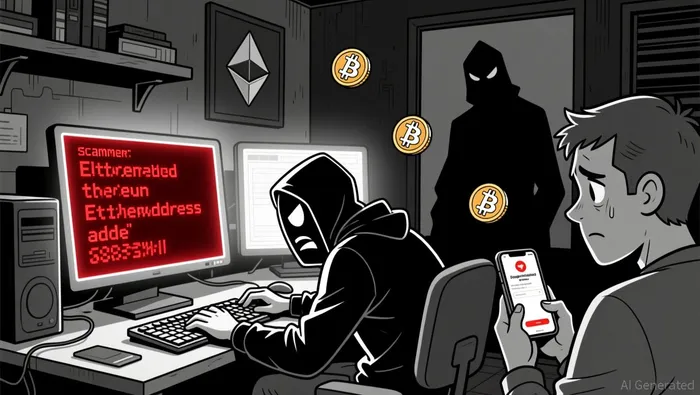
Address poisoning scams operate by preying on user habits, particularly the reliance on abbreviated address displays and copy-paste convenience. Attackers craft wallet addresses that mirror legitimate ones, often sharing the first five and last four characters, and deploy small "dust" transactions to poison a victim's transaction history. This creates a false sense of legitimacy, as users see the address in their transaction logs and assume it is safe.
For example, in May 2024, a crypto whale nearly lost $68 million in WBTCWBTC-- after attackers used automated tools to generate thousands of spoofed addresses. These tools, available on the dark web, enable even non-technical actors to execute large-scale campaigns. The attack vector is particularly effective against users who reuse wallet addresses or fail to verify the full 42-character EthereumETH-- address before sending funds according to security experts.
Financial Impact: A Growing Liability for Investors
The financial toll of address poisoning is staggering. In 2025 alone, confirmed losses exceeded $83 million, with victims ranging from individual traders to DeFi platforms according to industry analysis. One of the most high-profile cases involved a December 2025 incident where a trader lost $50 million in USDT after falling for a scam. The attacker laundered the funds through Tornado CashTORN--, a privacy mixer, and later moved the assets into ETH and DAIDAI-- as reported in industry analysis.
Recovery efforts are often futile. While some victims, like the $70 million case in 2024, managed to negotiate partial returns via onchain messages and bounties, most face irrecoverable losses. Jonelle Still of Mastercard noted that exchanges with robust address-filtering systems are rare, and even then, recovery is not guaranteed.
Infrastructure Gaps: Why the Ecosystem Fails to Protect Users
The root cause of these vulnerabilities lies in the lack of standardized security practices across crypto platforms. Most wallets truncate addresses, obscuring the middle characters that distinguish legitimate from malicious addresses. This design flaw is compounded by the absence of automated checks to flag suspicious transactions. Security experts like Jameson Lopp have long advocated for wallet interfaces that highlight discrepancies in full addresses, yet adoption remains inconsistent as reported in industry analysis.
Further, the proliferation of phishing, malware, and social engineering tools on the dark web has democratized access to attack vectors. Automated address-generation toolkits allow attackers to deploy thousands of spoofed addresses simultaneously, increasing the likelihood of hitting high-value targets. Even institutions are not immune: the U.S. SecretSCRT-- Service lost $55,000 to a similar scam in 2023.
Mitigation Strategies: A Call for Systemic and Behavioral Change
Address poisoning demands a dual approach: strengthening infrastructure and fostering user vigilance. On the technical front, platforms must implement real-time transaction alerts, dynamic blacklists, and full-address verification prompts. Binance CEO Changpeng Zhao (CZ) has emphasized the potential of automated systems to reduce attack success rates by flagging addresses with suspicious similarity to known targets.
For investors, the lessons are clear:
1. Avoid address reuse and treat every transaction as a fresh verification opportunity.
2. Use hardware wallets that display full addresses and support secure transaction signing.
3. Leverage address books to store verified destinations and minimize reliance on copy-paste actions.
Long-term, the industry must prioritize "human-layer security"-a cultural shift toward operational rigor and continuous education. As Chainalysis noted in its 2025 report, 80% of address poisoning victims admitted to skipping basic verification steps. This underscores the need for platforms to integrate mandatory security tutorials and behavioral nudges.
Conclusion: A Race Against Time
Address poisoning scams represent a ticking time bomb for crypto's institutional adoption. While the technology underpinning blockchain remains resilient, the human and infrastructural layers are increasingly fragile. Investors must treat wallet security as a non-negotiable component of risk management, while platforms bear the responsibility of closing design flaws that enable these attacks.
As the ecosystem evolves, the line between innovation and vulnerability will narrow. Those who fail to adapt-both individuals and institutions-risk becoming the next cautionary tale in a landscape where a single misplaced decimal or truncated address can erase fortunes overnight.






Comentarios
Aún no hay comentarios