
Address Poisoning and Human Error: The Hidden Risks in Crypto Transfers
The cryptocurrency ecosystem, while lauded for its innovation and decentralization, harbors systemic vulnerabilities rooted in user behavior. Among the most insidious threats are address poisoning attacks and human error, which exploit psychological biases and interface design flaws to siphon high-value assets. As the scale and sophistication of these attacks escalate, investors and institutions must confront the reality that even the most technically secure systems are vulnerable when users become the weakest link.
The Mechanics of Address Poisoning: A Systemic Exploit
Address poisoning operates by injecting malicious wallet addresses into a victim's transaction history through small or zero-value transfers. These addresses are often crafted using homoglyphs (e.g., Cyrillic characters) or zero-width joiners to mimic legitimate addresses visually according to analysis. A 2024 case study revealed a $68 million theft of wrapped bitcoin from a crypto whale, where the victim was tricked into sending funds to a lookalike address after a "test transaction" seeded by the attacker. 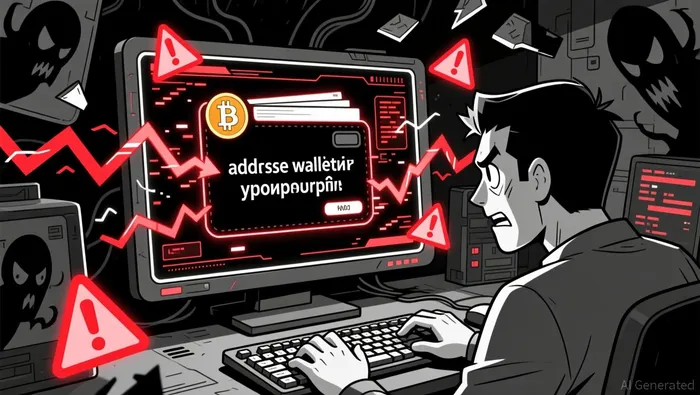 Over two years (July 2022–June 2024), researchers identified 270 million such attack attempts across EthereumETH-- and BSC, with 6,633 successful incidents resulting in $83.8 million in losses according to findings.
The Q3-Q4 2025 data underscores a worsening trend: 32,290 address-poisoning events were detected in September 2025 alone, impacting 6,516 victims. Ethereum accounted for 91% of these incidents, with stablecoins like USDTUSDT-- and USDCUSDC-- as primary targets according to reports. Attackers exploit the trust users place in their transaction history, a design flaw that prioritizes convenience over security.
Human Error as a Vector for Exploitation
Address poisoning is often compounded by human error, particularly in high-value transactions. Social engineering tactics-such as phishing emails, fake "death" notifications, and support ticket manipulation-have proven devastating. In a 2024-2025 case, a high-net-worth individual lost $40 million in bitcoinBTC-- after attackers used multifaceted deception to extract sensitive information, despite the victim using a hardware wallet according to reports.
The DPRK's $1.5 billion hack of ByBit in 2025, the largest crypto theft in history, further illustrates the systemic risks of centralized custody models according to analysis. While this incident involved exchange-level vulnerabilities, it highlights how attackers increasingly target both institutional and individual users through coordinated campaigns. By mid-2025, over $2.17 billion had been stolen from crypto services, with wallet compromises ($1.71 billion) and phishing ($410.7 million) as dominant vectors according to data.
The ROI of Exploiting Human Psychology
The economics of address poisoning and social engineering are alarming. Attackers leverage the low success rate per address (0.03%) against the astronomical returns of successful attacks. For instance, a $70 million incident in 2024 yielded $3 million in appreciation gains for the scammer according to findings. This asymmetry incentivizes attackers to scale campaigns, as evidenced by a network generating 82,031 seeded addresses and compromising 2,774 victims according to research.
User interfaces exacerbate the problem. Wallets that auto-fill addresses from transaction history or fail to highlight subtle character differences create a false sense of security. The reliance on visual verification-rather than cryptographic checks-leaves users exposed to even basic homoglyph attacks according to analysis.
Mitigation Strategies: Beyond Technical Fixes
Addressing these risks requires a dual focus on technical and behavioral interventions. Multi-factor authentication (MFA) and cold storage remain foundational, but they are insufficient without user education. For example, verifying recipient addresses through out-of-band communication (e.g., phone calls) and avoiding reliance on transaction history can mitigate poisoning risks according to reports.
Institutional investors should adopt emergency response protocols, including pre-approved withdrawal limits and multi-signature wallets. For individual users, tools like address checksums and third-party verification services can add layers of defense. However, the ultimate solution lies in redesigning user interfaces to prioritize security cues-such as highlighting suspicious characters or requiring manual address confirmation according to research.
Conclusion: A Call for Systemic Resilience
The rise of address poisoning and human error-driven thefts underscores a critical truth: the crypto ecosystem's security is only as strong as its users' vigilance. While technological advancements will continue to evolve, attackers will persistently exploit psychological and behavioral weaknesses. Investors must treat cybersecurity not as an afterthought but as a core component of risk management. In a space where trust is decentralized but human error is centralized, the path forward demands both innovation and humility.






Comentarios
Aún no hay comentarios