
Will ADA Reach $2 by 2030? A Strategic Assessment of Cardano's Long-Term Value Proposition
The question of whether Cardano's ADAADA-- token can reach $2 by 2030 is not merely a speculative exercise-it is a test of the cryptocurrency's ability to navigate a maturing market, execute its technical roadmap, and align with macroeconomic tailwinds. As the crypto industry evolves from speculative frenzy to institutional legitimacy, CardanoADA-- (ADA) stands at a crossroads. This analysis examines the convergence of fundamental and technical factors to assess the feasibility of ADA's $2 price target by 2030.
Fundamental Developments: Building a Scalable, Real-World Ecosystem
Cardano's foundational strength lies in its research-driven approach and strategic upgrades. The Vasil hard fork in 2022 laid the groundwork for improved scalability and transaction efficiency, while the Hydra protocol-a layer-2 solution-aims to break 110,000 transactions per second, rivaling platforms like SolanaSOL-- and EthereumETH--. These upgrades are critical for supporting real-world applications, such as supply chain management (e.g., the Bolnisi wine-batch tracker) and regulated real-world asset (RWA) tokenization according to analysis.
The Cardano Foundation's roadmap emphasizes DeFi, Web3, and RWA integrations, with initiatives like liquidity provision for stablecoins and the Cardano Venture Hub fueling ecosystem growth according to the foundation. By 2025, over 2,000 projects had launched on the platform, driven by partnerships with entities like Petrobras and Toto Finance. Additionally, Cardano's inclusion in the U.S. government's strategic crypto reserve-a rare honor-signals growing institutional recognition according to reports.
Technical Indicators: A Path of Rebound and Breakouts
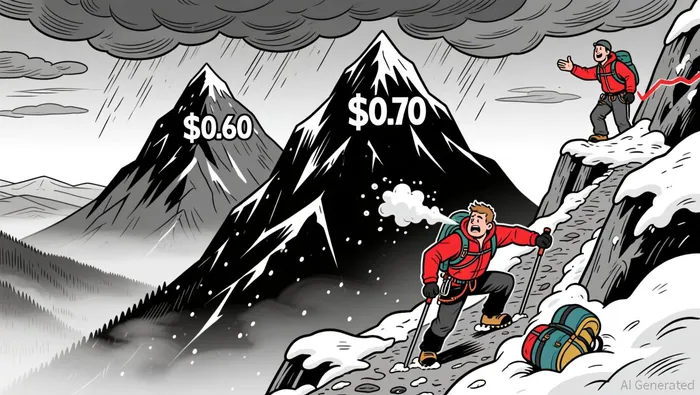
Technically, ADA's price trajectory has been volatile but shows signs of alignment with its fundamentals. As of late 2025, ADA trades around $0.39, consolidating within a descending channel with key support at $0.51 and resistance at $0.60. The Relative Strength Index (RSI) hovers near oversold levels, suggesting potential for a rebound. A breakout above $0.60 could trigger a bullish reversal, targeting $0.70 and beyond.
Longer-term projections hinge on the success of upgrades like Hydra and Midnight (a privacy-focused sidechain). These innovations are expected to drive on-chain activity and developer engagement, which could manifest in improved technical indicators. For instance, the MACD crossover and bullish engulfing patterns observed in early 2026 hint at a potential rebound to $0.5111.
Macroeconomic Tailwinds: Stability, Adoption, and Institutional Trust
The broader crypto market's maturation is a double-edged sword. While regulatory clarity and reduced volatility (projected to decline by 15–20% by 2030) could attract institutional capital, macroeconomic imbalances-such as U.S. public debt and inflation-remain catalysts for crypto adoption. ADA's high staking participation rate (over 70% of supply locked up) creates deflationary pressure, reducing sell-side liquidity and supporting price stability.
Consumer sentiment also plays a role. By 2025, 28% of U.S. adults owned crypto, with 14% planning to enter the market-a trend that could amplify demand for ADA if its real-world use cases gain traction according to consumer data. Furthermore, a potential return of a pro-crypto administration could accelerate regulatory frameworks favorable to blockchain innovation, indirectly boosting ADA's appeal.
Convergence: Can Fundamentals and Technicals Align for $2?
For ADA to reach $2 by 2030, three conditions must converge:
1. Successful Execution of Roadmap: Full implementation of Hydra, Midnight, and Leios upgrades is non-negotiable. These must translate into measurable improvements in TPS, developer activity, and enterprise adoption.
2. Real-World Utility Expansion: Cardano must capture meaningful market share in DeFi, supply chain, and digital identity solutions. Partnerships in emerging markets (e.g., Africa, Latin America) will be pivotal.
3. Favorable Macro Conditions: Stable interest rates, reduced regulatory uncertainty, and continued institutional adoption will create a conducive environment for ADA's ascent.
Optimistic projections suggest ADA could hit $3.33 by 2030 under ideal conditions, but reaching $2 requires a more conservative alignment of these factors. Risks include technological delays, competition from Ethereum and Solana, and adverse regulatory shifts.
Conclusion: A Realistic but Conditional Outlook
ADA's $2 price target by 2030 is realistic but conditional. The convergence of Cardano's technical execution, real-world adoption, and macroeconomic tailwinds creates a plausible path. However, this outcome depends on the project's ability to maintain relevance amid fierce competition and deliver on its roadmap. Investors should monitor key milestones-such as Hydra's TPS benchmarks and the success of RWA integrations-while keeping an eye on global macro trends.
In a maturing crypto market, ADA's journey to $2 will be less about hype and more about execution.







Comentarios
Aún no hay comentarios